
Blackjack Risk of Ruin: Bankroll & Kelly Betting
Blackjack risk of ruin describes the chance of reaching a defined failure boundary. This guide explains which inputs determine it, why positive expected value does not guarantee survival, and how bankroll sizing, bet resizing and fractional Kelly change the tradeoff between growth and drawdown.
On this page
- Risk of ruin at a glance
- Positive expected value does not eliminate ruin risk
- Define ruin before calculating it
- Infinite-horizon versus finite-horizon risk
- Total bankroll, trip bankroll and session cash
- Replenishable versus non-replenishable bankroll
- The main quantitative inputs
- Bankroll size
- Bet size and spread
- Edge
- Variance and standard deviation
- Edge and variance must be evaluated together
- Why “100 units is enough” is not a universal rule
- Fixed-dollar betting versus proportional resizing
- Kelly criterion
- Full Kelly versus fractional Kelly
- Kelly does not mean zero risk
- Overbetting
- Underbetting
- Playing errors and model error
- Wonging and play-all strategies
- Playing multiple hands
- Team bankrolls
- Withdrawals reduce compounding capital
- Expenses and living costs
- Risk of ruin for negative-EV players
- Session stop-loss versus risk of ruin
- Goal probability
- Drawdown probability
- A fixed loss boundary is different from a peak drawdown
- Why simulation is usually the right tool
- Inputs for an ROR calculator or simulator
- SCORE, N0 and ROR
- Worked comparison: same edge, different bankroll
- Worked comparison: same bankroll, different top bet
- Bankroll resizing example
- What to track
- Common risk-of-ruin mistakes
- Using 100 units as a universal bankroll
- Calculating from the minimum bet only
- Assuming positive EV means eventual success is assured
- Keeping bets fixed after a severe drawdown
- Calling a session stop-loss mathematical ROR control
- Ignoring expenses and withdrawals
- Using simulated edge with real-world mistakes
- Confusing trip ruin with total-bankroll ruin
- Applying a single-hand model to two-hand play
- Quoting a Kelly ROR without defining practical ruin
- Ten-step ROR planning process
- Frequently asked questions
- Technical and mathematical sources
- Recalculate when the plan changes
For an advantage-play bankroll, first evaluate whether the actual game and strategy have positive expected value using creating a negative house edge in blackjack. Then connect the bankroll to the planned blackjack betting spread.
Risk of ruin, or ROR, is the probability that a defined bankroll reaches a defined failure point before the player reaches the stated goal or time horizon.
The definition matters. “Ruin” can mean:
- The bankroll reaches exactly zero.
- The bankroll falls below the minimum amount needed to place the next required wager.
- The bankroll reaches a stop-loss or unacceptable drawdown.
- The bankroll becomes too small to continue the planned bet spread.
- A trip bankroll is exhausted even though a separate total bankroll still exists.
A risk-of-ruin percentage is incomplete unless the bankroll, betting policy, edge, variance, ruin threshold, goal and resizing rules are all specified.
Risk of ruin at a glance
| Input | How it affects risk |
|---|---|
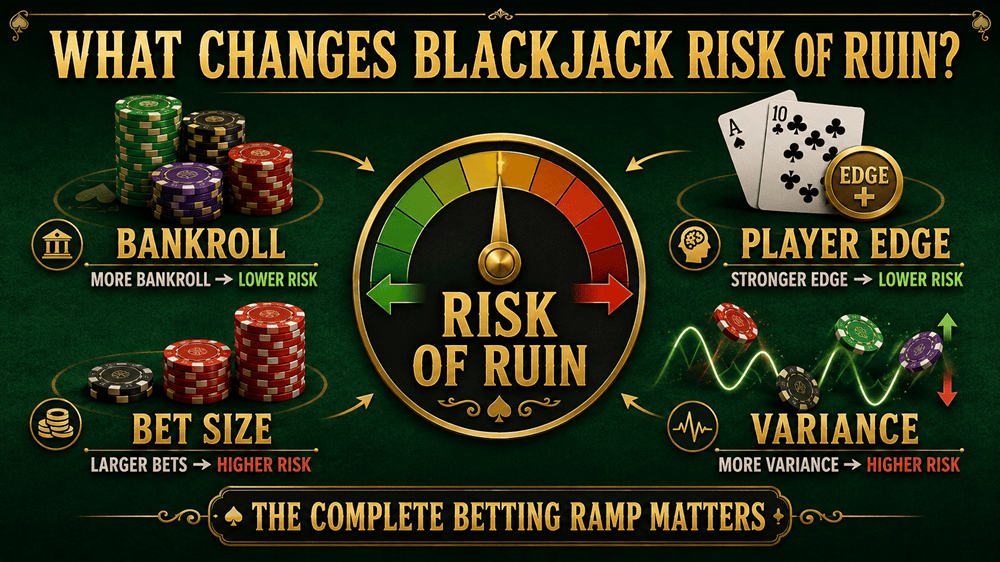
| Larger bankroll | Usually lowers risk when the game and wagers remain unchanged. |
| Larger wagers | Increase dollar variance and usually raise risk relative to a fixed bankroll. |
| Stronger player edge | Lowers risk, all else equal. |
| Higher variance | Raises the probability of large drawdowns. |
| Wider bet spread | Can raise EV but also increases volatility and bankroll requirements. |
| Deeper penetration | Can improve a counter’s EV and count opportunities, changing both expected return and variance. |
| Playing errors | Reduce the real edge and therefore increase risk. |
| Bet resizing | Can reduce the chance of absolute ruin after losses, but changes growth and operational practicality. |
| Withdrawals and expenses | Reduce the bankroll available to absorb variance. |
| Finite time horizon | Produces a different risk question from playing indefinitely. |
Positive expected value does not eliminate ruin risk
A card counter can have positive expected value and still experience a severe losing sequence before the advantage has time to dominate the results.
For example, a player can have:
- A +1.00% average advantage
- Accurate basic strategy
- A proven count system
- A mathematically sound betting ramp
and still lose many maximum bets during a short period.
Expected value describes the average result over repeated comparable opportunities. Risk of ruin asks whether the bankroll can survive the path.
Define ruin before calculating it
Consider a player whose table minimum is $25 and whose planned maximum bet is $300.
Possible ruin definitions include:
- Absolute ruin: bankroll reaches $0.
- Operational ruin: bankroll falls below the amount needed to continue the planned spread.
- Minimum-bet ruin: bankroll falls below $25.
- Drawdown ruin: bankroll falls 40% from its peak.
- Trip ruin: the cash allocated to one trip is exhausted.
Those are different events and produce different percentages.
Infinite-horizon versus finite-horizon risk
An infinite-horizon calculation asks whether ruin occurs eventually if the betting process continues without a fixed endpoint.
A finite-horizon calculation asks whether ruin occurs within:
- One trip
- 100 hours
- 10,000 hands
- One year
- Before a target bankroll is reached
A player can have a low chance of ruin over 100 hours and a higher chance over an unlimited horizon.
Total bankroll, trip bankroll and session cash
Total blackjack bankroll
The complete amount genuinely available to support the advantage-play plan without affecting rent, bills, emergency savings or debt obligations.
Trip bankroll
The amount allocated to a specific trip. It may be only part of the total bankroll.
Session cash
The amount physically carried or available for one session.
Running out of session cash is not necessarily mathematical ruin when additional precommitted bankroll remains available. Conversely, repeatedly “reloading” from money that was never part of the bankroll invalidates the original ROR estimate.
Replenishable versus non-replenishable bankroll
A non-replenishable bankroll must survive on its own.
A replenishable bankroll can receive defined future contributions from outside income.
These produce different risk questions. A player who can add $1,000 every month may tolerate a drawdown that would end play for someone using a closed bankroll.
Future contributions should be modeled explicitly rather than assumed emotionally after a loss.
The main quantitative inputs
A credible blackjack ROR estimate normally needs:
- Starting bankroll
- Minimum and maximum bets
- Complete betting ramp by true count
- Rules and penetration
- Count system and indices
- Expected value per round or per 100 rounds
- Variance or standard deviation
- Hands per hour
- Number of players at the table
- Wonging or play-all policy
- Bet resizing rules
- Ruin threshold
- Goal or time horizon
- Expenses and withdrawals
Approved blackjack rules vary in payout, doubling, splitting and other options, so EV and variance must be generated for the actual game rather than borrowed from an unrelated table.
Bankroll size
With the game and betting policy fixed, a larger bankroll generally reduces risk of ruin because the same dollar swings represent a smaller fraction of available capital.
But bankroll should not be expressed only in minimum-bet units.
A $10,000 bankroll can represent:
- 1,000 units at a $10 minimum
- 100 maximum bets at a $100 top wager
- Only 33 maximum bets at a $300 top wager
The spread and frequency of large wagers matter more than the minimum bet alone.
Bet size and spread
A wider spread can improve expected value by putting more money into favorable counts, but it also creates larger fluctuations.
Two players with the same $20,000 bankroll can have very different risk:
| Player | Spread | Top bet | Bankroll in top bets |
|---|---|---|---|
| A | 1–8 | $80 | 250 |
| B | 1–20 | $200 | 100 |
This does not prove Player A has the better game because EV, variance, penetration and count frequency still matter. It shows why “same bankroll” does not mean “same risk.”
Edge
A stronger edge lowers ROR when bankroll and variance remain constant.
But the relevant figure is the weighted advantage across all action, including:
- Minimum bets in negative counts
- Medium bets near break-even
- Large bets in positive counts
- Playing deviations
- Errors
Using only the edge on the maximum-bet rounds can greatly overstate the quality of the complete game.
Variance and standard deviation
Variance measures the spread of possible results. Standard deviation is its square root and is often easier to interpret in dollars or betting units.
Blackjack variance is affected by:
- Natural blackjacks
- Doubles
- Splits and resplits
- Bet variation
- Number of simultaneous hands
- Rule package
- Side bets
Two games with the same hourly EV can have different ROR because one produces more volatile results.
Edge and variance must be evaluated together
A higher-EV game is not automatically more bankroll-efficient.
Example:
| Game | Hourly EV | Hourly standard deviation | Interpretation |
|---|---|---|---|
| Game A | $50 | $700 | Lower EV, lower volatility |
| Game B | $65 | $1,200 | Higher EV, much higher volatility |
The better choice depends on bankroll, risk target, hours available and operational constraints.
Why “100 units is enough” is not a universal rule
A unit can mean:
- Minimum table bet
- Base betting unit
- Average wager
- Maximum wager
- One hand at the top of the ramp
Without defining the unit and the full ramp, “100 units” communicates little.
One hundred $10 minimum units can be only five $200 maximum bets. Another player’s 100 units might equal 100 top bets.
Fixed-dollar betting versus proportional resizing
Fixed-dollar ramp
The player continues using the same dollar bets as the bankroll rises or falls.
After a large drawdown, those wagers become a larger fraction of the remaining bankroll, so risk accelerates.
Proportional resizing
The player reduces or increases bets as bankroll changes.
This can protect the bankroll after losses, but practical constraints include:
- Table minimums
- Chip denominations
- Discrete count-based ramps
- Casino attention
- Inability to resize every hand precisely
ROR figures for fixed betting should not be transferred to a continuously resized strategy or vice versa.
Kelly criterion
Kelly-style betting sizes risk according to estimated advantage, bankroll and variance. The objective is long-run logarithmic bankroll growth rather than the smallest possible drawdown.
Edward Thorp’s work helped establish the practical connection between Kelly betting and blackjack card counting.
A simplified small-edge approximation is:
Kelly fraction ≈ mean net return per unit stake ÷ variance of that unit-stake return
The numerator and denominator here describe the same unit-stake return distribution, not an hourly dollar win rate divided by an hourly dollar variance. The expression is a small-edge approximation, not an exact sizing rule. Blackjack requires a full model because the payoff distribution includes pushes, blackjacks, doubles, splits and varying wagers.
Full Kelly versus fractional Kelly
Full Kelly
Targets maximum long-run logarithmic growth under an accurate model. It can produce uncomfortable drawdowns and is sensitive to errors in estimated edge and variance.
Half Kelly
Uses half the full-Kelly wager. Expected growth is lower, but drawdowns and model-error sensitivity are reduced.
Quarter Kelly
Uses one-quarter of full Kelly. It sacrifices more growth for further risk reduction.
Fractional Kelly is common because real blackjack estimates are imperfect and bets cannot always be resized continuously.
Kelly research also emphasizes that drawdown constraints and model uncertainty can justify betting less aggressively than a theoretical full-Kelly allocation.
Kelly does not mean zero risk
Statements such as “full Kelly has exactly 13.5% ROR” depend on the chosen ruin definition, approximation and betting assumptions.
In an idealized proportional-betting model where no permitted outcome can exhaust the bankroll, literal zero is avoided over a finite sequence. That does not mean the bankroll must approach zero, or that a real player cannot fail. Practical ruin can occur when:
- The bankroll falls below the table minimum
- The planned spread is no longer possible
- A drawdown threshold is breached
- Expenses cannot be funded
- The player stops for psychological or operational reasons
Define practical ruin before quoting a Kelly-related risk figure.
Overbetting
Betting above the growth-optimal fraction can:
- Increase short-term EV in dollar terms
- Increase variance sharply
- Reduce long-run bankroll growth
- Increase drawdown probability
- Raise practical ruin risk
A larger bet is not automatically a better use of a positive edge.
Underbetting
Betting far below Kelly reduces risk and growth.
That may be rational when:
- The bankroll cannot be replenished
- The edge estimate is uncertain
- The game may disappear
- The player has limited emotional tolerance for drawdowns
- Casino countermeasures make a large spread impractical
Playing errors and model error
ROR calculations often assume perfect execution.
Real-world errors include:
- Losing the count
- Misestimating decks remaining
- Using the wrong true-count rounding method
- Missing an index
- Overbetting a marginal count
- Playing a different rule than the simulation
- Failing to notice a penetration change
If the actual edge is lower than modeled, the true ROR is higher.
Wonging and play-all strategies
Play all
The player remains through negative and positive counts. This creates more negative-EV minimum-bet action.
Wonging
The player enters only at favorable counts or leaves sufficiently negative shoes.
Wonging can improve EV and reduce negative action, but changes:
- Hands per hour
- Table access
- Operational visibility
- Count distribution actually played
- Variance
Use simulation inputs that match the real entry and exit policy.
Playing multiple hands
Spreading to two hands can alter:
- Total wager per round
- Covariance between hands sharing the dealer outcome
- Cards consumed per round
- Hands per shoe
- Variance
- Casino attention
Do not estimate the ROR of two-hand play by simply doubling a single-hand EV figure.
Team bankrolls
A shared team bankroll can diversify individual session results and support larger opportunities, but only if:
- All play is recorded
- Ownership shares are defined
- Expenses and withdrawals are agreed
- Player skill is monitored
- The bankroll is genuinely shared
- Maximum exposure across simultaneous players is modeled
Several players betting at once can increase total hourly EV and total hourly variance.
Withdrawals reduce compounding capital
Removing profit from the bankroll can raise future ROR if bets remain unchanged.
Example:
- Bankroll grows from $20,000 to $24,000.
- Player withdraws $4,000.
- Bankroll returns to $20,000.
- The original risk profile remains rather than improving with the win.
A withdrawal policy should be included in long-run bankroll planning.
Expenses and living costs
Travel, rooms, meals, tips, software and other costs can turn a positive table EV into a weaker net opportunity.
When expenses are paid from the blackjack bankroll, they reduce available capital just like withdrawals and increase risk.
A professional relying on blackjack income also needs a separate living reserve, because withdrawing living expenses during a drawdown can force bets to become oversized relative to remaining capital.
Risk of ruin for negative-EV players
A flat-betting recreational player normally faces a casino edge.
Over an unlimited horizon with a finite closed bankroll and continued play, eventual depletion becomes the dominant outcome.
For recreational play, more useful questions are:
- What is the chance of losing the session budget?
- What is the expected loss for the planned action?
- How long will the budget likely support play?
- What loss limit prevents access to non-gambling funds?
Money management can limit exposure but cannot convert a negative game into positive EV.
Session stop-loss versus risk of ruin
A stop-loss ends play after a specified session loss.
It can:
- Limit the amount lost in one sitting
- Reduce tilt
- Protect non-session funds
It does not automatically reduce the mathematical ROR of a long-term strategy if the same play simply resumes later under identical conditions.
A stop-loss is a behavioral and cash-control rule, not a source of edge.
Goal probability
Some bankroll questions are better expressed as:
What is the probability of reaching a target before hitting the ruin boundary?
Example:
- Starting bankroll: $20,000
- Ruin boundary: $8,000
- Target: $30,000
This differs from asking whether the player will eventually reach zero over unlimited play.
Drawdown probability
A player may care more about a 30%, 40% or 50% drawdown than absolute ruin.
Drawdown analysis can estimate:
- Probability of crossing the threshold
- Recovery time conditional on recovery, including paths that never recover
- Maximum observed drawdown distribution
- Effect of fractional Kelly
This often matches real operational and psychological limits better than zero-bankroll ruin.
A fixed loss boundary is different from a peak drawdown
Suppose the starting bankroll is $20,000. A fixed failure boundary of $12,000 represents an $8,000 loss from the starting amount. A 40% drawdown from the highest bankroll initially gives the same boundary, but the two definitions separate after a win. If the bankroll reaches $30,000, a 40% peak drawdown is reached at $18,000, while the fixed $12,000 boundary remains unchanged.
A path that rises to $30,000 and then falls to $17,000 has breached the peak-drawdown limit even though it never reached the fixed ruin boundary. Specify whether the threshold follows the running peak or stays fixed. This choice changes what the simulator counts as failure and what a recovery would mean.
Why simulation is usually the right tool
Blackjack has:
- Changing advantage by true count
- Multiple possible wagers
- Doubles and splits
- Rule-dependent payoffs
- Correlated hands
- Entry and exit policies
- Discrete chip sizes
Closed-form formulas can provide approximations, but a trustworthy operational ROR estimate usually comes from a large simulation matched to the exact game and betting policy.
Inputs for an ROR calculator or simulator
| Category | Required details |
|---|---|
| Game | Decks, payout, S17/H17, DAS, surrender, resplitting, penetration |
| Strategy | Count system, indices, true-count method, entry and exit points |
| Betting | Wager at every count, number of hands, table limits, resizing policy |
| Bankroll | Starting amount, replenishment, withdrawals, expenses |
| Risk definition | Ruin boundary, target, time horizon, acceptable drawdown |
| Output | EV, standard deviation, SCORE, N0, ROR and drawdown probabilities |
SCORE, N0 and ROR
SCORE
SCORE is a standardized way to compare card-counting games under stated bankroll and risk assumptions. It is useful for relative game quality, but it does not replace the player’s actual bankroll simulation.
N0
N0 is commonly used to describe the approximate number of rounds at which cumulative expected value equals one standard deviation.
Lower N0 generally indicates a stronger signal relative to variance. It is not the number of rounds after which a profit is guaranteed, and it does not directly give the probability of touching a ruin boundary.
For a simplified fixed process with independent rounds, constant mean profit μ and per-round variance v, N0 = v ÷ μ² follows by setting nμ equal to √(nv). With hypothetical mean profit of $0.50 per round and a standard deviation of $50 per round, N0 is 2,500 ÷ 0.25 = 10,000 rounds. At that point, cumulative expectation is $5,000 and cumulative standard deviation is also $5,000. Large deviations are still possible. These are illustrative inputs, not a simulated blackjack game.
The QFIT glossary defines N0 for a fixed spread and distinguishes standard deviation per round, hour and shoe. Use consistent units: a per-100-round mean cannot be paired with per-round variance. Changing bets, shared dealer outcomes or dependence between rounds requires an appropriately matched model.
Risk of ruin
ROR uses the actual bankroll and betting process to estimate failure probability.
These metrics are related but answer different questions.
Worked comparison: same edge, different bankroll
Assume two players use the same game, spread and strategy:
| Player | Bankroll | Top bet | Bankroll in top bets |
|---|---|---|---|
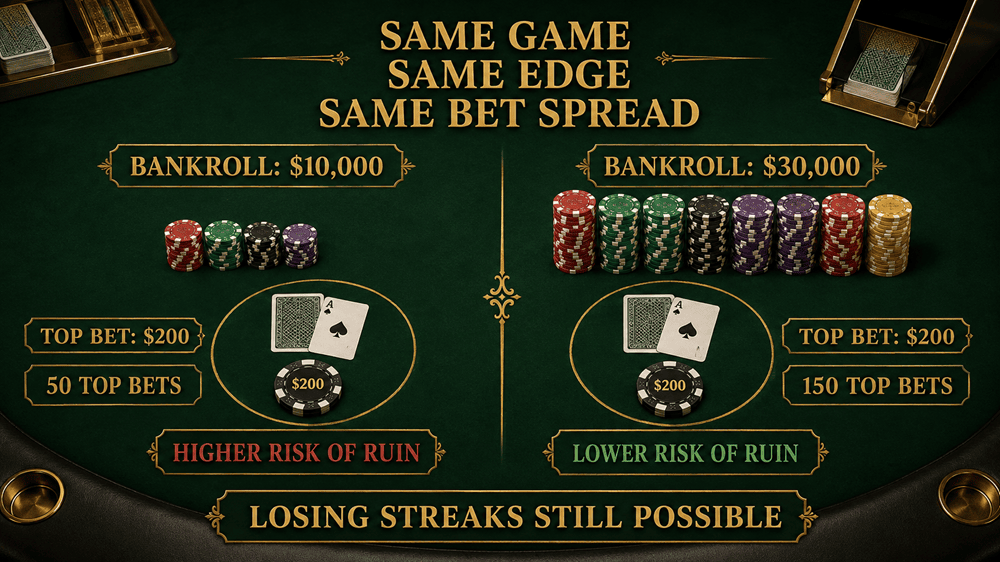
| A | $10,000 | $200 | 50 |
| B | $30,000 | $200 | 150 |
Player B has three times the bankroll supporting the same dollar volatility and therefore a much lower ROR.
No exact percentage should be assigned without the game’s EV, variance, penetration and full ramp.
Worked comparison: same bankroll, different top bet
| Player | Bankroll | Top bet | Bankroll in top bets |
|---|---|---|---|
| A | $20,000 | $100 | 200 |
| B | $20,000 | $400 | 50 |
Player B accepts far larger dollar swings. The higher bet may produce more EV when the count is favorable, but the bankroll is more exposed.
Bankroll resizing example
Suppose a player begins with $20,000 and a $200 top bet.
After a drawdown to $15,000:
- Keeping the $200 top bet increases the bet from 1.00% to 1.33% of bankroll.
- Reducing the top bet to $150 preserves the original proportion.
Resizing lowers future dollar EV but prevents the unchanged ramp from becoming progressively more aggressive after losses.
What to track
Record:
- Date and casino
- Rules and penetration
- Hours and rounds
- Minimum and maximum bets
- Number of hands played
- Wonging entry and exit
- Observed mistakes
- Backoffs or rule changes
- Gross result
- Expenses
- Bankroll before and after withdrawals
Results alone cannot reveal whether the modeled ROR remains valid.
Common risk-of-ruin mistakes
Using 100 units as a universal bankroll
Unit definition, spread, EV and variance are missing.
Calculating from the minimum bet only
Maximum bets and their frequency drive much of the volatility.
Assuming positive EV means eventual success is assured
A finite bankroll can fail before expectation dominates.
Keeping bets fixed after a severe drawdown
The same dollar wagers become more aggressive relative to the remaining bankroll.
Calling a session stop-loss mathematical ROR control
Stopping and restarting later does not change the underlying process by itself.
Ignoring expenses and withdrawals
Both reduce capital available to survive variance.
Using simulated edge with real-world mistakes
Execution errors increase actual risk.
Confusing trip ruin with total-bankroll ruin
They are separate boundaries.
Applying a single-hand model to two-hand play
Shared dealer outcomes create correlation.
Quoting a Kelly ROR without defining practical ruin
Table minimums and drawdown limits can create failure long before literal zero.
Ten-step ROR planning process
- Confirm that the game is positive EV after realistic errors.
- Define total bankroll, trip bankroll and session cash.
- Define the ruin boundary and goal.
- Set the exact betting ramp and number of hands.
- Choose fixed betting or a resizing policy.
- Simulate EV and variance for the actual rules and penetration.
- Calculate ROR and drawdown probabilities.
- Reduce wagers when the risk exceeds the chosen tolerance.
- Include expenses, withdrawals and replenishment.
- Recalculate whenever the game or bankroll changes.
Frequently asked questions
What does risk of ruin mean in blackjack?
It is the probability that a defined bankroll reaches a defined failure boundary before the player reaches the stated goal or time horizon.
Can a winning blackjack player go broke?
Yes. Positive expected value does not prevent a finite bankroll from being overwhelmed by short-term variance.
What inputs determine blackjack risk of ruin?
The main inputs are bankroll, complete betting ramp, edge, variance, rules, penetration, playing accuracy, resizing policy, ruin boundary and time horizon.
Is 100 betting units enough?
There is no universal answer. The unit must be defined, and the result depends on the top bet, spread, EV, variance and risk target.
Does lowering the betting unit reduce risk of ruin?
Yes, when the game and bankroll remain unchanged. Smaller dollar wagers reduce the size of fluctuations relative to the bankroll.
Does basic strategy eliminate risk of ruin?
No. Basic strategy normally leaves a small casino edge, and even a true advantage player still faces substantial variance.
What is the difference between session bankroll and total bankroll?
Session bankroll is the cash allocated to one sitting. Total bankroll is the complete capital committed to the long-term blackjack plan.
Does a stop-loss reduce mathematical risk of ruin?
It limits one session’s loss and can prevent tilt, but simply restarting later under identical conditions does not change the game’s expectation.
How does fractional Kelly affect risk?
Fractional Kelly reduces wager size, expected bankroll growth and drawdown severity compared with full Kelly, while providing more protection against model error.
Why should risk of ruin be simulated?
Blackjack includes changing counts, multiple bet sizes, doubles, splits and operational rules that are difficult to represent accurately with one simple formula.
Technical and mathematical sources
- Nevada Gaming Control Board: approved blackjack rules
- GLI-19: required disclosure of blackjack options and restrictions
- Edward O. Thorp: Kelly criterion in blackjack, sports betting and markets
- Thorp: published Kelly criterion chapter
- Hsieh and Barmish: limitations and drawdown issues in Kelly betting
- Sukhov: drawdown-constrained Kelly de-risking
A percentage from another game is not a bankroll recommendation. A useful estimate must match the complete rules, penetration, count system, betting ramp, number of hands, bankroll policy and ruin definition. If those inputs differ, the probability describes a different betting process.
Recalculate when the plan changes
A risk-of-ruin estimate only describes the inputs used to create it. Recalculate after changing the game, rules, number of hands, betting ramp, number of simultaneous hands, withdrawal policy, or replenishment assumption. Keep the previous result with its inputs so that a lower estimate cannot be attributed to a model change that was never recorded.