Learn the point value of every blackjack card, how aces move between 1 and 11, how to total hands containing multiple aces, and the difference between a natural blackjack and an ordinary total of 21.
On this page
- Blackjack card values at a glance
- How to calculate any blackjack hand
- How the ace works
- Can an ace change value during the hand?
- Blackjack hands with multiple aces
- What is a soft blackjack hand?
- What is a hard blackjack hand?
- Soft total versus hard total examples
- Why 10-value cards are so common
- What is a natural blackjack?
- Blackjack versus an ordinary total of 21
- Does ace-10 after splitting count as blackjack?
- Why the blackjack payout matters
- Do suits matter in blackjack?
- Does the dealer use different card values?
- Does the number of decks change card values?
- Do blackjack card values change online?
- Card values in blackjack variations
- Blackjack point values versus card-counting values
- Common blackjack card-value mistakes
- Counting every ace as 11
- Counting every ace as 1
- Calling A-A a total of 2
- Calling A-A a bust
- Confusing a three-card 21 with blackjack
- Assuming ace-10 after a split pays 3:2
- Thinking face-card rank changes the total
- Using suits to rank the main hand
- Mixing card-counting tags with point values
- Assuming card values determine the correct play by themselves
- Practice hand-total examples
- Fast method for recognizing a hand
- What card values do not tell you
- From the right total to the right strategy row
- Frequently asked questions
- Technical and regulatory sources
For the complete dealing and settlement rules, read our blackjack rules guide. For the mathematically correct play after identifying the hand total, use our blackjack basic strategy charts.
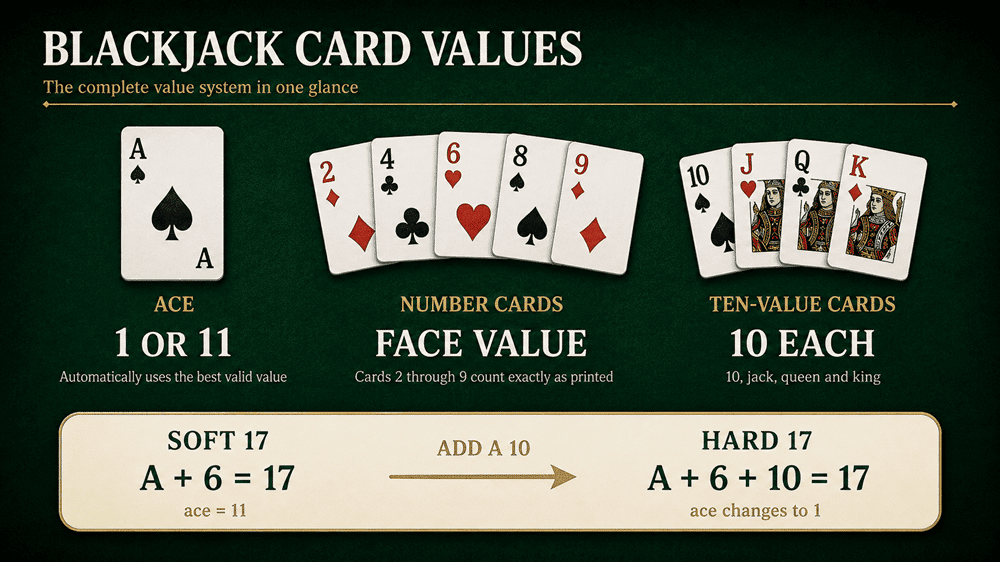
In standard blackjack, cards 2 through 10 count at their printed value, jacks, queens and kings count as 10, and an ace counts as either 1 or 11.
The ace does not require a permanent choice. Its value adjusts as cards are added so that the hand receives the highest possible total without exceeding 21.
For example:
- Ace-6 is soft 17 because the ace counts as 11.
- Ace-6-10 is hard 17 because the ace must change to 1.
- Ace-ace-8 totals 20 because one ace counts as 11 and the other counts as 1.
The point values are used for both player and dealer hands. Card suits do not affect the main blackjack total, although ranks and suits can matter to optional side bets.
Blackjack card values at a glance
| Card | Point value | Important detail |
|---|---|---|
| Ace | 1 or 11 | Counts as 11 when possible without exceeding 21; otherwise counts as 1. |
| 2 | 2 | Counts at face value. |
| 3 | 3 | Counts at face value. |
| 4 | 4 | Counts at face value. |
| 5 | 5 | Counts at face value. |
| 6 | 6 | Counts at face value. |
| 7 | 7 | Counts at face value. |
| 8 | 8 | Counts at face value. |
| 9 | 9 | Counts at face value. |
| 10 | 10 | One of four ten-value ranks. |
| Jack | 10 | Face card worth 10. |
| Queen | 10 | Face card worth 10. |
| King | 10 | Face card worth 10. |
How to calculate any blackjack hand
A reliable way to total a hand is:
- Count every ace as 1.
- Add the values of all other cards.
- If the hand contains at least one ace and adding 10 does not take the total above 21, add 10 for one ace.
Adding 10 changes one ace from a value of 1 to a value of 11.
Example: ace-5
Begin by counting the ace as 1:
1 + 5 = 6
Adding 10 produces 16 without exceeding 21:
6 + 10 = 16
The hand is therefore soft 16.
Example: ace-5-10
Count the ace as 1:
1 + 5 + 10 = 16
Adding another 10 for the ace would make 26, so the ace remains 1.
The hand is hard 16.
Example: ace-ace-7
Count both aces as 1:
1 + 1 + 7 = 9
One ace can increase from 1 to 11:
9 + 10 = 19
The hand is soft 19.
How the ace works
The ace is the only standard blackjack card with two possible point values.
It counts as:
- 11 when using 11 keeps the hand at 21 or below.
- 1 when using 11 would make the hand exceed 21.
This adjustment happens automatically as additional cards are dealt.
The player does not need to announce:
- “My ace is 11.”
- “I am changing the ace to 1.”
- “I choose which ace is high.”
The dealer or software calculates the best valid point total.
Can an ace change value during the hand?
Yes. The same ace can begin as 11 and later count as 1.
| Cards | Calculation | Final hand |
|---|---|---|
| A-6 | 11 + 6 | Soft 17 |
| A-6-3 | 11 + 6 + 3 | Soft 20 |
| A-6-3-10 | 1 + 6 + 3 + 10 | Hard 20 |
The total does not become 30. The ace falls from 11 to 1, reducing the total by 10.
Blackjack hands with multiple aces
When a hand contains several aces, count all of them as 1 first. Then allow one ace to count as 11 when adding 10 keeps the hand at 21 or below.
| Hand | Best valid calculation | Total | Type |
|---|---|---|---|
| A-A | 11 + 1 | 12 | Soft 12 |
| A-A-5 | 11 + 1 + 5 | 17 | Soft 17 |
| A-A-8 | 11 + 1 + 8 | 20 | Soft 20 |
| A-A-9 | 11 + 1 + 9 | 21 | Soft 21 |
| A-A-9-10 | 1 + 1 + 9 + 10 | 21 | Hard 21 |
| A-A-A-7 | 11 + 1 + 1 + 7 | 20 | Soft 20 |
More than one ace cannot normally count as 11 at the same time because two aces valued at 11 already total 22.
What is a soft blackjack hand?
A hand is soft when at least one ace is currently counted as 11 without making the total exceed 21.
Examples include:
- A-2: soft 13
- A-5: soft 16
- A-6: soft 17
- A-7: soft 18
- A-A-5: soft 17
Soft hands can receive another card without immediately busting because the ace can change from 11 to 1.
That does not mean every soft hand should automatically be hit. The correct action still depends on the dealer upcard and the table rules.
See our complete guide to soft and hard blackjack hands.
What is a hard blackjack hand?
A hand is hard when:
- It contains no ace; or
- Every ace must count as 1 to prevent the hand from exceeding 21.
Examples include:
- 10-6: hard 16
- 9-8: hard 17
- A-5-10: hard 16
- A-A-9-10: hard 21
The word “hard” describes how the ace is being counted. It does not mean the hand is necessarily difficult to play.
Soft total versus hard total examples
| Cards | Total | Soft or hard? | Reason |
|---|---|---|---|
| A-4 | 15 | Soft | The ace counts as 11. |
| 10-5 | 15 | Hard | The hand contains no ace. |
| A-4-10 | 15 | Hard | The ace must count as 1. |
| A-A-3 | 15 | Soft | One ace counts as 11 and one as 1. |
These hands all total 15, but they are not strategically identical. The usable ace changes the risk of taking another card.
Why 10-value cards are so common
A standard 52-card deck contains:
- Four 10s
- Four jacks
- Four queens
- Four kings
That creates 16 ten-value cards in each complete deck.
Before any cards are removed, 16 of 52 cards—or approximately 30.77% of the deck—have a blackjack point value of 10.
Every other individual point rank appears only four times per deck.
This concentration affects:
- The frequency of natural blackjacks
- Dealer finishing totals
- Doubling decisions
- Dealer bust probabilities
- Card-counting systems
It does not justify assuming that every hidden or future card is a 10. Basic strategy considers all possible cards and their probabilities.
What is a natural blackjack?
A blackjack, also called a natural, is an ace plus a ten-value card as the original two-card hand.
These are all blackjacks:
- Ace-10
- Ace-jack
- Ace-queen
- Ace-king
The suits do not matter to the main wager.
Blackjack versus an ordinary total of 21
Every blackjack totals 21, but not every total of 21 is a blackjack.
| Hand | Total | Blackjack? | Typical settlement |
|---|---|---|---|
| A-K as the original cards | 21 | Yes | Paid at the posted blackjack payout when the dealer does not also have blackjack. |
| 7-7-7 | 21 | No | Ordinary winning hand, normally paid 1:1. |
| 5-6-10 | 21 | No | Ordinary winning hand, normally paid 1:1. |
| A-3-7 | 21 | No | Ordinary three-card 21. |
| Ace plus 10 after splitting aces | 21 | Usually no | Normally treated as ordinary 21 and paid 1:1. |
A player blackjack normally beats a dealer 21 made with three or more cards.
If both the player and dealer have natural blackjacks, the main wager normally pushes.
Does ace-10 after splitting count as blackjack?
Usually not.
Suppose the player begins with A-A and splits the pair. One of the split aces then receives a king.
The new hand totals 21, but standard rules normally classify it as an ordinary 21 rather than a natural blackjack because it was created after splitting.
That ordinarily means:
- It pays 1:1 rather than 3:2.
- It does not necessarily beat a dealer blackjack.
- It can be treated differently by proprietary variants.
Always read the table rules because a special game can define split-hand blackjack differently.
Why the blackjack payout matters
A natural blackjack can receive a special payout.
| Original wager | 3:2 blackjack profit | 6:5 blackjack profit | Difference |
|---|---|---|---|
| $10 | $15 | $12 | $3 |
| $20 | $30 | $24 | $6 |
| $50 | $75 | $60 | $15 |
| $100 | $150 | $120 | $30 |
The hand value is identical at both tables. The rule governing the payout is different.
Keep these two ideas separate:
- Card values determine the total.
- Table rules determine how the resulting hand is played and paid.
Do suits matter in blackjack?
Suits do not affect the total or rank of the main blackjack hand.
For example:
- 10 of hearts and 10 of spades both count as 10.
- Ace of clubs and ace of diamonds can both count as 1 or 11.
- A suited ace-king does not receive a larger main-game payout than an unsuited ace-king under ordinary rules.
Suits can matter to optional side bets such as:
- 21+3
- Top 3
- Perfect Pairs
- Royal Match
- Suited blackjack bonuses
- Progressive wagers
Those wagers use separate paytables and should not be confused with the main blackjack total.
See our blackjack side-bet guide.
Does the dealer use different card values?
No. The dealer totals cards using the same point values as the player:
- 2 through 10 at face value
- Jacks, queens and kings as 10
- Aces as 1 or 11
The difference is that the dealer does not choose strategically whether to hit or stand. The dealer follows the table’s fixed drawing rule.
For example:
- Dealer 10-6 is hard 16 and must hit.
- Dealer A-6 is soft 17.
- At an S17 table, the dealer stands on A-6.
- At an H17 table, the dealer hits A-6.
The value of the cards remains the same; the dealer procedure changes.
Does the number of decks change card values?
No. One-deck, double-deck, six-deck and eight-deck blackjack use the same standard point values.
Deck count changes:
- The composition of the available cards
- The probability of selected outcomes
- Some basic-strategy decisions
- The value of card-removal information
- The house edge when other rules remain equal
It does not change a queen from 10 or an ace from 1 or 11.
Do blackjack card values change online?
Standard RNG and live-dealer blackjack use the same point values as physical blackjack.
The software should calculate the total automatically, but players should still understand the cards so they can:
- Recognize soft hands
- Verify the displayed total
- Select the correct strategy chart row
- Understand split-hand totals
- Identify a natural blackjack
A proprietary game can change deck composition, bonus rules or settlement procedures. Read the game information rather than relying only on the word “blackjack” in the title.
Card values in blackjack variations
Many blackjack variants keep the normal point values but change the deck or rules around them.
Spanish 21
Spanish 21 normally removes the four numeral 10 cards from each deck. Jacks, queens and kings remain and continue to count as 10.
The game compensates with special player rules and bonus payouts. Standard blackjack strategy does not transfer directly.
Double Exposure Blackjack
The basic card values remain familiar, but both dealer cards are exposed and the game changes payouts and tie rules.
Blackjack Switch
Cards retain their normal point values, but the player can switch the second card between two hands. Dealer 22 and blackjack payout rules can also differ.
Pontoon
Cards generally use familiar blackjack values, but the terminology, dealer procedure, five-card rules and payouts can be different.
Browse our blackjack variations directory before applying standard rules to another game.
Blackjack point values versus card-counting values
Card-counting systems assign temporary tracking tags that are completely separate from blackjack point values.
For example, the Hi-Lo system commonly assigns:
| Cards | Blackjack point value | Hi-Lo count tag |
|---|---|---|
| 2 through 6 | Face value | +1 |
| 7 through 9 | Face value | 0 |
| 10, J, Q, K | 10 | −1 |
| Ace | 1 or 11 | −1 |
A 5 still contributes five points to the hand even though Hi-Lo records it as +1 in the running count.
An ace still counts as 1 or 11 in the hand even though Hi-Lo records it as −1.
Do not add card-counting tags to calculate the blackjack total.
See our blackjack card-counting guide.
Common blackjack card-value mistakes
Counting every ace as 11
Only one ace can usually count as 11, and only when doing so keeps the total at 21 or below.
Counting every ace as 1
That understates the hand whenever one ace can safely count as 11.
Calling A-A a total of 2
A-A is normally soft 12: one ace counts as 11 and the other as 1.
Calling A-A a bust
The two aces do not both remain 11. One changes to 1.
Confusing a three-card 21 with blackjack
A natural blackjack requires an ace and ten-value card as the original two cards.
Assuming ace-10 after a split pays 3:2
It normally counts as ordinary 21 and pays 1:1.
Thinking face-card rank changes the total
A jack, queen and king all contribute 10 points.
Using suits to rank the main hand
Suits do not affect the normal blackjack total or main wager.
Mixing card-counting tags with point values
Running-count tags are tracking tools, not hand totals.
Assuming card values determine the correct play by themselves
The total is only one input. Correct strategy also depends on:
- Hard, soft or pair status
- The dealer upcard
- Deck count
- S17 or H17
- DAS
- Surrender
- Hole-card procedure
Practice hand-total examples
| Cards | Correct total | Classification |
|---|---|---|
| K-4 | 14 | Hard 14 |
| Q-6 | 16 | Hard 16 |
| A-3 | 14 | Soft 14 |
| A-3-7 | 21 | Soft 21 |
| A-3-7-10 | 21 | Hard 21 |
| A-A-6 | 18 | Soft 18 |
| A-A-6-9 | 17 | Hard 17 |
| 10-5-7 | 22 | Bust |
| A-K as first two cards | 21 | Blackjack |
| 7-7-7 | 21 | Ordinary 21 |
Fast method for recognizing a hand
When the first cards arrive:
- Check for an ace plus a ten-value card: that is blackjack.
- Check whether the cards form a splittable pair.
- Count all aces as 1.
- Add every other card.
- Add 10 when at least one ace can count as 11 without exceeding 21.
- Label the hand soft when an ace remains 11; otherwise label it hard.
- Use the correct row on the basic-strategy chart.
With practice, this process becomes automatic.
What card values do not tell you
Knowing the total does not by itself tell you whether to hit, stand, double, split or surrender.
For example, hard 16 can be formed by:
- 10-6
- 9-7
- 8-8
- A-5-10
The first, second and fourth hands can usually be treated as hard 16 under a total-dependent chart. The pair of 8s must first be checked on the pair-splitting chart.
Exact card composition can also matter in advanced single-deck analysis. Our composition-dependent blackjack strategy guide explains why two hands with the same total can occasionally have different plays.
From the right total to the right strategy row
Practice two separate steps: calculating the value and classifying the hand. With A-2-5, first count 1 + 2 + 5 = 8. Adding 10 stays below 22, so the hand is soft 18; do not use the hard-18 row. With A-2-5-9, the minimum total is 17 and adding 10 would make 27. The hand is now hard 17. An ace is still present, but it cannot count as 11.
With 8-8, the total is 16, but check the pair row first if splitting is allowed. With 10-6, use the hard-16 row. With A-K, identify a natural blackjack only when those are the original two cards of an unsplit hand. An A-K created after splitting normally counts as ordinary 21.
Before looking up a recommendation, name the total, whether the hand is hard, soft or a pair, and the dealer upcard. Then check that the chart matches the game rules. This exercise prevents a correct sum from leading to the wrong decision because a different chart row was selected. Continue with the basic-strategy charts.
Frequently asked questions
What are the card values in blackjack?
Cards 2 through 10 count at face value, jacks, queens and kings count as 10, and an ace counts as 1 or 11 according to which value produces the best valid total.
What is an ace worth in blackjack?
An ace counts as 11 when that value keeps the hand at 21 or below. It counts as 1 when using 11 would make the hand exceed 21.
Can an ace change from 11 to 1 during a hand?
Yes. An ace can begin as 11 and automatically change to 1 after another card is dealt if keeping it at 11 would cause the hand to bust.
Which cards are worth 10 in blackjack?
The 10, jack, queen and king each count as 10. A complete standard deck therefore contains 16 ten-value cards.
What is the difference between blackjack and an ordinary 21?
A blackjack is an ace plus a ten-value card as the original two-card hand. A total of 21 made with three or more cards is ordinarily paid as a regular win rather than as a natural blackjack.
Does an ace and 10 after splitting count as blackjack?
Usually not. An ace and ten-value card received after splitting normally count as ordinary 21 and are generally paid 1:1 rather than at the blackjack payout.
What is the difference between a soft and hard hand?
A soft hand contains an ace currently counted as 11. A hard hand contains no ace counted as 11 because there is no ace or every ace must count as 1.
Do card suits matter in blackjack?
Suits do not affect the main blackjack hand total or ordinary payout. They can matter to optional side bets and proprietary bonuses.
Do blackjack card values change online or with more decks?
Standard blackjack point values remain the same in physical, RNG and live-dealer games and do not change with deck count. Proprietary variations can alter deck composition or other rules.
Technical and regulatory sources
- New Jersey Division of Gaming Enforcement: 2015 proposal with card values and hard/soft-total definitions
- New Jersey Division of Gaming Enforcement: definition of blackjack and split-hand 21
- New Jersey blackjack table inscriptions and payout rules
- GLI-19: interactive blackjack rule-disclosure requirements
- Nevada Gaming Control Board: natural blackjack versus a 21 formed by hitting
Rules note: this guide describes standard blackjack point values. Proprietary variants and side wagers can use ranks, suits, modified decks or special settlement rules differently. The posted game rules control.