Blackjack Rules: How to Play, Payouts & Dealer Rules
Learn the rules that control a blackjack round—from card values and the initial deal through player actions, dealer procedures, payouts and settlement.
On this page
- Blackjack rules at a glance
- Blackjack card values
- How aces are valued
- Soft hand versus hard hand
- What counts as a blackjack?
- How a blackjack round works
- Step 1: placing the wager
- Step 2: the initial deal
- American peek versus European no-hole-card blackjack
- Step 3: insurance and the dealer blackjack check
- Step 4: player actions
- Hit
- Stand
- Double down
- Split
- Surrender
- Step 5: dealer rules
- S17: dealer stands on soft 17
- H17: dealer hits soft 17
- Dealer bust
- Step 6: settling the hand
- Worked example: settling a split and a double
- What is a push?
- Blackjack pays 3:2
- Blackjack pays 6:5
- How important rules affect the house edge
- Double after split
- Resplitting
- Rules for split aces
- Blackjack hand signals
- Can players touch the chips after the deal?
- When are the cards shuffled?
- Can players join in the middle of a shoe?
- Playing more than one hand
- Back betting
- Side bets are separate games
- Blackjack variants use different rules
- RNG blackjack rules
- Live-dealer blackjack rules
- How to inspect a blackjack game in 10 steps
- Common blackjack rules mistakes
- Calling a soft hand hard
- Assuming every total of 21 is blackjack
- Assuming a split ace and ten pays 3:2
- Ignoring the blackjack payout
- Assuming all dealers stand on soft 17
- Assuming no-hole-card always means all wagers lose
- Believing insurance prevents a loss
- Touching the original wager after the deal
- Assuming a shoe always means more than two decks
- Assuming all cards are dealt before shuffling
- Using standard blackjack strategy on a variant
- Frequently asked questions
- Technical and regulatory sources
- Related rules analysis
- Verify the rules at three points
For the mathematically correct decision after the cards are dealt, use our blackjack basic strategy charts. For betting areas, dealer equipment and seat positions, see the blackjack table layout guide.
The objective of blackjack is to beat the dealer without exceeding 21. You can win by finishing with a higher valid total than the dealer, by having a natural blackjack when the dealer does not, or by remaining in the hand when the dealer busts.
Players compete against the dealer—not against one another. Another player’s hit, stand or split can change which unknown card appears next, but it does not change the rule governing your hand or provide a predictable long-run advantage or disadvantage.
Blackjack is not one completely standardized game. The number of decks, natural-blackjack payout, dealer soft-17 rule, doubling permissions, split rules, surrender, hole-card procedure and treatment of additional wagers can all vary.
Read the felt, table sign or online information screen before placing a wager.
Blackjack rules at a glance
| Rule or term | Typical standard-blackjack meaning |
|---|---|
| Objective | Beat the dealer without exceeding 21. |
| Number cards | Cards 2 through 10 count at face value. |
| Face cards | Jack, queen and king each count as 10. |
| Ace | Counts as 1 or 11, whichever produces the best valid total. |
| Natural blackjack | An ace plus a ten-value card as the original two-card hand. |
| Ordinary win | Normally pays 1:1. |
| Blackjack payout | Commonly 3:2, although weaker 6:5 and other payouts exist. |
| Push | A tie in which the original wager is normally returned. |
| Dealer rule | Dealer draws to at least 17, with soft 17 governed by S17 or H17. |
| Player actions | Hit, stand, double, split and surrender when offered. |
| Insurance | A separate wager offered when the dealer shows an ace. |
| Bust | A total above 21; the affected wager loses immediately. |
Blackjack card values
Standard blackjack uses one or more conventional 52-card decks without jokers.
| Card | Blackjack value |
|---|---|
| 2 through 9 | Printed value |
| 10 | 10 |
| Jack | 10 |
| Queen | 10 |
| King | 10 |
| Ace | 1 or 11 |
Card suits have no effect on the main blackjack hand. A king of spades and king of hearts both count as 10.
Suits can matter for optional wagers such as 21+3, Perfect Pairs or Royal Match, but those are separate from the main game.
How aces are valued
An ace does not require the player to make a permanent choice between 1 and 11. Its value changes automatically to produce the strongest total that does not exceed 21.
Example: ace-6
Ace-6 is soft 17 because the ace can count as 11:
11 + 6 = 17
Example: ace-6-10
The ace can no longer count as 11 because the total would be 27. It changes to 1:
1 + 6 + 10 = 17
The hand is now hard 17.
Multiple aces
A-A-8 totals 20:
11 + 1 + 8 = 20
Only one ace can remain 11 because counting both as 11 would exceed 21.
See our dedicated guide to soft and hard blackjack hands.
Soft hand versus hard hand
The distinction depends on the ace’s current value, not simply on whether an ace appears in the hand. A soft hand can become hard after another card is drawn.
- Soft hand: contains an ace currently counted as 11 without exceeding 21.
- Hard hand: contains no ace, or every ace must count as 1.
| Hand | Total | Type |
|---|---|---|
| A-5 | Soft 16 | Ace counts as 11 |
| A-5-10 | Hard 16 | Ace must count as 1 |
| 9-7 | Hard 16 | No ace |
| A-A-5 | Soft 17 | One ace counts as 11 and the other as 1 |
What counts as a blackjack?
A blackjack, also called a natural, is an ace plus a ten-value card in the player’s original two-card hand.
Examples include:
- Ace-10
- Ace-jack
- Ace-queen
- Ace-king
A blackjack is different from an ordinary total of 21.
| Hand | Classification | Typical payout |
|---|---|---|
| Ace-king as original two cards | Blackjack | 3:2 at a 3:2 table |
| 7-7-7 | Ordinary 21 | 1:1 if it wins |
| 5-6-10 | Ordinary 21 | 1:1 if it wins |
| Ace-10 after splitting aces | Usually ordinary 21 | Normally 1:1 rather than 3:2 |
A player blackjack normally beats a dealer total of 21 made with three or more cards.
If both the player and dealer have natural blackjacks, the hand normally pushes and the player’s original wager is returned.
Proprietary variants can use different tie and payout rules, so always verify the game.
How a blackjack round works
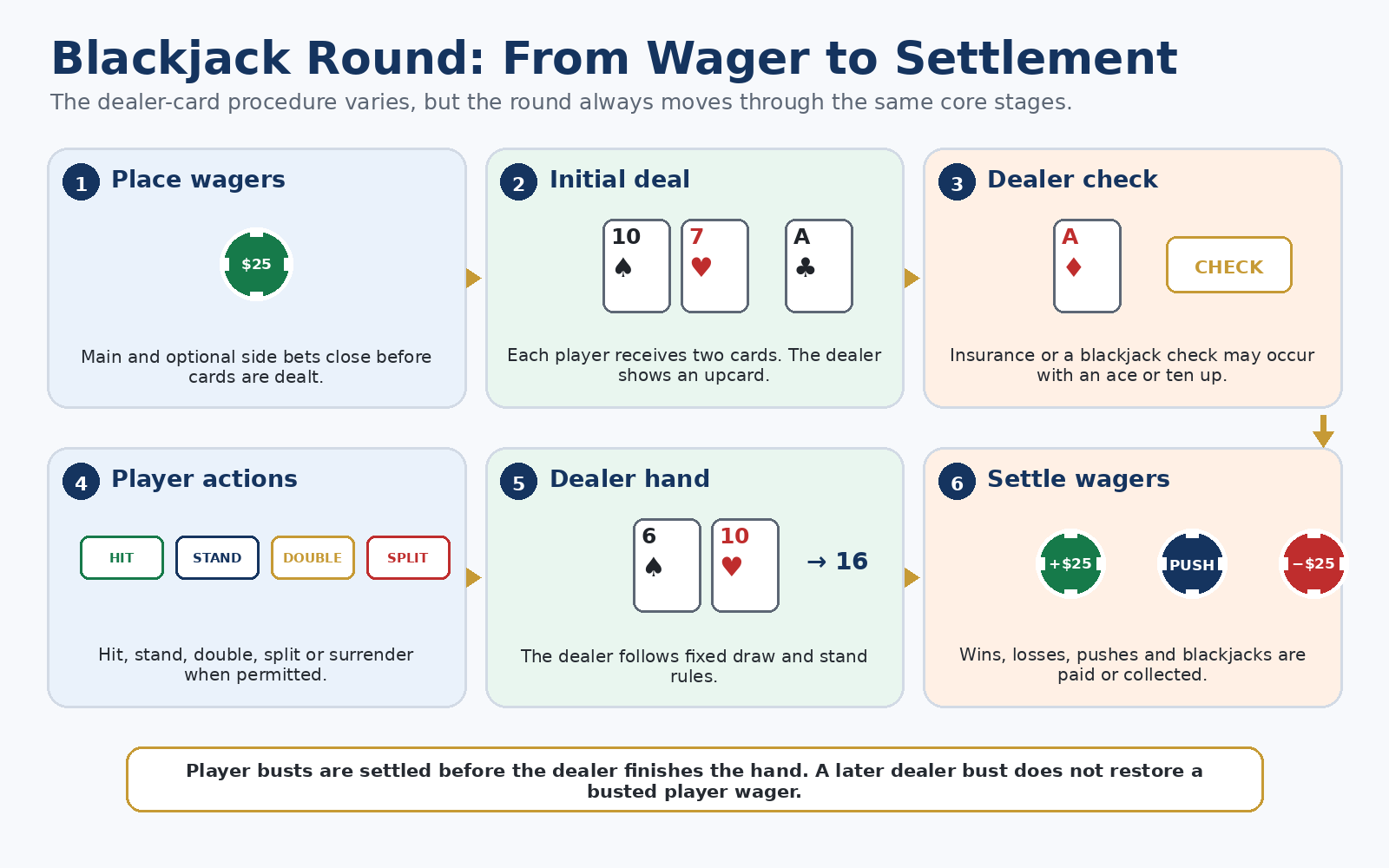
A standard round moves through six basic stages:
- Wagers are placed.
- Initial cards are dealt.
- Insurance or a dealer-blackjack check occurs when applicable.
- Players complete their decisions.
- The dealer completes the house hand.
- Winning, losing and pushing wagers are settled.
Step 1: placing the wager
The player places the main wager inside the designated betting spot before the dealer closes betting.
The table or interface can also offer separate areas for:
- Insurance
- 21+3
- Perfect Pairs
- Progressive wagers
- Other proprietary side bets
Once the dealer announces “no more bets,” or the online betting timer expires, the original wager normally cannot be increased, reduced or removed.
Additional chips may later be placed only through an authorized action such as:
- Doubling down
- Splitting
- Taking insurance
Minimums and maximums are explained in our guide to blackjack table limits.
Step 2: the initial deal
Each active player receives two cards.
The dealer receives at least one visible upcard. What happens with the dealer’s second card depends on the dealing procedure.
American hole-card game
The dealer normally receives:
- One face-up card
- One face-down hole card
The dealer may check the hole card for blackjack when showing an ace or ten-value card.
European no-hole-card game
The dealer initially receives only the visible upcard.
The dealer’s second card is taken after the players finish their hands.
Live-dealer and electronic variations
A live-dealer studio can use an American, European or proprietary procedure. An RNG game can visually imitate either one.
Do not infer the rule from the graphics alone. Read the help screen.
American peek versus European no-hole-card blackjack
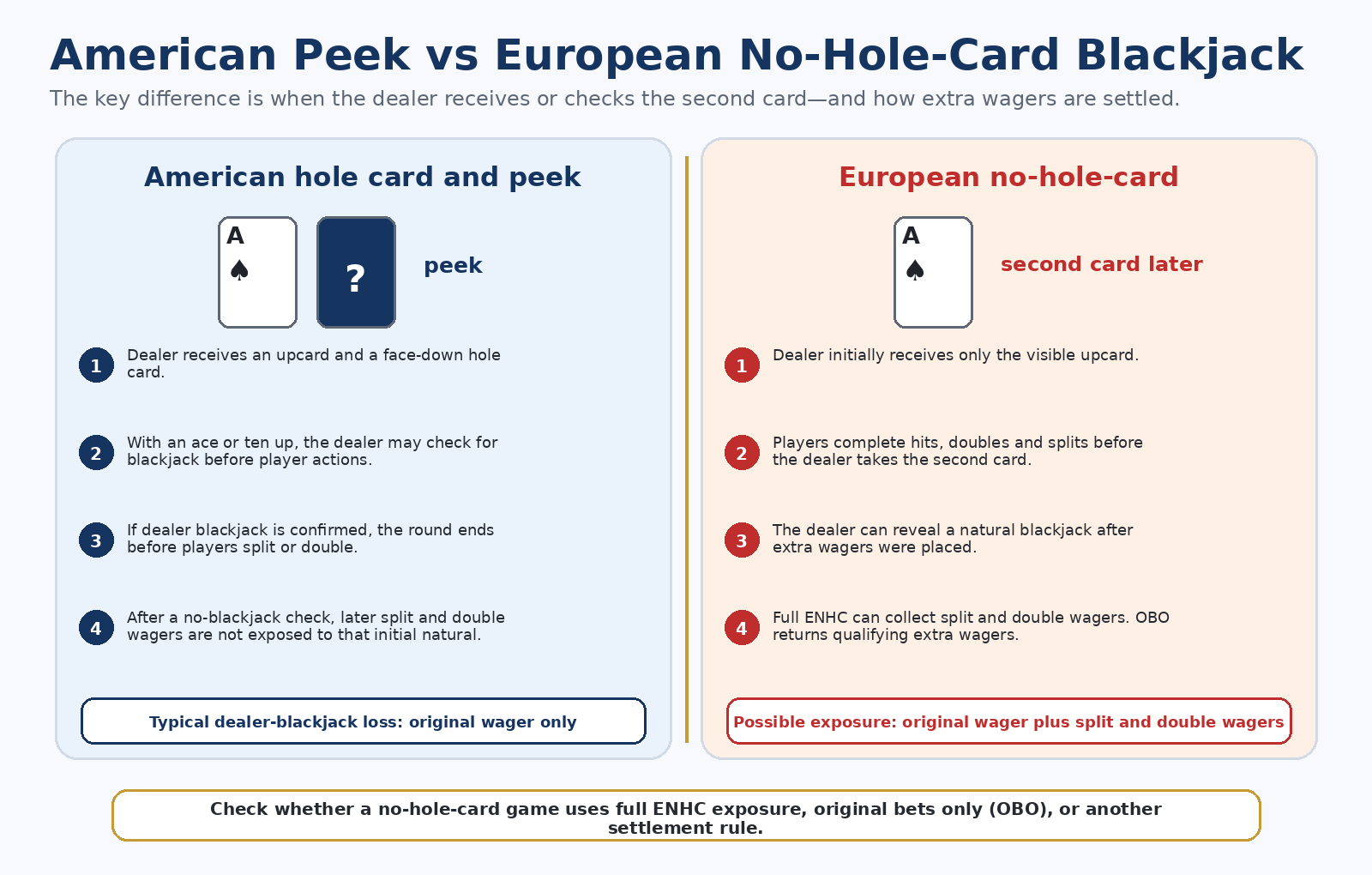
This distinction affects more than the order of dealing. It can determine whether additional split and double wagers are exposed to a dealer blackjack.
American peek procedure
The dealer has a face-down hole card and may check it when the upcard is an ace or ten-value card.
If the dealer has blackjack:
- The round ends before players act.
- The player normally loses only the original wager.
- A player blackjack normally pushes.
If the dealer does not have blackjack, players complete their hands.
Full European no-hole-card exposure
Players may split and double before the dealer receives the second card.
If that second card completes a dealer blackjack, the player can lose:
- The original wager
- Additional split wagers
- Double-down wagers
This changes the correct strategy against dealer 10 and ace.
Original bets only and other settlement protections
Under original-bets-only protection (OBO), dealer blackjack costs only the original wager for the round; added split and double wagers are returned. Do not treat every similar abbreviation as the same rule.
OBBO generally means original bets and busted bets only: each resulting split hand can retain an original-unit loss, while busted wagers are also lost. Another rule, BB+1, takes busted wagers plus one original unit from the surviving hands. Terminology varies, so ask how a split hand, a doubled hand and a busted hand would each be settled.
Do not assume every European-style game takes every additional wager. Confirm the exact settlement language.
See our European blackjack guide for rule-specific strategy.
Step 3: insurance and the dealer blackjack check
When the dealer shows an ace, insurance may be offered before the main player decisions.
Insurance is a separate wager that the dealer’s second card is worth ten.
It is normally limited to one-half of the original main wager and pays 2:1 when the dealer has blackjack.
$20 insurance example
Suppose the main wager is $20:
- Maximum insurance wager: $10
- Dealer has blackjack: insurance wins $20 profit
- Main $20 wager loses, unless the player also has blackjack
If the player does not have a natural blackjack, the $20 insurance profit exactly offsets the $20 main-wager loss: the combined net result is $0. Returned stakes are not additional profit. If the player also has blackjack, the main wager normally pushes and the insurance result must be counted separately.
This does not mean insurance “protects” the cards or prevents dealer blackjack. It is simply a side wager on the dealer’s hidden or later card.
If the dealer does not have blackjack
The insurance wager loses immediately, and the main hand continues.
The result of the main hand does not restore the lost insurance wager.
Even money
When the player has a blackjack and the dealer shows an ace, the casino may offer even money.
At a table paying 3:2 for a natural blackjack, accepting an immediate 1:1 payout is mathematically equivalent to placing the maximum insurance wager on that blackjack. Do not apply this equivalence without adjustment to 6:5 or other payouts.
Basic-strategy players normally decline insurance and even money. Card counters can make a different insurance decision when the remaining cards are sufficiently rich in ten-value cards.
See insurance in blackjack for the complete analysis.
Step 4: player actions
Players normally act in order around the table, beginning with first base and ending with third base.
Available options can include:
- Hit
- Stand
- Double down
- Split
- Surrender
Not every option is available on every hand.
Hit
To hit is to request another card.
The player can normally continue hitting until:
- The player stands
- The hand reaches 21
- The player busts
- A special card limit or automatic-win rule ends the hand
Some games automatically stand the player at 21. Others simply remove further action buttons because no additional legal hit is needed.
Use our hit-or-stand guide for the strategy behind the decision.
Stand
To stand is to keep the current total and take no further cards.
The hand remains active until the dealer completes the house hand and settles it.
“Sit” is not the standard blackjack action. The usual term is stand.
Double down
Doubling adds an additional wager and commits the player to exactly one more card.
A full double normally adds an amount equal to the original wager.
$25 double example
- Original wager: $25
- Additional double wager: $25
- Total wager on the hand: $50
- Player receives one final card
Rules can vary regarding:
- Which totals may be doubled
- Whether doubling is allowed on any first two cards
- Whether doubling for less is permitted
- Whether doubling after splitting is allowed
- Whether a split-ace hand can be doubled
- How a dealer blackjack affects the added wager
See doubling down in blackjack.
Split
When the player’s first two cards qualify as a pair under the game rules, the player may be allowed to separate them into two hands.
An additional wager equal to the original wager funds the new hand.
$25 split example
- Original wager: $25
- Additional split wager: $25
- Two separate hands are created
- Total initial exposure after the split: $50
Important split rules include:
- Whether equal-value cards or only identical ranks may be split
- Maximum number of hands
- Whether pairs may be resplit
- Whether aces may be resplit
- Whether split aces receive only one card each
- Whether cards may be drawn after splitting aces
- Whether doubling after split is allowed
Ten-value cards
Many standard games allow any two ten-value cards to be split, such as queen-king, because both have the same value. Other procedures can require matching ranks.
Ordinary basic strategy does not split ten-value cards, but the eligibility rule should still be stated accurately.
Blackjack after a split
An ace plus a ten-value card received after splitting normally counts as ordinary 21 rather than a natural blackjack.
It therefore normally pays 1:1 rather than 3:2.
See our blackjack pair-splitting guide.
Surrender
Surrender allows the player to abandon the original two-card hand and recover part of the original wager, normally one-half.
It is usually available only before the player has hit, doubled or split.
Late surrender
In a peek game, late surrender against an ace or ten-value upcard is effective only after dealer blackjack has been ruled out. With an upcard from 2 through 9, dealer blackjack is impossible and no such check is needed. A no-hole-card game may use a conditional surrender procedure; verify whether a later dealer blackjack overrides the surrender.
If the dealer already has blackjack, the full original wager loses before surrender becomes effective.
Early surrender
Early surrender occurs before the dealer checks for blackjack.
It is much more favorable to the player because the hand can be surrendered even when the dealer would otherwise have a natural.
Early surrender is uncommon and requires its own strategy.
Surrender procedure
The physical signal varies by casino. The dealer may require:
- A verbal request
- A line drawn behind the wager with one finger
- Both a verbal request and a hand signal
Do not rely on one universal gesture. State the request clearly and follow the dealer’s instruction.
Step 5: dealer rules
After all surviving player hands are complete, the dealer plays according to fixed rules.
The dealer does not choose strategically whether to hit or stand.
The usual structure is:
- Dealer hits totals of 16 or less.
- Dealer stands on hard 17 or more.
- Soft 17 is governed by the table’s S17 or H17 rule.
S17: dealer stands on soft 17
S17 means the dealer stands with all totals of 17, including:
- 10-7
- 9-8
- A-6
- A-2-4
The felt may state:
Dealer must draw to 16 and stand on all 17s.
H17: dealer hits soft 17
H17 means the dealer draws another card with a soft 17 such as ace-6.
The dealer still stands on hard 17.
The felt may state:
Dealer must draw to 16 and soft 17 and stand on hard 17 and all 18s.
H17 is less favorable to the player than otherwise identical S17 rules. It adds approximately 0.22 percentage points to the house advantage under common comparison assumptions.
H17 also changes several basic-strategy decisions, including selected doubles and surrender plays.
Dealer bust
The dealer busts when the completed house hand exceeds 21.
Every player hand that has not already:
- Busted
- Surrendered
- Lost to dealer blackjack
normally wins at 1:1 when the dealer busts.
Player busts are settled first
If a player busts before the dealer acts, the player wager loses immediately.
A later dealer bust does not create a push and does not return the player’s wager.
This settlement order is a fundamental source of the casino’s advantage.
Step 6: settling the hand
| Outcome | Typical settlement |
|---|---|
| Player busts | Player loses immediately. |
| Dealer busts | Every surviving player hand normally wins 1:1. |
| Player total exceeds dealer total | Player wins 1:1. |
| Dealer total exceeds player total | Player loses. |
| Equal totals | Push; original wager normally returned. |
| Player blackjack, dealer no blackjack | Paid according to the posted blackjack payout. |
| Player and dealer blackjack | Normally a push. |
| Dealer blackjack, player ordinary 21 | Dealer blackjack normally wins. |
| Surrender | Player normally loses half the original wager. |
Worked example: settling a split and a double
Suppose your balance is $100 and the initial wager is $10. You split 8-8, adding $10, then double one resulting hand, adding another $10. Assume doubling after splitting is allowed, the dealer has no blackjack and ordinary wins pay 1:1.
| Hand | Total wager | Result | Returned including stake | Net result |
|---|---|---|---|---|
| Doubled first hand | $20 | Win | $40 | +$20 |
| Second split hand | $10 | Loss | $0 | −$10 |
| Round total | $30 | One win, one loss | $40 | +$10 |
The balance falls to $70 while $30 is committed, then rises to $110 when $40 is returned. The $40 return is not $40 profit. If the doubled hand pushed instead, it would return $20 and the round would finish at $90, a $10 net loss.
Use this distinction when reading a game history or planning a session: the initial wager, total exposure, returned stakes and net result describe different amounts. A split or double changes exposure during the round even if the original betting amount never changes.
What is a push?
A push is a tie under rules that return the original wager.
Examples include:
- Player 18 and dealer 18
- Player 20 and dealer 20
- Player blackjack and dealer blackjack
A push produces no net win or loss on the affected main wager.
Side bets are settled independently and do not necessarily push merely because the main blackjack hand ties.
Some proprietary variants give ties to the dealer or treat specific dealer totals differently. Those are not standard push rules.
Blackjack pays 3:2
At a 3:2 table, a qualifying natural blackjack wins one and one-half times the original wager.
| Original wager | Blackjack profit at 3:2 | Total returned including stake |
|---|---|---|
| $10 | $15 | $25 |
| $20 | $30 | $50 |
| $25 | $37.50 | $62.50 |
| $100 | $150 | $250 |
Chip denominations can affect how fractional payouts are handled. Some tables require wagers in increments that allow exact settlement.
Blackjack pays 6:5
At a 6:5 table, a natural wins only 1.2 times the original wager.
| Original wager | Blackjack profit at 3:2 | Blackjack profit at 6:5 | Lost profit under 6:5 |
|---|---|---|---|
| $10 | $15 | $12 | $3 |
| $20 | $30 | $24 | $6 |
| $50 | $75 | $60 | $15 |
| $100 | $150 | $120 | $30 |
Changing the payout from 3:2 to 6:5 adds approximately 1.39 percentage points to the house advantage under standard assumptions.
That change is far more important than the cosmetic appeal of a single-deck table.
How important rules affect the house edge
The following values are approximate changes under standard comparison assumptions. Exact effects depend on the complete game and strategy.
| Rule change | Approximate effect on player return | Meaning |
|---|---|---|
| Blackjack pays 6:5 instead of 3:2 | −1.39 percentage points | Major loss of value on every natural blackjack. |
| Dealer hits soft 17 | −0.22 percentage points | Dealer receives another chance to improve soft 17. |
| No double after split | −0.14 percentage points | Removes profitable doubles from selected split hands. |
| Double only on 10 and 11 | −0.18 percentage points | Removes other profitable doubling opportunities. |
| Full European no-hole-card exposure | Approximately −0.11 percentage points | Additional split and double wagers can lose to dealer blackjack. |
| Resplitting aces allowed | Approximately +0.08 percentage points | Creates additional playable ace hands. |
| Late surrender against dealer 10 | Approximately +0.07 percentage points | Reduces losses on selected weak starting hands. |
A lower number of decks is generally favorable when every other rule is identical. In practice, single-deck games are often paired with 6:5 blackjack or other restrictions that erase the deck-count benefit.
Use a complete calculator rather than adding isolated effects without checking the baseline assumptions.
Double after split
DAS means double after split is permitted.
Suppose a player splits 8-8 and receives a 3 on one hand, producing 11. With DAS, that hand may be doubled when the rules otherwise permit it.
Without DAS, the player must choose another action, normally hit or stand according to the strategy for the resulting hand.
DAS is favorable because it preserves profitable doubling opportunities created by splitting.
Resplitting
A game can allow or prohibit further splits when another matching card appears.
Possible rules include:
- Split once only
- Resplit to three hands
- Resplit to four hands
- Unlimited resplitting under an unusual ruleset
- Resplit non-aces but not aces
- Resplit aces allowed
Each new hand requires an additional wager equal to the original split amount.
Rules for split aces
Split aces frequently have special restrictions.
A common procedure is:
- One card is dealt to each split ace.
- No additional hit is allowed.
- A ten-value card creates ordinary 21, not blackjack.
- Resplitting aces may be prohibited.
Other games allow:
- Drawing additional cards
- Resplitting aces
- Doubling after splitting aces
- Ace-ten after split to qualify as blackjack
Do not transfer one split-ace rule to another table.
Blackjack hand signals
Physical casinos use visible hand signals because surveillance needs a record of the player’s decision.
Face-up shoe game
- Hit: tap or point toward the felt near the cards.
- Stand: wave a flat hand horizontally over the cards.
- Double: place the additional chips beside the original wager and indicate one card.
- Split: place an equal wager beside the original and separate two fingers when instructed.
- Surrender: procedure varies; make the request clearly and follow the dealer’s direction.
Face-down pitch game
Card-handling and signals differ. Common rules can require:
- Using only one hand to touch the cards
- Keeping cards above the table
- Sliding cards beneath chips to stand
- Scratching the table lightly with the cards to hit
Never bend, mark, conceal or remove cards. Follow the dealer’s instructions for that table.
Can players touch the chips after the deal?
The original wager should not be changed after betting closes.
Do not:
- Add chips to the original stack because the first card is favorable
- Remove chips because the dealer has a strong upcard
- Move the wager to another position
- Collect a winning stack before the dealer settles it
Additional chips may be placed only for a valid split, double, insurance or another approved wager.
When are the cards shuffled?
A conventional shoe is not normally dealt until every card is exhausted.
An opaque cut card or operating procedure ends the shoe while undealt cards remain.
Possible shuffle systems include:
- Hand shuffle
- Batch automatic shuffler
- Pre-shuffled cards
- Continuous shuffling machine
- RNG reshuffle before every online round
A batch shuffler and a continuous shuffler are not the same.
Our blackjack table guide explains the shoe, discard tray, cut card and shuffling equipment.
Can players join in the middle of a shoe?
That depends on the table.
A casino may:
- Allow entry before any new round
- Permit entry only after the shuffle
- Post “no mid-shoe entry”
- Close a position temporarily
- Allow only existing players to add a hand
Online live tables may require the player to wait until the next betting window. RNG games normally begin a new independent round whenever the player is ready.
Playing more than one hand
A player may be allowed to control more than one betting spot.
The casino can impose:
- A higher minimum on each hand
- A maximum number of spots
- A combined maximum wager
- Restrictions during busy periods
- Floor approval
Each hand has its own decisions and settlement. Their results are not statistically independent when they share the same dealer hand and shoe: one dealer bust can pay several surviving hands at once. Playing two spots also creates two initial wagers, before any split or double additions.
Back betting
Some casinos and live-dealer platforms allow a person to place a wager behind another player’s hand.
Back-betting rules are not universal.
The behind bettor may:
- Have no control over player decisions
- Be permitted or prohibited from matching a double
- Follow only one resulting hand after a split
- Have separate minimums and maximums
Do not present back betting as a standard feature of every blackjack table. Verify the local procedure.
Side bets are separate games
Optional blackjack wagers can include:
- 21+3
- Top 3
- Perfect Pairs
- Lucky Ladies
- Buster Blackjack
- Royal Match
- Progressive jackpots
Each side bet has its own:
- Winning conditions
- Paytable
- House edge
- Minimum and maximum
- Settlement timing
A side bet can win while the main blackjack hand loses, or lose while the main hand wins.
Do not combine the side-bet return with the main blackjack house edge.
See our blackjack side-bet guide.
Blackjack variants use different rules
Games that resemble blackjack can materially change:
- The deck composition
- The blackjack payout
- How ties are settled
- Whether dealer 22 pushes
- Whether cards can be switched
- Player automatic-win rules
- Bonus payouts
- Dealer-card visibility
Examples include:
- Spanish 21
- Free Bet Blackjack
- Blackjack Switch
- Super Fun 21
- Double Exposure Blackjack
- Pontoon
A variant is not automatically worse or better because it offers unusual player options. Its complete rules and matching strategy must be evaluated together.
Do not use a standard blackjack strategy chart without confirming that it applies.
Browse the blackjack variations directory.
RNG blackjack rules
RNG blackjack generates cards electronically according to the game’s programmed deck and shuffle model.
An RNG game can:
- Reshuffle before every round
- Use a persistent virtual shoe
- Offer one or several hands
- Use American or European dealer procedures
- Apply automatic decision limits
- Include proprietary rules
Open the help screen and verify:
- Number of decks
- Shuffle model
- Blackjack payout
- S17 or H17
- Doubling rules
- Split and resplit rules
- Surrender
- Hole-card treatment
- Side bets
Live-dealer blackjack rules
Live-dealer blackjack uses physical cards and a real dealer streamed through an online interface.
The interface can add:
- A betting countdown
- Automatic wager limits
- Digital hit, stand, double and split buttons
- Decision timers
- Bet-behind participation
- Game-history displays
- Disconnection procedures
One approved implementation, for example, uses an American-style hole card, eight pre-shuffled decks, seven seats, S17, insurance and configurable side bets. That describes one product—not every live-dealer blackjack table.
Technical standards call for online blackjack games to explain:
- Insurance
- Pair splitting
- Resplitting
- Double after split
- Double-down restrictions
- Surrender
- Card-draw limits
- Special rules
- Available player actions
See our live online blackjack guide.
How to inspect a blackjack game in 10 steps
- Read the blackjack payout. Identify 3:2, 6:5, even money or another payout.
- Identify the dealer soft-17 rule. Look for S17 or H17 wording.
- Count or confirm the decks. Do not infer the number solely from the presence of a shoe.
- Check doubling. Any two cards, 9–11, 10–11 or another restriction?
- Check DAS. Can resulting split hands be doubled?
- Check split rules. Maximum hands, resplitting and special ace treatment.
- Check surrender. Early, late or unavailable?
- Check the dealer-card procedure. American peek, full ENHC, OBO or another model?
- Check the shuffle. Traditional shoe, batch shuffler, CSM or every-round RNG reset?
- Read limits and side bets. Main and optional wagers may use separate ranges and paytables.
The full rule set matters more than one attractive feature.
A single-deck game paying 6:5 can be worse than an eight-deck game paying 3:2.
Common blackjack rules mistakes
Calling a soft hand hard
A hand is soft when an ace can count as 11 without busting. It is hard when no ace can remain 11.
Assuming every total of 21 is blackjack
Blackjack requires an ace and ten-value card as the original two-card hand.
Assuming a split ace and ten pays 3:2
It normally counts as ordinary 21 and pays 1:1.
Ignoring the blackjack payout
6:5 materially worsens the game compared with 3:2.
Assuming all dealers stand on soft 17
Some games are S17 and others H17. Read the table.
Assuming no-hole-card always means all wagers lose
Some games use original-bets-only protection. Confirm the settlement rule.
Believing insurance prevents a loss
Insurance is a separate wager. It loses whenever the dealer does not have blackjack.
Touching the original wager after the deal
Once betting closes, the original wager should remain untouched except through approved actions.
Assuming a shoe always means more than two decks
Shoes, hand-dealt games and electronic equipment can be configured differently. Confirm the deck count.
Assuming all cards are dealt before shuffling
A cut card normally ends a conventional shoe with undealt cards remaining.
Using standard blackjack strategy on a variant
Spanish 21, Free Bet, Switch, Pontoon and other variants require their own rules and strategy.
Frequently asked questions
What is the main goal in blackjack?
The goal is to beat the dealer without exceeding 21. A player can win with a higher valid total, a natural blackjack when the dealer does not have one, or by remaining in the hand when the dealer busts.
How are blackjack cards valued?
Cards 2 through 10 count at face value, jacks, queens and kings count as 10, and an ace counts as 1 or 11 according to which value produces the best valid hand.
What is the difference between blackjack and 21?
A blackjack is an ace plus a ten-value card as the original two-card hand. A total of 21 made with three or more cards, or after splitting, is normally an ordinary 21 and pays 1:1.
What is a push in blackjack?
A push is a tie under standard rules. Neither side wins the main wager, and the player’s original stake is returned.
What rules does the blackjack dealer follow?
The dealer normally hits totals of 16 or less and stands on hard 17 or more. Soft 17 is controlled by the posted S17 or H17 rule.
What is the difference between S17 and H17?
S17 means the dealer stands on soft 17. H17 means the dealer must draw another card on soft 17. H17 is less favorable to the player when other rules are identical.
Why does 3:2 versus 6:5 matter?
A 3:2 table pays $15 profit for a $10 blackjack, while a 6:5 table pays only $12. The lower payout adds approximately 1.39 percentage points to the house advantage under standard assumptions.
What is European no-hole-card blackjack?
The dealer initially receives only an upcard and takes the second card after player actions. Under full ENHC rules, additional split and double wagers can lose if the dealer then has blackjack.
What is blackjack insurance?
Insurance is a separate wager offered when the dealer shows an ace. It normally costs up to half the original wager and pays 2:1 when the dealer has blackjack.
Can another player’s decision make me lose?
Another player can change which unknown card appears next, but cannot predict that card. Their decision does not systematically alter the long-run expected value of your correctly played hand.
Technical and regulatory sources
- Nevada Gaming Control Board: approved game rules
- Nevada Gaming Control Board: approved Blackjack Live rules
- New Jersey blackjack equipment and layout rules
- GLI-19: interactive blackjack disclosure standards
- Wizard of Odds: mathematical effects of blackjack rule variations
- Wizard of Odds: blackjack house-edge calculator
- Wizard of Odds: rule-specific blackjack strategy calculator
- The Venetian: standard American-style blackjack procedure
Rules note: blackjack procedures vary by casino, jurisdiction, provider and game version. The posted table rules, approved game documentation and online help screen control the game being offered.
Related rules analysis
See which blackjack rules are most favorable to the player, and verify the actual table placard before using any strategy or house-edge estimate.
Verify the rules at three points
Check the game before choosing a strategy, again before the first wager and whenever the table, lobby entry or dealer procedure changes. Use the rules screen or placard, the paytable and the actual dealing procedure as separate evidence. If they conflict, pause and ask for clarification.
Record the blackjack payout, S17 or H17, deck count, doubling rules, DAS, surrender, split-ace restrictions and the dealer-blackjack procedure. A familiar game name is not enough. For online play, save the game title and version with the rules because two similarly named tables can use different configurations.