what the insurance side bet actually wagers on, why a positive expected value at its 2:1 payout requires a dealer-blackjack probability above one-third, how even money is equivalent to maximum insurance at a 3:2 table, and when composition information can change the decision.
On this page
- Blackjack insurance at a glance
- Reference game used on this page
- What insurance actually wagers on
- How insurance works with a main wager
- Why the break-even probability is one-third
- Fresh-shoe insurance probabilities
- Correct interpretation of the insurance house edge
- Player cards change the exact composition
- Insurance is not hand protection
- Insurance is offered on an ace upcard
- How to take insurance at a physical table
- How insurance works online
- Is insurance offered in every blackjack game?
- What is even money?
- Even money is insurance
- Is even money safer?
- Does even money work the same with 6:5 blackjack?
- When can insurance be correct?
- Hi-Lo insurance index
- Why the running count alone is not enough
- Insurance correlation and counting systems
- American peek versus no-hole-card games
- Can insurance be taken after splitting?
- Insurance and bankroll exposure
- Common insurance mistakes
- Taking insurance because the main hand is strong
- Taking insurance to protect a large bet
- Assuming winning insurance means winning the round
- Taking even money because it sounds guaranteed
- Believing insurance is offered on dealer 10
- Using a positive running count without true-count conversion
- Calling every ace-up situation one-third
- Assuming every game offers insurance
- Worked insurance examples
- Five-step insurance decision
- Frequently asked questions
- Technical and regulatory sources
- Separate the insurance decision from the main hand
- A quick composition check before buying insurance
For the main-hand decisions that follow a failed dealer blackjack check, use our blackjack basic strategy charts. For the related dealer-check procedure, see blackjack rules.
Insurance in blackjack is a separate side bet that the dealer’s hidden card is worth 10 when the dealer shows an ace. It is not protection for a particular player hand, and the strength of the player’s main hand does not determine whether the insurance wager has positive expected value.
The insurance wager is normally limited to one-half of the original main wager and pays 2:1 when the dealer has blackjack. If the dealer does not have blackjack, insurance loses immediately and the main hand continues.
For a player who is not tracking the remaining card composition, the basic-strategy decision is simple: decline insurance, including even money.
Blackjack insurance at a glance
| Question | Answer |
|---|---|
| When is insurance offered? | Normally when the dealer’s upcard is an ace and before the dealer checks the hole card for blackjack. |
| What does insurance bet on? | That the dealer’s hidden card is a 10, jack, queen or king, completing blackjack. |
| How much can be wagered? | Usually up to one-half of the original main wager. |
| What does insurance pay? | 2:1 when the dealer has blackjack. |
| What happens when the dealer does not have blackjack? | The insurance wager loses and the main hand continues normally. |
| Is insurance part of the main hand? | No. It is settled independently. |
| What probability is needed to break even? | Exactly one-third of the unseen cards must be 10-value cards for zero expected value; more than one-third is needed for positive expected value. |
| Does basic strategy take insurance? | No, unless the player has reliable composition or count information that crosses the break-even threshold. |
| Is even money different? | No. On a 3:2 blackjack, accepting even money is mathematically equivalent to taking maximum insurance. |
Reference game used on this page
The examples assume:
- Four to eight decks unless another deck count is stated
- American hole-card and peek procedure
- Dealer offers insurance only with an ace upcard
- Maximum insurance wager is one-half of the original main wager
- Insurance pays 2:1
- Player blackjack pays 3:2
Proprietary games and no-hole-card games can use different procedures. The rules screen controls.
What insurance actually wagers on
Insurance asks one narrow question:
Is the dealer’s hidden card a 10-value card?
The dealer already shows an ace, so a hidden:
- 10
- Jack
- Queen
- King
completes a two-card dealer blackjack.
The player’s cards do not change the insurance payoff. A player with hard 12, hard 20 or a natural blackjack is making the same side bet against the same hidden card.
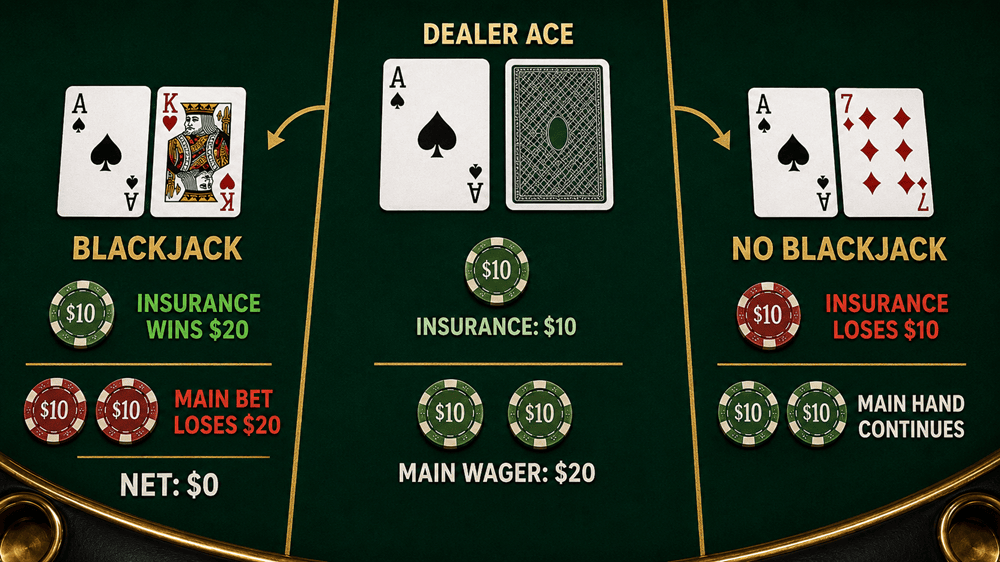
How insurance works with a $20 main wager
Suppose the player wagers $20 and the dealer shows an ace.
- Maximum insurance wager: $10
- Insurance payout when dealer has blackjack: $20 profit plus the $10 insurance stake returned
- Insurance loss when dealer does not have blackjack: $10
Dealer has blackjack
The main $20 wager normally loses. The $10 insurance wager wins $20 at 2:1.
Net result for a non-blackjack player:
- Main wager: −$20
- Insurance profit: +$20
- Net: $0
Dealer does not have blackjack
The $10 insurance wager loses immediately. The $20 main hand then continues and can still win, lose or push.
This independence is important: losing insurance does not mean the main hand loses, and winning insurance does not mean the main hand wins.
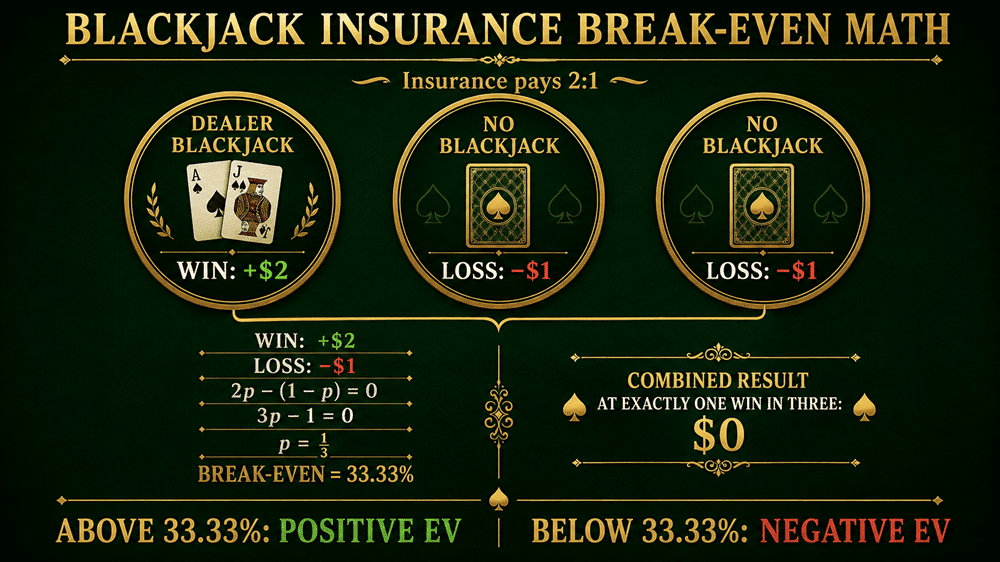
Why the break-even probability is one-third
For each $1 wagered on insurance:
- A win produces $2 profit.
- A loss costs $1.
Let p be the probability that the dealer’s hidden card is 10-valued.
The expected profit per $1 is:
2p − (1 − p) = 3p − 1
Break-even occurs when:
3p − 1 = 0
Therefore:
p = 1/3 = 33.333…%
Insurance has positive expected value only when more than one-third of the unseen cards are 10-valued.
Fresh-shoe insurance probabilities
After the dealer’s ace upcard is removed from a fresh shoe, every 10-value card remains available.
With d decks:
- 10-value cards remaining: 16d
- Total unseen cards before considering the player cards: 52d − 1
- Dealer-blackjack probability: 16d ÷ (52d − 1)
| Decks | 10-value cards | Unseen cards after dealer ace | Dealer blackjack probability | Insurance house edge |
|---|---|---|---|---|
| 1 | 16 | 51 | 31.373% | 5.882% |
| 2 | 32 | 103 | 31.068% | 6.796% |
| 4 | 64 | 207 | 30.918% | 7.246% |
| 6 | 96 | 311 | 30.868% | 7.395% |
| 8 | 128 | 415 | 30.843% | 7.470% |
These figures show why insurance is negative expected value from a fresh shoe: the dealer-blackjack probability is below the one-third break-even threshold.
Correct interpretation of the insurance house edge
A 5.882% house edge does not mean the casino “wins back almost $106” for every $100 wagered.
It means that, over a sufficiently large number of comparable insurance bets, the expected loss is about $5.88 per $100 wagered and the expected amount returned is about $94.12, including returned stakes.
Short-run results can differ sharply because an individual insurance bet either wins at 2:1 or loses.
Player cards change the exact composition
The fresh-shoe table ignores the player cards. Once exposed cards are considered, the exact probability changes.
Player holds two non-10 cards
In a single-deck game after a dealer ace and two non-10 player cards are exposed:
- 10-value cards unseen: 16
- Total unseen cards: 49
- Probability of dealer blackjack: 16/49 ≈ 32.653%
This is still below one-third, but closer to break-even.
Player holds two 10-value cards
After a dealer ace and two player 10-value cards are exposed:
- 10-value cards unseen: 14
- Total unseen cards: 49
- Probability of dealer blackjack: 14/49 ≈ 28.571%
Insurance becomes worse because two of the cards needed by the dealer are already visible in the player hand.
Why this matters
Insurance is a composition-dependent wager. The ratio of unseen 10-value cards to total unseen cards controls its expected value.
Insurance is not hand protection
The word “insurance” encourages the wrong mental model.
The wager does not protect:
- A strong total
- A large main wager
- A recent winning streak
- A natural blackjack specifically
It is simply a bet on the dealer’s hidden card.
Taking it because the main hand is strong or the wager feels important does not improve the insurance odds.
Insurance is offered on an ace upcard
In ordinary American blackjack, insurance is offered when the dealer shows an ace.
When the dealer shows a 10-value upcard, the dealer can still check for blackjack, but ordinary insurance is not offered because the hidden card needed for blackjack is an ace rather than a 10-value card.
Insurance applies to an ace upcard. A dealer 10-value upcard may trigger a blackjack check, but it does not trigger the ordinary insurance offer.
How to take insurance at a physical table
A common procedure is:
- The dealer shows an ace and announces insurance.
- The player places the insurance wager on the marked insurance line.
- The wager must not exceed the table’s permitted amount, normally half the main bet.
- The dealer closes insurance betting and checks for blackjack.
- The insurance wager is settled before the main hand continues.
Speaking is not prohibited, and there is no advantage to trying to appear experienced. Follow the dealer’s instructions and place the wager clearly in the designated area.
How insurance works online
RNG and live-dealer games normally display an insurance prompt when the dealer shows an ace.
The interface can offer:
- Maximum insurance automatically
- A choice from zero up to half the main wager
- Even money when the player holds blackjack
- A countdown timer
If insurance is unavailable, the prompt should not appear. Interactive blackjack standards require insurance rules to be explained when the option exists.
Is insurance offered in every blackjack game?
No.
Availability can vary by:
- Casino
- Table
- Online game
- Blackjack variant
- Dealer hole-card procedure
- Jurisdiction and approved rules
Check the felt, table placard or rules screen.
What is even money?
Even money can be offered when:
- The player has a natural blackjack.
- The dealer shows an ace.
- Blackjack normally pays 3:2.
Accepting even money ends the player’s result at a 1:1 profit on the original wager, regardless of whether the dealer has blackjack.
Even money is insurance
Suppose the original wager is $20 and the player has blackjack.
Take maximum insurance
Insurance wager: $10.
If the dealer has blackjack:
- Main blackjack pushes: $0 profit
- Insurance wins: +$20
- Net profit: +$20
If the dealer does not have blackjack:
- Main blackjack wins 3:2: +$30
- Insurance loses: −$10
- Net profit: +$20
The player earns $20 either way—the same as a 1:1 even-money payout.
Therefore, even money and maximum insurance on a 3:2 blackjack are mathematically equivalent.
Is even money safer?
It removes result variance on that hand, but it does not improve expected value when insurance itself is negative.
Declining even money preserves the full 3:2 blackjack payout when the dealer does not have blackjack. Over repeated fresh-shoe situations, that has higher expected value than locking in 1:1.
Does even money work the same with 6:5 blackjack?
No.
The standard equivalence assumes the player blackjack pays 3:2. A 6:5 game already uses a different main-hand payout, and the available insurance or even-money treatment can differ.
Read the exact paytable. Avoid transferring the 3:2 calculation blindly to a 6:5 table.
When can insurance be correct?
Insurance becomes positive expected value when reliable information shows that more than one-third of the unseen cards are 10-valued.
This can happen through:
- Card counting
- Direct composition information in a hand-dealt game
- Unusual exposed-card conditions
- A hole-card information situation, where legal and properly obtained
The main hand does not matter to the insurance calculation except through the cards it removes from the unseen pool.
Hi-Lo insurance index
In common Hi-Lo practice, insurance is often taken at a true count of approximately +3 or higher.
The exact index can vary with:
- Deck count
- Index convention
- Risk-averse versus expected-value-maximizing indices
- True-count rounding method
- Specific published system
Use the index set for the counting system being played rather than treating “+3” as universal across every system.
Why the running count alone is not enough
In a shoe game, the same running count means different things with six decks remaining and one deck remaining.
A count-based insurance decision normally requires:
- Maintain the running count.
- Estimate decks remaining.
- Convert to a true count.
- Compare the true count with the insurance index.
Taking insurance merely because the running count is positive can be incorrect.
Insurance correlation and counting systems
A counting system’s insurance correlation measures how efficiently it identifies insurance opportunities.
Systems that track 10-value cards more directly can outperform a general betting count for the insurance decision.
For most players, this distinction is advanced. Basic strategy remains to decline insurance.
American peek versus no-hole-card games
American peek
The dealer offers insurance with an ace upcard and checks the hole card. Insurance settles immediately.
European no-hole-card procedure
The dealer may not yet have a hidden card. A game can omit insurance, offer it against the dealer’s eventual second card, or use a game-specific procedure.
Do not assume the American timing applies. Read the rules, especially where player doubles and splits can remain exposed to a later dealer blackjack.
Can insurance be taken after splitting?
Under normal American dealing order, insurance is offered before players split because the dealer ace is checked before ordinary player actions.
Insurance is normally offered and closed before any split decisions in an American hole-card game. A proprietary game may use another sequence, which must be stated in its rules.
A proprietary game can use another procedure, but that must be stated in its rules.
Insurance and bankroll exposure
Insurance adds a separate wager to the round.
$20 main wager
- Main wager: $20
- Maximum insurance: $10
- Total money committed before the check: $30
If the dealer does not have blackjack, the $10 insurance loss is final while the $20 main hand remains at risk.
Repeatedly buying negative-EV insurance increases total money wagered and accelerates expected loss.
Common insurance mistakes
Taking insurance because the main hand is strong
The insurance wager depends on unseen-card composition, not the player total.
Taking insurance to protect a large bet
A larger main wager does not change the dealer’s hidden-card probability.
Assuming winning insurance means winning the round
Insurance and the main hand settle independently.
Taking even money because it sounds guaranteed
It guarantees a 1:1 profit but gives up expected value when the insurance bet is negative.
Believing insurance is offered on dealer 10
Ordinary insurance is triggered by a dealer ace.
Using a positive running count without true-count conversion
Shoe-game insurance indices normally use a true count.
Calling every ace-up situation one-third
Exposed cards alter the exact fraction of unseen 10-value cards.
Assuming every game offers insurance
Insurance is common, not universal.
Worked insurance examples
$10 main wager, dealer has blackjack
- Insurance wager: $5
- Main wager result: −$10
- Insurance profit at 2:1: +$10
- Net result: $0
$10 main wager, dealer does not have blackjack
- Insurance wager: −$5
- Main hand continues
- Final round result depends on the main hand
$20 blackjack, take even money
- Immediate profit: $20
- Equivalent to maximum insurance on a 3:2 blackjack
$20 blackjack, decline even money
- Dealer has blackjack: push, $0 profit
- Dealer does not have blackjack: +$30 profit
Unseen composition: 18 tens among 50 cards
- Dealer-blackjack probability: 18/50 = 36%
- Break-even threshold: 33.333%
- Insurance has positive expected value
Unseen composition: 15 tens among 50 cards
- Dealer-blackjack probability: 15/50 = 30%
- Below break-even
- Decline insurance
Five-step insurance decision
- Confirm that the dealer shows an ace and insurance is offered.
- Separate the side bet mentally from the main hand.
- For basic strategy without composition information, decline.
- For advantage play, estimate the ratio of unseen 10-value cards or use the exact count index.
- Take insurance only when the estimated dealer-blackjack probability exceeds one-third.
Frequently asked questions
What is insurance in blackjack?
Insurance is a separate side bet that the dealer’s hidden card is 10-valued when the dealer shows an ace.
How much does blackjack insurance cost?
The maximum insurance wager is normally one-half of the original main wager.
What does insurance pay?
Insurance normally pays 2:1 when the dealer has blackjack. Otherwise, the insurance wager loses.
What probability makes insurance break even?
The dealer-blackjack probability must be exactly one-third for zero expected value at a 2:1 payout. A probability above one-third gives positive expected value; below it, the expected value is negative.
Does basic strategy recommend insurance?
No. Without reliable composition or count information, decline insurance.
Is even money the same as insurance?
Yes. When blackjack pays 3:2, accepting even money is mathematically equivalent to taking maximum insurance on a player blackjack.
Is insurance offered when the dealer shows 10?
Not in ordinary blackjack. Insurance is normally offered when the dealer shows an ace.
Can card counters take insurance?
Yes. Insurance can have positive expected value when a rule-matched count index indicates that more than one-third of the unseen cards are 10-valued.
Can insurance lose while the main hand wins?
Yes. If the dealer does not have blackjack, insurance loses, but the main hand continues and can still win.
Is insurance available in every blackjack game?
No. Availability and procedure vary by game, table and blackjack variant.
Technical and regulatory sources
- Nevada Gaming Control Board: live blackjack insurance settlement
- Nevada Gaming Control Board: ace upcard, half-wager insurance and 2:1 payout example
- Nevada Gaming Control Board: insurance and even-money example
- GLI-19: interactive blackjack insurance-rule disclosure
Math note: fresh-shoe probabilities assume the dealer ace is exposed and no other cards are considered. Actual composition changes as player cards and previously dealt cards are observed.
Separate the insurance decision from the main hand
Insurance is a separate wager on whether the dealer has blackjack. Evaluate it from the unseen-card composition and the 2:1 payoff, then decide the main hand under its own strategy rules. Keeping those calculations separate prevents a strong hand, a large original wager, or fear of losing from being mistaken for evidence that insurance is favorable.
A quick composition check before buying insurance
Count the unseen cards that would complete the dealer’s blackjack: every ten, jack, queen and king. Divide that total by all unseen cards. Insurance breaks even only at one-third, so 17 ten-value cards among 50 unseen cards is favorable at 34%, while 16 among 50 is unfavorable at 32%. Use cards that are actually visible at that moment; do not mix a fresh-shoe percentage with a partly dealt shoe.
If you use a counting index, keep the system, true-count conversion and rounding method consistent. A borrowed index can be wrong when it was published for another deck count or conversion convention. Record the rule set with practice results so the decision can be reproduced instead of guessed from memory.