Negative House Edge in Blackjack: Player Advantage Explained
What this guide explains: how blackjack can move from a small casino advantage to positive player expectation through game selection, accurate card counting, disciplined bet variation, playing deviations. Risk control then manages exposure; it does not create the advantage.
On this page
- Negative house edge at a glance
- Why “negative house edge” can be confusing
- Why the starting house edge must match the rules
- Basic strategy is necessary but usually not sufficient
- Start with a beatable game
- How card counting changes the expectation
- Running count and true count
- True count does not map to one universal edge
- Why the wager must change with the advantage
- Bet spread
- Playing deviations
- Penetration
- Continuous shuffling machines
- Hands per hour
- Worked positive-EV example
- Another EV example with mixed counts
- Variance and standard deviation
- Bankroll and risk of ruin
- Kelly-style betting
- Expenses can erase a small advantage
- Casino countermeasures
- Online blackjack and card counting
- Promotions, rebates and lossbacks
- Betting systems do not create a negative house edge
- Advanced advantage-play methods
- Realistic path to positive EV
- Common mistakes
- Assuming basic strategy creates a player edge
- Quoting a universal 1% to 1.5% counting advantage
- Betting more without a measured advantage
- Ignoring negative-count hands
- Using a running count as though it were a true count
- Playing through a CSM
- Confusing EV with guaranteed profit
- Calling bankroll management an edge source
- Ignoring costs and casino countermeasures
- Five-question advantage test
- Frequently asked questions
- How to verify an advantage estimate before betting
- What the research establishes
- Technical and regulatory sources
Start with our blackjack house-edge guide for the base-game math, then use blackjack basic strategy before adding any advantage-play technique.
A negative house edge means the casino’s mathematical expectation has fallen below zero and the player has a positive expected value. In practical terms, the casino is no longer favored on average over a sufficiently large sample.
This does not mean the player will win every session, every shoe or even most individual hands. It means the long-run expected result is positive before expenses, errors, heat, travel costs and other practical limits.
Negative house edge at a glance
| Concept | Meaning |
|---|---|
| Positive house edge | The casino has positive expected value. |
| Zero edge | The game is approximately break-even before expenses and errors. |
| Negative house edge | The player has positive expected value. |
| Basic strategy | Minimizes the casino edge for the stated rules but usually does not eliminate it. |
| Card counting | Estimates whether the remaining cards favor the player or dealer. |
| Bet variation | Places more money when the player has an advantage and less when the casino does. |
| Playing deviations | Changes selected basic-strategy decisions at defined count indices. |
| Positive EV | A favorable average result over repeated comparable opportunities. |
| Variance | Short-term fluctuation around the expected result. |
Why “negative house edge” can be confusing
Most players find it clearer to say:
- Casino edge when the house is favored.
- Player advantage when the player is favored.
A house edge of −1.00% is the same mathematical condition as a player advantage of +1.00%.
Why the starting house edge must match the rules
Blackjack does not have one universal starting house edge. A quoted 2% can describe a particular combination of rules and mistakes, but it should not be applied automatically to a carefully selected basic-strategy game.
A properly selected 3:2 game played with accurate rule-matched basic strategy can have a casino edge around one-half of one percent or lower. Poor rules, especially 6:5 blackjack, and player mistakes can push the edge much higher.
Always attach an edge estimate to:
- The complete ruleset
- The strategy used
- The wager base
- Whether side bets are included
Basic strategy is necessary but usually not sufficient
Basic strategy determines the highest-value action for every player hand and dealer upcard under stated rules.
It prevents expensive errors involving:
- Hit or stand
- Double down
- Pair splitting
- Surrender
- Insurance
Basic strategy can reduce a poor recreational-player result dramatically, but it usually leaves the casino with a small edge.
It is the foundation of advantage play because counting on top of incorrect basic strategy can leave enough errors to erase the potential advantage.
Start with a beatable game
Card counting cannot rescue every table.
Look for:
- Blackjack pays 3:2
- Reasonable deck count
- S17 when available
- Double on any first two cards
- DAS
- Late surrender when available
- Good penetration
- No continuous shuffling machine
- Table limits that permit a usable bet spread
- A pace and crowd level that support accurate play
Approved blackjack rules show that payout, surrender, doubling and splitting conditions vary by game, so no advantage estimate should be made before the rules are confirmed.
How card counting changes the expectation
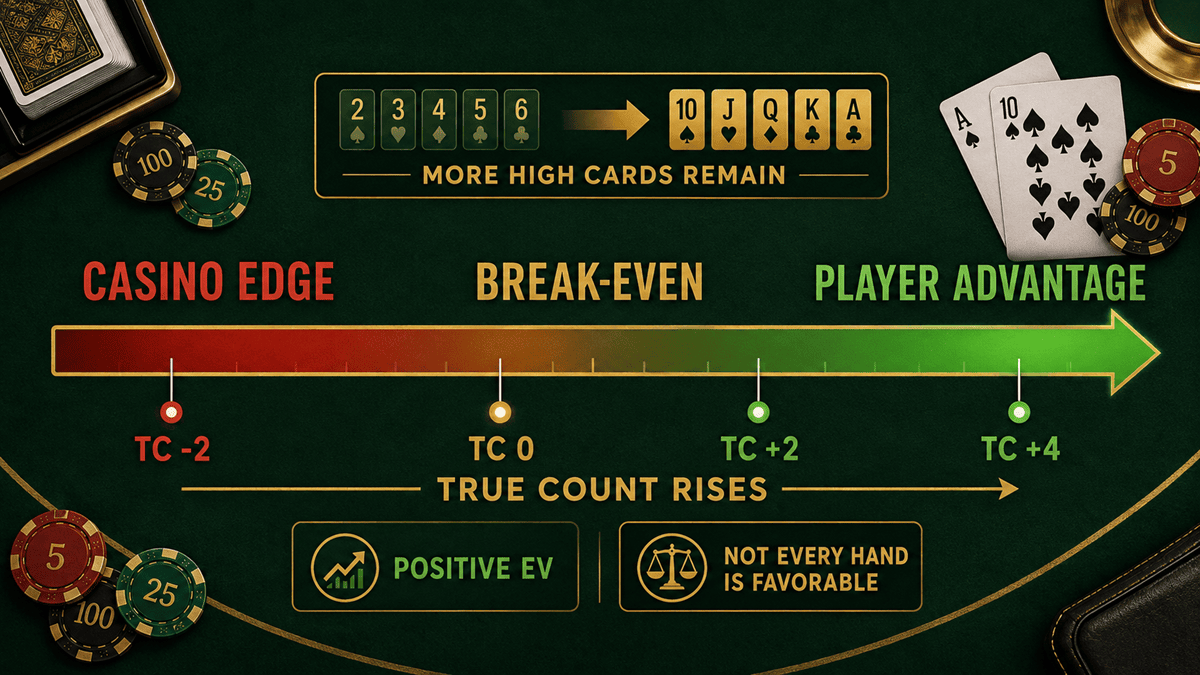
High and low cards do not affect the player and dealer equally.
A higher concentration of 10-value cards and aces can help the player because:
- Player blackjacks pay more than ordinary wins in a 3:2 game.
- Profitable doubles become stronger.
- Insurance can become positive expected value.
- The dealer is forced to hit stiff totals under fixed rules.
A higher concentration of low cards generally favors the dealer because low cards help the dealer complete forced draws without busting.
A counting system tracks this changing composition rather than predicting the exact next card.
Running count and true count
Balanced shoe-game systems such as Hi-Lo maintain a running count that must be adjusted for the number of decks remaining.
The common conversion is:
True count = running count ÷ estimated decks remaining
Example
- Running count: +8
- Decks remaining: 4
- True count: +2
The same +8 running count with one deck remaining would be a true count of +8 and represent a much stronger imbalance.
Research and simulations of blackjack advantage play support the use of composition-dependent betting rather than a flat wager, while also showing that the expected edge remains small relative to variance.
True count does not map to one universal edge
A common teaching shortcut says each additional Hi-Lo true-count point moves the edge by about half a percentage point toward the player.
That can be a useful rough estimate for selected shoe games, but it is not an exact universal law.
The actual advantage at a given true count depends on:
- Starting house edge
- Deck count
- S17 or H17
- DAS and surrender
- Penetration
- True-count method
- Betting and playing indices
- Cards included in the observed composition
Use simulation or published data matched to the exact game.
Why the wager must change with the advantage
Counting cards without changing the wager usually does not create a meaningful positive overall result.
The counter sees many more neutral or negative rounds than strongly positive rounds. The betting strategy therefore normally:
- Uses a small wager when the casino has the edge.
- Raises the wager when the player advantage becomes positive.
- Reduces the wager when the advantage disappears.
The goal is not to alter short-term results. It is to weight more money toward positive-expectation rounds.
Bet spread
A bet spread compares the minimum and maximum wagers used.
Examples:
- 1–4 spread: $10 to $40
- 1–8 spread: $10 to $80
- 1–12 spread: $10 to $120
A larger spread can increase expected value but also increases:
- Variance
- Bankroll requirements
- Risk of ruin
- Visibility to casino surveillance
- Chance of being backed off
There is no universally optimal spread independent of rules, penetration, bankroll, table limits and tolerance for attention.
Playing deviations
Card counters can improve expected value further by changing selected basic-strategy plays at defined count thresholds.
Examples can include:
- Taking insurance at the system’s insurance index
- Standing on hard 16 against dealer 10 at a specified count
- Standing on hard 15 against dealer 10 at a higher count
- Doubling hard 10 against dealer ace at a specified count
- Splitting 10s against weak dealer cards at high indices
The exact threshold depends on the counting system and rules. “The count is positive” is not a usable index.
Penetration
Penetration is the percentage of the shoe dealt before the shuffle.
Deeper penetration generally improves a counter’s opportunity because:
- More cards are observed.
- Larger true-count swings become possible.
- More positive rounds can occur before the shuffle.
- Information becomes more valuable late in the shoe.
Mathematical work on the distribution of the true count shows that count variability increases as more cards are removed, which helps explain why deeper penetration matters.
Continuous shuffling machines
A continuous shuffling machine returns used cards to the available pool frequently.
This largely removes the persistent depletion information required for traditional shoe-based card counting.
A CSM can still offer an ordinary basic-strategy game, but it is usually unsuitable for the standard running-count and true-count approach.
Hands per hour
Hourly expected value depends on both edge and volume.
Expected hourly value = average total initial action per hour × player advantage
More hands can increase hourly value when the player has an edge. They also increase expected loss when the casino has the edge.
Worked positive-EV example
Suppose a counter produces:
- Average initial action per hour: $5,000
- Average player advantage across that action: 1.00%
Expected hourly value is:
$5,000 × 0.01 = $50
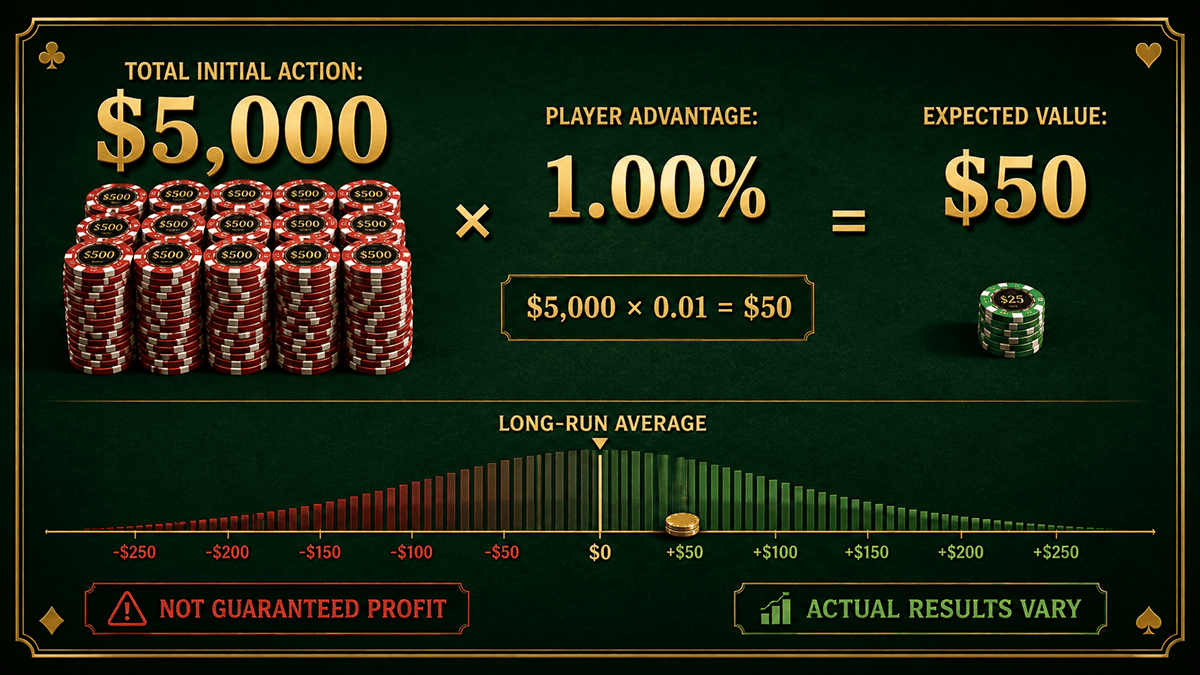
The player can still lose hundreds or thousands of dollars during that hour. Expected value and observed profit are different concepts.
Another EV example with mixed counts
| Condition | Action | Player edge | Expected value |
|---|---|---|---|
| Negative and neutral counts | $2,000 | −0.50% | −$10 |
| Positive counts | $3,000 | +1.50% | +$45 |
| Combined | $5,000 | Weighted result | +$35 |
This illustrates why a counter can accept small negative action at minimum wagers while directing more money toward positive counts.
Calculate the weighted edge, not the average of the percentages
In the mixed-count example, the total expectation is −$10 + $45 = +$35 on $5,000 of initial wagers. The effective player advantage is therefore $35 ÷ $5,000 = 0.007, or 0.70%. Simply averaging −0.50% and +1.50% gives +0.50%, which is wrong for these unequal amounts.
The negative-count portion accounts for 40% of the money and the positive-count portion for 60%, so the same result is 0.40 × (−0.50%) + 0.60 × (+1.50%) = +0.70%. These percentages describe the stated groups of initial wagers, not the percentage of hands won. This example alone does not identify a usable bet ramp: the frequency of each count, table limits and risk also matter.
For elapsed hourly EV, divide the combined expectation by the complete time represented. If those wagers took two hours including observation and waiting, +$35 becomes +$17.50 per elapsed hour before expenses. The hourly EV guide explains why played hours and elapsed hours must not be mixed.
Variance and standard deviation
Blackjack variance is much larger than a typical counting edge.
A player with a 1% advantage can still experience:
- Long losing sessions
- Extended losing streaks
- Large drawdowns
- Results far below expectation over thousands of hands
Positive expected value describes the average destination, not a smooth path.
Bankroll and risk of ruin
Money management does not create an edge. It changes exposure and the probability of exhausting the bankroll under a specified model; no plan guarantees survival through normal variance.
Risk of ruin depends on:
- Bankroll size
- Bet spread
- Average advantage
- Game variance
- Number of hands
- Whether bets are resized after bankroll changes
A player can have positive EV and still use a bankroll so small that bankruptcy is likely.
Kelly-style betting
Kelly betting links wager size to:
- Estimated advantage
- Bankroll
- Variance
Full Kelly seeks long-run logarithmic growth but produces substantial volatility. Many players use fractional Kelly to reduce drawdowns and risk.
Kelly does not make an inaccurate count, bad game or negative edge profitable.
Expenses can erase a small advantage
Gross table EV is not the same as net profit.
Subtract:
- Travel
- Accommodation
- Meals beyond normal spending
- Parking and tips
- Software and training costs
- Currency conversion
- Taxes where applicable
- Any actual costs of scouting unavailable games; also include scouting time in the elapsed-time denominator
A $40 hourly table EV can become unattractive after expenses and downtime.
Casino countermeasures
Casinos can respond to suspected advantage play by:
- Shuffling earlier
- Changing dealers or tables
- Restricting bet sizes
- Flat-betting the player
- Removing blackjack privileges
- Asking the player to leave
- Sharing observations within permitted systems
Operational longevity is a separate problem from mathematical EV.
Online blackjack and card counting
Many RNG blackjack products reset the card state between rounds or do not expose a persistent countable shoe. Check the exact product rules: ordinary shoe-based counting cannot transfer useful depletion information into a round whose card state has been independently reset.
Live-dealer games can use physical shoes, but many have:
- Shallow penetration
- Early reshuffles
- Limited bet ranges
- Slow game pace
- Account-level monitoring
- Terms that can affect promotional or advantage play
Do not assume that a visible shoe automatically creates a profitable online counting game.
Promotions, rebates and lossbacks
Positive EV can also come from an external offer rather than card composition.
Potential sources include:
- Cashback
- Loss rebates
- Match-play coupons
- Deposit bonuses
- Tournaments
- Comps
Calculate them separately from the game edge.
A promotion is positive only after accounting for:
- Wagering requirements
- Blackjack contribution rate
- Maximum bets
- Excluded games or strategies
- Withdrawal restrictions
- Probability of receiving the advertised value
Betting systems do not create a negative house edge
Martingale, Fibonacci and loss-chasing systems only rearrange wager sizes.
They do not change:
- Card composition
- Blackjack payout
- Dealer rules
- Expected value of the next hand
Without information or an external subsidy, a betting progression cannot turn a negative game positive.
Advanced advantage-play methods
Other methods can create player advantage under specific conditions, including:
- Hole-card information
- Shuffle tracking
- Ace sequencing
- Promotional overlays
- Rule or dealing errors
These methods require separate technical analysis and legal awareness. They should not be presented as automatic or universally available opportunities.
Realistic path to positive EV
- Master rule-matched basic strategy.
- Learn one counting system accurately.
- Practice running count without errors.
- Learn true-count conversion.
- Memorize a defined set of playing indices.
- Use simulation to evaluate the exact rules, penetration and spread.
- Set a bankroll and acceptable risk of ruin.
- Track actual hours, action, expenses and results.
- Recalculate when conditions change.
Common mistakes
Assuming basic strategy creates a player edge
It usually only minimizes the casino advantage.
Quoting a universal 1% to 1.5% counting advantage
Actual EV depends on rules, penetration, spread and execution.
Betting more without a measured advantage
Large wagers magnify a negative expectation when the game is unfavorable.
Ignoring negative-count hands
They contribute losses and reduce the weighted overall advantage.
Using a running count as though it were a true count
Decks remaining matter in balanced shoe systems.
Playing through a CSM
Traditional depletion-based counting normally cannot build persistent information.
Confusing EV with guaranteed profit
A positive edge can still produce severe short-term losses.
Calling bankroll management an edge source
It controls risk but does not alter the game’s expectation.
Ignoring costs and casino countermeasures
Gross mathematical EV can exceed net practical profit.
Five-question advantage test
- What is the off-the-top house edge for the exact rules?
- How does the count map to advantage in this game?
- What spread and indices are being used?
- What are the expected value, variance and risk of ruin?
- What remains after expenses, errors and operational limits?
Frequently asked questions
What is a negative house edge in blackjack?
It means the casino’s expected value is below zero and the player has a positive mathematical advantage.
Does basic strategy create a player advantage?
Usually not. Basic strategy minimizes the casino edge for the stated rules but normally leaves a small house advantage.
Can card counting create positive expected value?
Yes, when the rules, penetration, bet spread, indices and execution are strong enough to overcome the off-the-top disadvantage.
How large is a card counter’s advantage?
There is no universal number. It depends on the game, true-count distribution, penetration, spread, strategy deviations and errors.
Does a positive true count guarantee a winning hand?
No. It changes expected value over repeated hands but does not predict the next result.
Why is penetration important?
Deeper penetration allows more cards to be observed and creates more useful true-count variation before the shuffle.
Can a CSM be counted?
Traditional shoe-based counting is generally ineffective because used cards are returned to the available pool continuously.
Does money management create an edge?
No. It manages bankroll volatility and risk of ruin after an edge has been established.
Can promotions create positive EV?
Yes, when their real value exceeds expected game loss and all restrictions, costs and withdrawal conditions.
Is positive EV the same as guaranteed profit?
No. Positive EV is a long-run average and can coexist with long losing periods.
How to verify an advantage estimate before betting
A claimed player edge is useful only when another person can reproduce it. Record the exact rules, number of decks, penetration, counting system, true-count convention, betting ramp and playing indices. Then compare the stated edge with a simulation or published result that uses the same assumptions.
Keep promotional value separate from the underlying game. A rebate or bonus can change the combined expectation, but it does not change the probability of the next blackjack hand. Subtract travel, fees and other costs only after calculating the table result. This sequence makes it easier to see whether a small theoretical advantage survives real conditions.
- Verify the rules before estimating the off-the-top edge.
- Use the same wager base when comparing percentages.
- Separate game EV, promotional EV and expenses.
- Recalculate when penetration, limits or procedures change.
What the research establishes
Bordeu and Castro’s 2025 study compares betting policies within a specified rules configuration and a simplified player-versus-dealer model. It supports analyzing composition and risk preferences together; it does not establish one profitable spread for every game. Muñoz García and Perez Marco’s true-count analysis explains increasing count variability as cards are removed. Greater variability creates opportunities and uncertainty, rather than guaranteed positive counts late in every shoe.
Technical and regulatory sources
- Nevada Gaming Control Board: approved blackjack rules of play
- Nevada Gaming Control Board: configurable 3:2 and 6:5 blackjack example
- GLI-19: blackjack rule-disclosure standards
- Utah State University: expected value of an advantage blackjack player
- Bordeu and Castro: blackjack betting strategies and expected utility
- Muñoz García and Perez Marco: true-count variability as cards are removed
Method note: advantage estimates must be matched to the exact game, count system, penetration, spread, indices and true-count method. Illustrative EV figures are arithmetic examples, not promised results.