Focus here: composition-dependent blackjack strategy—how the exact cards forming a player’s hand can sometimes change the mathematically correct decision even when the total remains the same.
On this page
- Composition-dependent strategy at a glance
- Total-dependent versus composition-dependent blackjack strategy
- How total-dependent basic strategy is created
- Why exact card composition changes the mathematics
- Core example: 10-2 versus 7-5 against dealer 4
- Correcting the hard-12 doubling claim
- Single-deck H17 composition exceptions
- Double-deck S17 composition exceptions
- Multi-card hard 16 against dealer 10
- Why 10-4-2 and 10-3-3 can play differently
- Soft-hand composition
- Pair strategy and hand composition
- Composition-dependent strategy is not card counting
- Does composition-dependent strategy use all cards on the table?
Start with the correct basic blackjack strategy for your rules. Composition-dependent exceptions are advanced refinements, not a substitute for learning ordinary hard totals, soft totals and pair strategy.
Composition-dependent blackjack strategy uses the exact cards in the player’s hand, rather than only the hand total, to choose the action with the highest expected value.
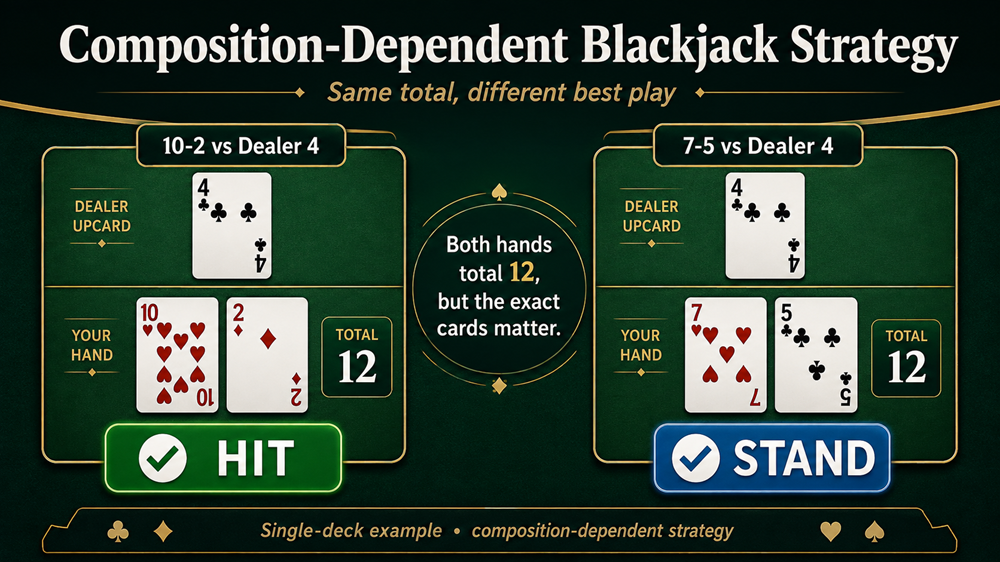
For example, 10-2 and 7-5 both total hard 12. A total-dependent strategy chart normally groups them together. Composition-dependent analysis recognizes that the hands remove different ranks from the remaining deck, so their probabilities—and occasionally their correct decisions—are not identical.
In a commonly analyzed single-deck game, hard 12 normally stands against a dealer 4. However, when the hand is specifically 10-2, hitting has the higher expected value. The ten already in the player’s hand slightly reduces the concentration of ten-value cards that would bust a hit.
That does not mean players should improvise exceptions from intuition. Composition-dependent plays depend on the exact hand, number of decks, dealer soft-17 rule, surrender, doubling rules, hole-card procedure and other conditions.
Composition-dependent strategy at a glance
| Question | Answer |
|---|---|
| What does “composition” mean? | The exact ranks of the cards forming the player’s hand. |
| What does total-dependent strategy use? | The player total, hard or soft status, pair status, dealer upcard and applicable table rules. |
| What does composition-dependent strategy add? | It distinguishes combinations such as 10-2 and 7-5 even though both total 12. |
| Is it card counting? | No. Card counting tracks exposed cards across the shoe. Composition-dependent basic strategy can use only the exact cards in the current hand. |
| Where does it matter most? | Single-deck games, followed by double-deck games. |
| Does it create a large advantage? | No. It produces a small improvement over accurate total-dependent strategy. |
| Does it still work after every-hand reshuffling? | Yes. The cards in the current hand remain removed while the current playing decision is made. |
| Should beginners learn it first? | No. Correct total-dependent basic strategy offers far more practical value. |
Total-dependent versus composition-dependent blackjack strategy
Most blackjack charts are total dependent. They base the decision on information such as:
- The player’s total
- Whether the hand is hard or soft
- Whether the hand is a pair
- The dealer’s upcard
- The number of decks
- Whether the dealer stands or hits soft 17
- Doubling restrictions
- Whether doubling after splitting is allowed
- Surrender availability
- The dealer’s hole-card procedure
A total-dependent chart might therefore say:
- Stand on hard 13 against dealer 2.
- Hit hard 12 against dealer 3.
- Hit hard 16 against dealer 10 when surrender is unavailable.
Those actions represent the best weighted choice across the different card combinations that can form each total.
A hard 13 can consist of:
- 10-3
- 9-4
- 8-5
- 7-6
- A-2-10
- 2-5-6
- Many other multi-card combinations
Total-dependent strategy combines those compositions into one strategic category. Composition-dependent strategy calculates them separately.
How total-dependent basic strategy is created
Total-dependent basic strategy is not an arbitrary shortcut. It is produced by calculating the expected value of every legal action and weighting the possible hand compositions according to how often they occur.
Consider single-deck hard 13 against a dealer 2 under a dealer-stands-soft-17 rule set.
| Player composition | Composition-dependent action |
|---|---|
| 7-6 | Stand |
| 8-5 | Stand |
| 9-4 | Stand by a small expected-value margin |
| 10-3 | Hit |
Despite the 10-3 exception, standing remains the ordinary total-dependent action because it has the higher weighted expected value across all hard-13 compositions.
This illustrates the relationship between the two methods:
- Total-dependent strategy gives the best general action for the category.
- Composition-dependent strategy identifies exceptions within that category.
Why exact card composition changes the mathematics
Blackjack is dealt without replacement from a finite deck or shoe. Once a card appears in the player’s hand, that physical card is no longer available for the next draw during that round.
Two hands with the same total can therefore leave different concentrations of:
- Cards that bust the player
- Cards that improve the total
- Ten-value cards
- Aces
- Small cards
- Cards that affect the dealer’s final result
The effect is largest with fewer decks.
A single deck contains sixteen ten-value cards. If the player holds one of them, fifteen remain among the unseen cards.
A six-deck shoe contains ninety-six ten-value cards. Removing one changes the remaining concentration much less.
Core example: 10-2 versus 7-5 against dealer 4
Both hands total hard 12.
| Hand | Cards removed | Relevant effect |
|---|---|---|
| 10-2 | One ten-value card and one 2 | One card that would bust hard 12 has already been removed. |
| 7-5 | One 7 and one 5 | No ten-value bust card has been removed by the player’s hand. |
Under the verified single-deck composition tables:
- 10-2 against dealer 4: Hit.
- 7-5 against dealer 4: Stand under ordinary hard-12 strategy.
The difference is small, but hitting 10-2 has the higher expected value under the relevant single-deck assumptions.
This is a change from stand to hit. It is not a general instruction to double hard 12.
Correcting the hard-12 doubling claim
The previous version of this article suggested that composition-dependent players might double hard 12 and that dealers commonly call out such wagers.
That is not an appropriate general example of ordinary composition-dependent basic strategy.
The widely documented 10-2 versus dealer 4 exception is:
Hit instead of stand.
Unusual promotions, exposed-card games or proprietary variants can produce unusual doubling decisions, but those should not be presented as standard blackjack composition strategy.
Single-deck H17 composition exceptions
The following examples come from a single-deck game where the dealer hits soft 17. They illustrate how exact composition and number of cards can change a decision.
Selected two-card exceptions
| Player hand | Dealer upcard | Composition-dependent action |
|---|---|---|
| 6-2 | 6 | Hit |
| 7-5 | 3 | Stand |
| 8-4 | 3 | Stand |
| 10-2 | 4 | Hit |
The 6-2 hand totals 8. Under many basic-strategy charts, hard 8 is simply hit. The composition table confirms that action against 6 rather than introducing a double under the cited rules.
Three-card hard 16 against dealer 10
For three-card hard 16 against a dealer 10, the general composition-dependent change is to stand.
However, the following single-deck H17 compositions remain hits:
- 6-6-4
- 7-6-3
- 8-6-2
- 9-6-A
A rule such as “always stand on every three-card 16” therefore captures much of the improvement, but it is not perfectly exact.
Double-deck S17 composition exceptions
In the published double-deck, dealer-stands-soft-17 analysis, selected two-card exceptions include:
| Player hand | Dealer upcard | Composition-dependent action |
|---|---|---|
| 9-2 | Ace | Hit |
| 8-3 | Ace | Hit |
| 10-2 | 4 | Hit |
For three-card hard 16 against dealer 10, the general change is again to stand, with exceptions including:
- 6-6-4: Hit
- 7-6-3: Hit
- 8-6-2: Hit
- 9-6-A: Hit
- 10-3-3: Hit
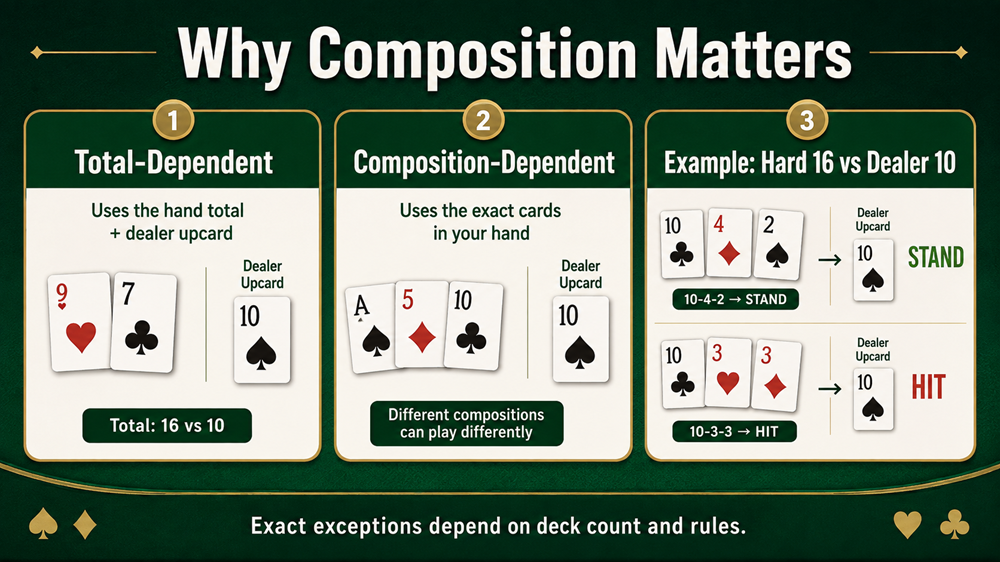
A composition such as 10-4-2 is not one of those exceptions, so it stands in the cited double-deck S17 game.
Multi-card hard 16 against dealer 10
Hard 16 against a dealer 10 is the most useful practical composition-dependent category.
Ordinary total-dependent strategy generally says:
- Surrender when surrender is available and correct.
- Otherwise hit hard 16 against dealer 10.
With three or more cards, standing frequently becomes preferable because the player’s hand has already removed several low cards that could otherwise improve a hit.
A widely taught simplified refinement is:
When surrender is unavailable, stand on hard 16 against dealer 10 if the hand contains three or more cards.
This captures most of the practical gain and has been published as a general number-of-cards exception for two through eight decks.
It remains a simplification. Exact composition tables contain the specific hit exceptions described above.
Why 10-4-2 and 10-3-3 can play differently
Both hands:
- Contain three cards
- Total hard 16
- Face a dealer 10
Yet under the cited double-deck S17 calculation:
- 10-4-2: Stand.
- 10-3-3: Hit.
The hands remove different low ranks from the remaining decks. The expected value of hitting changes enough to cross the decision boundary.
This is why the number of cards is a helpful shortcut but exact ranks provide the most precise result.
Soft-hand composition
Total-dependent strategy already separates soft hands from hard hands because an ace can count as either 1 or 11.
Composition-dependent analysis can refine soft hands further.
Soft 18 can be formed as:
- A-7
- A-A-6
- A-2-5
- A-3-4
- A-A-A-5
Those hands do not remove the same ranks from the deck.
In the published double-deck S17 composition table, a three-card soft 18 against a dealer ace generally stands. However, A-A-6 remains an exception and hits.
This again shows that “three-card hand” is a shortcut rather than a complete definition.
Pair strategy and hand composition
Pairs are already treated separately in ordinary basic strategy.
For example:
- 8-8 is evaluated as a pair with a splitting option, not merely as hard 16.
- 6-6 is evaluated as a pair, not merely as hard 12.
- A-A is evaluated as a pair despite also being soft 12.
Pair strategy is therefore already rank dependent.
Composition-dependent considerations can still arise:
- After the pair has been split
- When a split hand grows to three or more cards
- When resplitting rules change the available actions
- When other known cards affect a specialized analysis
Start with the correct blackjack pair-splitting strategy before adding deeper composition refinements.
Composition-dependent strategy is not card counting
| Feature | Composition-dependent basic strategy | Card counting |
|---|---|---|
| Primary information | The exact cards forming the current player hand | Exposed cards throughout the current shoe |
| Typical purpose | Refine a playing decision | Estimate changes in betting and playing advantage |
| Requires previous rounds? | No | Usually yes within the current shoe |
| Uses a running count? | No | Yes in conventional counting systems |
| Works with every-round reshuffling? | Yes, within the current hand | No carryover value from previous rounds |
| Level of information | Exact current hand composition | An estimate created by grouping cards into count values |
A card-counting index may say to stand on hard 16 against dealer 10 when the count reaches a threshold.
A composition-dependent strategy may say to stand because the hand specifically contains 10-4-2, even though no running count has been maintained.
The two methods can occasionally disagree because a counting system compresses several ranks into broad categories. Exact composition calculations retain more detailed card information.
Does composition-dependent strategy use all cards on the table?
Not in its standard basic-strategy definition.
Composition-dependent basic strategy normally means using every card in the player’s own hand, along with the dealer upcard and game rules.
Incorporating every exposed card at the table would require a broader analysis of the remaining deck or shoe. That can involve:
- Card counting
- Exact deck-composition tracking
- Computer-assisted expected-value calculation
- Full state-dependent optimal play
Those methods are related through card-removal mathematics, but they should not be presented as identical.
Three levels of blackjack strategy
- Total-dependent basic strategy: Uses the hand total or category, dealer upcard and rules.
- Composition-dependent basic strategy: Adds the exact ranks forming the player’s hand.
- Full state-dependent optimal strategy: Uses the exact composition of all remaining cards.
The third level can theoretically account for:
- The player’s exact cards
- The dealer upcard
- Other exposed player cards
- Cards from previous rounds
- The exact undealt deck or shoe
Full state-dependent strategy is computationally possible but generally impractical for a human player at normal casino speed.
How much does composition-dependent strategy improve return?
The improvement is mathematically real but small.
One published comparison evaluated total-dependent and composition-dependent strategy across 32 rule combinations. Surrender was unavailable and resplitting aces was not permitted in those comparisons.
| Decks | Approximate improvement across tested rule sets |
|---|---|
| 1 deck | 0.0361 to 0.0390 percentage points |
| 2 decks | 0.0112 to 0.0140 percentage points |
| 3 decks | 0.0065 to 0.0083 percentage points |
| 4 decks | 0.0045 to 0.0055 percentage points |
| 6 decks | 0.0028 to 0.0031 percentage points |
| 8 decks | Approximately 0.0019 percentage points |
These are percentage-point improvements.
For example, reducing a house edge from 0.500% to 0.497% is an improvement of 0.003 percentage points. It does not reduce the house edge by three percent and does not turn the game positive.
The published single-deck comparison estimates that the benefit is approximately equivalent to one additional betting unit of return per 2,800 hands.
Why the benefit falls with more decks
Removing one card has a smaller proportional effect as the shoe grows.
| Game | Starting ten-value cards | Effect of holding one ten-value card |
|---|---|---|
| Single deck | 16 | Removes 1 of 16 |
| Double deck | 32 | Removes 1 of 32 |
| Six decks | 96 | Removes 1 of 96 |
| Eight decks | 128 | Removes 1 of 128 |
The exact hand still changes the remaining shoe, but the practical effect becomes increasingly diluted.
Does composition-dependent strategy work in online blackjack?
Yes, provided the number of decks and rules are known.
An RNG game may reshuffle its virtual cards before every new round. That prevents traditional counting information from carrying forward.
However, once the current hand is dealt, those cards are removed from the possible next-card distribution for that hand. The exact composition can therefore still affect the optimal playing decision.
This remains true when:
- The virtual shoe is reset before each round
- The casino uses a true continuous shuffling machine
- Previous rounds cannot be counted profitably
Reshuffling removes information between rounds. It does not erase the mathematical effect of the cards already dealt in the current hand.
Continuous shuffling machines
A continuous shuffling machine repeatedly returns used cards to the available card supply, making conventional shoe-based card counting generally impractical.
The player’s active cards still remain outside the machine while the player decides whether to hit, stand or double.
Composition-dependent strategy therefore remains valid for the current hand, although its value is extremely small in a multi-deck CSM game.
Rule changes can reverse an exception
Never memorize a composition-dependent play without its assumptions.
Deck count
A single-deck exception can disappear in double deck or a larger shoe.
Dealer soft 17
H17 and S17 change dealer outcome probabilities and can move a close decision across the hit-or-stand boundary.
Dealer peek
In an American peek game, the player may know that the dealer does not have blackjack before doubling or splitting.
European no-hole-card rules
If extra split and double wagers can lose to a later dealer blackjack, actions against an ace or ten-value dealer upcard may change.
Surrender
When surrender is available and correct, it is considered before choosing between hit and stand.
Doubling restrictions
A mathematically favorable double is irrelevant when the rules do not permit doubling that hand or permit doubling only on two cards.
Charlie rules
An automatic win for reaching five, six or seven cards can substantially increase the value of hitting multi-card hands.
Should card counters use composition-dependent indices?
Advanced counting systems can use composition-dependent indices that distinguish exact hands such as:
- 10-4-2 against dealer 10
- 8-6-2 against dealer 10
- 10-3-3 against dealer 10
These indices can improve playing efficiency slightly, but they add significant memorization and error risk.
Most card counters gain more practical value from:
- Accurate basic strategy
- Maintaining the running count
- Correct true-count conversion
- Using a focused index set
- Selecting favorable rules
- Finding adequate penetration
- Using a sound betting spread
- Managing risk of ruin
Composition-dependent indices are an advanced refinement rather than a starting requirement.
How to learn composition-dependent strategy
Step 1: master total-dependent strategy
You should be able to play ordinary hard hands, soft hands and pairs without hesitation.
Step 2: identify the exact rule set
Record:
- Number of decks
- S17 or H17
- DAS or no DAS
- Surrender availability
- American peek or European no-hole-card procedure
- Split and resplit rules
- Blackjack payout
Step 3: use a matching composition table
Do not combine exceptions from sources using different rules.
Step 4: begin with the most recognizable refinements
- 10-2 versus dealer 4 in single deck
- 10-3 versus dealer 2 in single-deck S17
- Three-or-more-card hard 16 versus dealer 10
- The exact multi-card 16 hit exceptions
- Multi-card soft 18 versus dealer ace in selected S17 games
Step 5: test similar totals with different compositions
Practice distinguishing:
- 10-2 from 7-5
- 10-3 from 7-6
- 10-4-2 from 10-3-3
- A-A-6 from A-2-5
Step 6: verify close decisions mathematically
Use an exact expected-value calculator, published composition table or appropriate simulation software. Do not rely only on a verbal explanation about card removal.
When is composition-dependent strategy worth learning?
It may be worthwhile when:
- You regularly play single-deck or double-deck blackjack
- The game pays 3:2
- The rules are stable and clearly known
- Total-dependent strategy is already automatic
- You enjoy exact mathematical play
- You can verify the exceptions from a reliable source
- The additional complexity does not increase your error rate
It is generally low priority when:
- You play six- or eight-deck recreational games
- You still make ordinary basic-strategy mistakes
- You frequently switch between very different rules
- You play 6:5 blackjack
- You do not know the dealer’s soft-17 rule
- You are applying unverified rules of thumb
Skills that matter more for most players
- Choose 3:2 blackjack instead of 6:5.
- Use basic strategy matching the actual rules.
- Identify whether the dealer hits or stands on soft 17.
- Understand doubling and splitting restrictions.
- Check surrender availability.
- Understand dealer peek and no-hole-card exposure.
- Avoid high-house-edge side bets.
- Choose affordable table limits.
- Manage session stakes and bankroll risk.
Each of those decisions can matter more than memorizing a complete set of composition-dependent exceptions.
Common composition-dependent strategy mistakes
Using every visible card without maintaining a count
Seeing many low or high cards does not justify an improvised decision. That is moving toward card counting or exact state analysis, not ordinary composition-dependent basic strategy.
Always standing on any three-card 16
Standing is a strong shortcut against dealer 10, but exact hit exceptions exist.
Using single-deck exceptions in a shoe
Card-removal effects become much smaller as decks are added.
Ignoring surrender
A hit-or-stand exception may not matter when surrender is available and has the highest expected value.
Mixing H17 and S17 tables
The dealer’s soft-17 rule can reverse close decisions.
Doubling hard 12 because it appears “advanced”
The standard 10-2 versus dealer 4 exception is a hit, not a double.
Treating composition-dependent play as a guarantee
The expected-value differences are small, and the next card can still produce a losing outcome.
Learning exceptions before basic strategy
Occasional composition gains cannot offset repeated ordinary strategy mistakes.
Frequently asked questions
What is composition-dependent blackjack strategy?
Composition-dependent blackjack strategy uses the exact cards forming the player’s hand, together with the dealer upcard and game rules, rather than relying only on the hand total.
How is composition-dependent strategy different from basic strategy?
Standard total-dependent basic strategy groups hands by total, hard or soft status and pair status. Composition-dependent strategy distinguishes exact combinations such as 10-2 and 7-5 even though both total 12.
Is composition-dependent strategy the same as card counting?
No. Card counting tracks exposed cards across a shoe. Composition-dependent basic strategy can be applied from the exact cards in the current player hand without maintaining a running count.
Why can 10-2 play differently from 7-5?
The two hands remove different ranks from the deck. Holding a ten-value card reduces the number of ten-value cards remaining, which can change a close hit-versus-stand calculation.
Should you hit 10-2 against a dealer 4?
In verified single-deck composition-dependent tables, 10-2 against dealer 4 is hit even though ordinary hard 12 generally stands against 4. Do not transfer that exception to other deck counts or rule sets without verification.
Should you stand on a three-card 16 against dealer 10?
Standing is correct for many three-or-more-card hard 16 compositions, and it is a useful general refinement when surrender is unavailable. Exact exceptions such as 10-3-3 in double-deck S17 still hit.
Does composition-dependent strategy work in online blackjack?
Yes. Even when an online game reshuffles before every round, the exact cards in the current hand remain removed while the player decides whether to hit, stand or double.
How much does composition-dependent strategy reduce the house edge?
Published comparisons show an improvement of about 0.036 to 0.039 percentage points in single deck, about 0.011 to 0.014 in double deck and approximately 0.0028 to 0.0031 in six decks under the tested rules.
Is composition-dependent strategy worth learning?
It can be worthwhile for advanced single- or double-deck players who already know basic strategy perfectly. For most multi-deck recreational players, the additional benefit is too small to make it a priority.
Can composition-dependent strategy make blackjack positive expectation?
Usually not by itself. It slightly improves playing accuracy, but the blackjack payout, table rules, number of decks and other conditions still determine the underlying house edge.
Technical sources
- Wizard of Odds: total-dependent versus composition-dependent house edge
- Wizard of Odds: single-deck S17 composition-dependent strategy
- Wizard of Odds: single-deck H17 composition-dependent strategy
- Wizard of Odds: double-deck S17 composition-dependent strategy
- Wizard of Odds: composition-dependent expected-value tables
- Wizard of Odds: composition-dependent and total-dependent definitions
- Modern Blackjack: composition-dependent card-counting indices
- QFIT: composition-dependent index overview
Strategy note: every exception on this page depends on a defined blackjack rule set. Confirm the number of decks, soft-17 rule, surrender, doubling permissions and hole-card procedure before applying a composition-dependent play.