“10% cashback” is not a complete offer. Ten per cent of net losses, ten per cent of qualifying turnover and ten per cent of theoretical loss describe entirely different amounts. Before comparing percentages, identify the base, settlement period, cap and whether the result is cash you can withdraw.
This guide explains rebate mathematics rather than recommending promotions. The examples are hypothetical, with no assumption that a player can repeatedly obtain their advertised value.
Three rebate bases with different consequences
| Basis | Illustration | Key question |
|---|---|---|
| Actual net loss | 10% of a qualifying €100 loss is €10. | How are wins, deposits and withdrawals treated? |
| Qualifying turnover | 0.1% of €10,000 qualifying wagers is €10. | Do splits, doubles and excluded games count? |
| Theoretical loss | 20% of an assessed €50 theoretical loss is €10. | Which edge and wagering basis does the operator use? |
Deposits are not wagers. Depositing €100 and withdrawing €60 does not by itself establish €40 of eligible gaming loss: an opening balance, bonus funds, other games and fees can change that interpretation. The promotion’s definition controls eligibility, while your own records establish the full financial result.
Net-loss cashback: start with the qualifying window
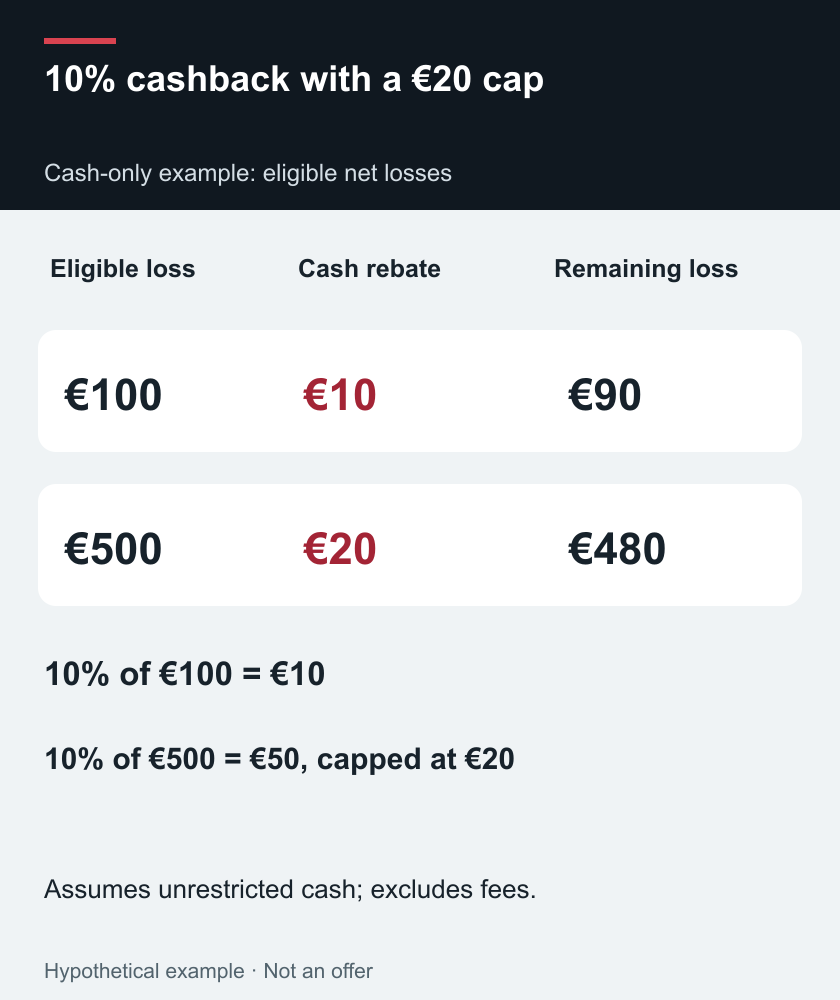
Let L be the qualifying net loss for one settlement period, r the rebate rate and C the cash cap. Under a simple cash-only model, rebate = min(C, r × max(0, L)). This assumes the stated loss qualifies and that the amount is paid as unrestricted cash.
With L = €100, r = 10% and C = €20, the rebate is €10 and the remaining gaming loss is €90. With L = €500, the uncapped calculation gives €50, but the cap limits the rebate to €20. The remaining loss is €480. “10%” describes neither result adequately without the cap.
If the period ends in a €100 net win, this simple loss-rebate model pays nothing. Do not substitute a positive expected loss into the formula and call the result an exact expected rebate. Expected value requires averaging the rebate over possible outcomes, including zero-rebate winning outcomes.
Why settlement periods matter
Suppose week one ends with a €100 qualifying loss and week two with a €100 win. A separate 10% loss rebate each week produces €10 in this uncapped model. Combining both weeks into one zero-net-loss period produces no rebate. The underlying wagering result is the same; the definition of the settlement window differs.
This illustrates a contract difference, not a reason to extend play or schedule extra losses. Check the time zone, settlement cutoff, eligible games and whether a win carries forward to offset later losses. A rebate can be much smaller than expected when different games share one loss calculation.
Turnover cashback: keep the denominator consistent
For a guaranteed unrestricted cash rebate on qualifying turnover T, a simplified expected net cost is hT − rT, where h is the house edge measured on that same turnover basis. Assume T = €10,000, h = 0.5% and r = 0.1%. Expected gaming loss is €50, the rebate is €10, and modelled net cost is €40.
The assumptions are essential. An edge measured against initial wagers cannot simply be applied to a total that also includes splits and doubles. If blackjack contributes only a fraction of wagers or the rebate has a cap, rT is not the correct payout. Strategy mistakes, side bets and payment fees also change the result.
A nominal rebate rate larger than an assumed edge is not proof of a usable advantage. Check the wagering basis, exact rules, exclusions, availability and settlement conditions before making any expected-value claim.
Bonus credit is not the same as cash
A €10 rebate credited as a conditional bonus is not automatically €10 withdrawable. It may require further wagering, exclude blackjack, expire or restrict conversion. A maximum cashout can also limit realised value. Read the bonus and wagering guide rather than valuing restricted funds at face value.
In Great Britain, current Gambling Commission incentive rules require clear, fair and accessible terms. Local rules differ; do not apply one country’s requirements worldwide.
Does cashback justify more play?
Compare the extra cost with the extra rebate. In the turnover example, another €1,000 of qualifying wagering has a €5 expected gaming cost and earns €1, leaving €4 expected net cost under the same assumptions. Chasing a larger rebate increases the expected expense; it does not turn that model profitable.
Loss-based offers are less straightforward, because the rebate depends on actual outcomes and settlement definitions. Never deliberately create losses to qualify. A rebate can reduce some realised losses while still leaving the session expensive and highly variable.
A practical comparison sheet
- Exact rebate base and eligible game list.
- Blackjack contribution and treatment of extra wagers.
- Settlement dates, time zone and carry-forward rules.
- Minimum qualifying amount and maximum payment.
- Cash or bonus credit, expiry and withdrawal restrictions.
- Opt-in and payment-method exclusions.
- Total result after fees and any further required play.
Common questions
Does 10% cashback reduce the house edge by ten percentage points?
No. The percentage applies to a defined rebate base, not automatically to every wager.
Is rakeback the same as lossback?
Not necessarily. The label is insufficient; inspect what amount the percentage multiplies.
Can cashback guarantee that I finish ahead?
No. Caps, conditions and the original gaming outcome remain decisive.
Next steps
Review the house-edge explanation and expected-loss calculator for their wagering basis. For broader sources of possible advantage, see player advantage; a promotional headline alone is not evidence of one.
Check a cash rebate example
Use an already established qualifying loss, not a predicted future loss. This simplified model covers withdrawable cash rebates without wagering requirements. Bonus credit needs a separate terms analysis.
An average cost is not a loss limit. Fees can exceed the starting amount; a negative balance here means the route is not funded. A negative net rebate means costs exceed the rebate. No result establishes a profitable or lawful game.