what a beginner actually does—from choosing a suitable blackjack table and buying chips through playing the hand, following dealer procedures and receiving the final payout.
On this page
- How to play blackjack in 7 steps
- Blackjack quick-start summary
- Before playing: understand the objective
- Blackjack card values
- Recognizing the four types of starting hand
- Step 1: choose a suitable blackjack table
- Step 2: sit down and buy chips
- Step 3: place the main wager
- Step 4: receive the initial cards
- Step 5: choose the correct player action
- Step 6: wait for the dealer to complete the hand
- Step 7: understand the payout
- A complete example blackjack round
- Land-based blackjack versus RNG blackjack
- Beginner mistakes to avoid
- Choosing the first open table
- Playing a minimum that feels stressful
- Ignoring the 6:5 inscription
- Using the wrong strategy chart
- Standing because the dealer looks strong
- Refusing to double because the wager is large
- Taking insurance automatically
- Touching chips after betting closes
- Blaming third base
- Using side bets while learning
- Chasing losses
- Playing too quickly online
- Beginner session checklist
- How to leave the table
- Beginner blackjack glossary
- Before your first real-money blackjack hand
- Frequently asked questions
- Technical and instructional sources
Practice a round without money →
For the complete legal and technical rules, read our blackjack rules guide. For the mathematically correct decision on each hand, use the blackjack basic strategy charts.
To play blackjack, place a wager, receive two cards, compare your hand with the dealer’s visible card and choose whether to hit, stand, double, split or surrender when those actions are available. After every surviving player finishes, the dealer completes the house hand under fixed rules and settles the wagers.
The objective is to beat the dealer without exceeding 21. You do not need to reach exactly 21, and you are not competing against the other players at the table.
This guide walks through the complete process as a first-time player would experience it. It explains the practical flow without replacing the rule-specific strategy chart you should use for actual decisions.
How to play blackjack in 7 steps
- Choose an affordable table with clear rules and a 3:2 blackjack payout where available.
- Buy chips or select the wager denomination online.
- Place the main wager before betting closes.
- Receive the cards, identify the dealer upcard and classify your hand as a natural, hard hand, soft hand or pair.
- Use the matching strategy chart and signal hit, stand, double, split or surrender as appropriate.
- Wait for the dealer to complete the hand under the table rules.
- Check the settlement and wait until betting reopens before touching the chips.
Blackjack quick-start summary
| Stage | What the beginner does |
|---|---|
| Choose a game | Check payout, minimum, S17 or H17, doubling, splitting and surrender. |
| Buy in | Wait for the current round to finish and place cash on the felt when the dealer is ready. |
| Place a wager | Put at least the minimum inside the betting circle before betting closes. |
| Read the cards | Total the player hand and note the dealer’s visible upcard. |
| Make the decision | Use a rule-matched chart for hit, stand, double, split or surrender. |
| Use a hand signal | Make the decision visible to the dealer and surveillance in a physical casino. |
| Dealer plays | The dealer follows fixed drawing rules rather than choosing strategically. |
| Settlement | Winning bets are paid, losing bets collected and pushes returned. |
Before playing: understand the objective
The goal is to finish with a valid total that beats the dealer.
You win the main wager when:
- Your hand is higher than the dealer’s without exceeding 21.
- The dealer exceeds 21 while your hand remains valid.
- You have a natural blackjack and the dealer does not.
You lose when:
- Your hand exceeds 21.
- The dealer has a higher valid total.
- The dealer has blackjack and you do not, subject to the game’s settlement procedure.
A tie normally results in a push, meaning the original main wager is returned.
Blackjack card values
| Card | Value |
|---|---|
| 2 through 9 | Printed value |
| 10 | 10 |
| Jack | 10 |
| Queen | 10 |
| King | 10 |
| Ace | 1 or 11 |
Card suits do not affect the main blackjack hand. A 7 of hearts and a 7 of clubs both count as 7.
An ace changes automatically between 1 and 11 to create the strongest total that does not exceed 21.
Example: ace-6
Ace-6 is soft 17 because the ace can count as 11:
11 + 6 = 17
Example: ace-6-10
The ace must now count as 1:
1 + 6 + 10 = 17
The hand is now hard 17.
See our guide to soft and hard blackjack hands.
Recognizing the four types of starting hand
Natural blackjack
A blackjack is an ace plus a ten-value card as the original two-card hand.
Examples:
- Ace-10
- Ace-jack
- Ace-queen
- Ace-king
A blackjack is stronger than an ordinary 21 made with three or more cards and normally receives the posted blackjack payout.
Hard hand
A hard hand contains no usable ace counted as 11.
Examples:
- 10-6: hard 16
- 9-8: hard 17
- A-5-10: hard 16
Soft hand
A soft hand contains an ace that can still count as 11 without exceeding 21.
Examples:
- A-2: soft 13
- A-6: soft 17
- A-7: soft 18
Pair
A pair is an initial two-card hand that qualifies for splitting under the table rules.
Examples:
- 8-8
- A-A
- 5-5
- King-king
Some games allow any two cards with the same value to be split, while others can impose rank-specific rules. Read the table information.
Step 1: choose a suitable blackjack table
Do not choose a table only because a seat is open.
Check the following before sitting down:
- Blackjack payout
- Table minimum and maximum
- Dealer stands or hits soft 17
- Number of decks
- Double-after-split rule
- Surrender availability
- American peek or no-hole-card procedure
- Side bets and their separate limits
Choose 3:2 instead of 6:5
A natural blackjack should preferably pay 3:2.
| Original wager | 3:2 blackjack profit | 6:5 blackjack profit | Difference |
|---|---|---|---|
| $10 | $15 | $12 | $3 |
| $20 | $30 | $24 | $6 |
| $50 | $75 | $60 | $15 |
| $100 | $150 | $120 | $30 |
The 6:5 payout adds approximately 1.39 percentage points to the house advantage under standard comparison assumptions.
That difference is usually more important than whether the game uses six or eight decks.
Choose a comfortable table minimum
The posted minimum is the smallest initial wager accepted on each active betting spot.
There is no universal rule that every beginner must bring exactly 20, 50 or 100 minimum wagers.
Instead, select a minimum that allows you to:
- Lose several hands without feeling pressure to chase.
- Fund a correct double down.
- Fund a correct split.
- Continue only within a predetermined session budget.
- Leave without obtaining more money to recover losses.
A $25 starting wager can become $100 of exposure after one split followed by a full double on both resulting hands.
Review our complete guide to blackjack table limits.
Check S17 or H17
- S17: dealer stands on soft 17.
- H17: dealer hits soft 17.
S17 is more favorable to the player when all other rules are identical.
The H17 rule also changes several basic-strategy decisions, so make sure your chart matches the table.
Does seat position matter?
No seat provides a mathematical advantage to a basic-strategy player.
- First base acts first.
- Third base acts last among the players.
Third base lets you observe the other player decisions before acting, but those decisions do not reveal the order of the undealt cards or improve your expected return.
Choose a seat based on comfort, visibility and pace—not a belief that one position receives better cards.
Step 2: sit down and buy chips
Wait until the current round is complete before entering the table unless the dealer invites you to sit or buy in immediately.
At a typical physical casino:
- Sit at an open position.
- Place cash flat on the felt when the dealer is ready.
- Do not hand the cash directly to the dealer unless instructed.
- The dealer spreads or counts the money where surveillance can see it.
- The dealer gives you chips from the tray.
- Check the amount before the next wager begins.
The casino may require identification or direct large transactions through the cage.
Chip colors
Common U.S. colors include:
- Red: often $5
- Green: often $25
- Black: often $100
Colors and denominations can vary by casino and jurisdiction. Read the printed value rather than relying only on color.
Do not place cash in the betting circle
The dealer generally exchanges cash for chips first. The main blackjack wager is then made with the casino’s approved chips or credits.
Buying in online
In RNG or live-dealer blackjack, the account has normally been funded before the game opens.
The interface can ask you to:
- Select a chip denomination.
- Choose an amount to bring to the table.
- Confirm the game currency.
- Set responsible-gaming limits.
The displayed table range can differ from the account deposit limit.
Step 3: place the main wager
Place at least the table minimum inside the marked betting position before betting closes.
Keep the wager:
- Completely inside the circle or marked area.
- In a neat stack.
- Separate from side-bet chips.
- Untouched after the dealer closes betting.
At an online table, click or tap the chip denomination and then the main betting area.
Side bets are optional
Wagers such as 21+3, Perfect Pairs, Lucky Ladies or Buster Blackjack are separate games.
They are not required to receive blackjack cards and usually have a higher house edge than the main game.
A beginner can ignore them while learning the normal round.
Step 4: receive the initial cards
Each active player receives two cards.
The dealer receives at least one visible upcard.
In an American hole-card game, the dealer also receives a face-down card before player actions.
In a European no-hole-card game, the dealer normally receives the second card only after players finish.
Read the rules because the no-hole-card settlement can affect split and double wagers.
What to look at first
When the cards arrive:
- Check whether you have a natural blackjack.
- Check whether the dealer shows an ace or ten-value card.
- Determine whether your cards form a pair.
- Determine whether the hand is soft or hard.
- Find the hand and dealer upcard on the correct strategy chart.
Do not base the decision only on how the total “feels.”
When the dealer shows an ace
The dealer may offer insurance.
Insurance is a separate wager that the dealer’s hidden or later card is worth ten.
- Maximum insurance is normally one-half of the original wager.
- It normally pays 2:1 when the dealer has blackjack.
- It loses when the dealer does not have blackjack.
A non-counter following ordinary basic strategy should normally decline insurance.
If you have a blackjack, the dealer may offer even money. At a 3:2 table, accepting even money is mathematically equivalent to insuring the blackjack. Do not assume the same equivalence at a 6:5 payout.
Read our blackjack insurance guide.
Step 5: choose the correct player action
Your possible actions are:
- Hit
- Stand
- Double down
- Split
- Surrender
The rules determine which actions are legal. Basic strategy determines which legal action has the highest expected value.
Hit
Hit means take another card.
You may normally continue hitting until:
- You choose to stand.
- You reach 21.
- You exceed 21 and bust.
- A special rule ends the hand.
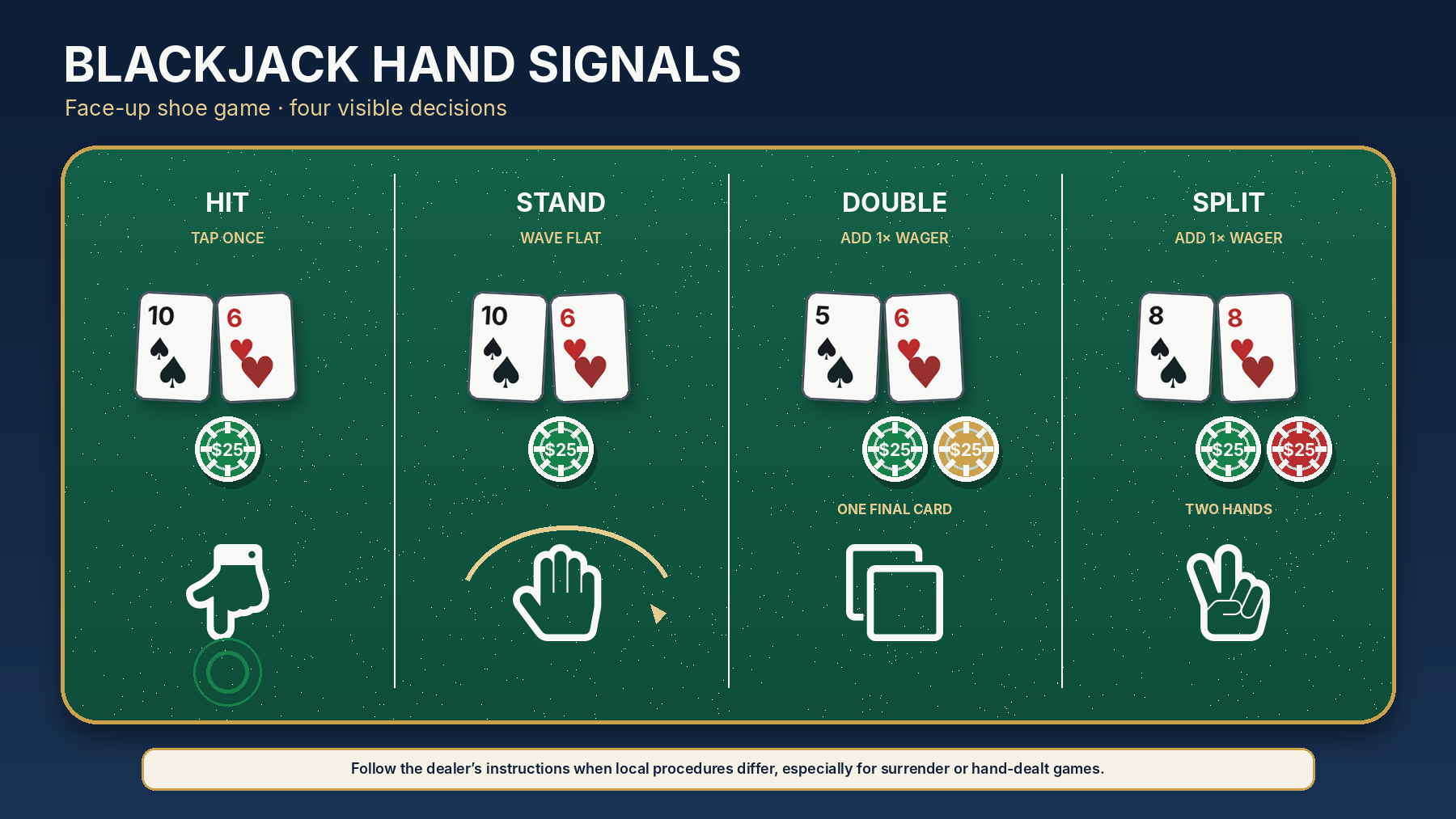
At a face-up table, tap or point to the felt behind the wager with one finger.
Stand
Stand means keep the current total and take no additional cards.
At a face-up table, wave a flat hand horizontally over the cards.
Double down
Doubling adds another wager and commits the player to one final card.
With a $10 original wager:
- Place another $10 beside the original stack.
- Receive exactly one additional card.
- Total wager becomes $20.
Rules can limit doubling to selected totals or permit it on any first two cards.
Split
Splitting separates an eligible pair into two hands.
With a $10 original wager:
- Place another $10 beside the original wager.
- The dealer separates the cards.
- Each card becomes the first card of a separate hand.
- A new card is dealt to each hand.
The two hands are played and settled separately.
Rules can limit:
- Which cards qualify as a pair.
- How many times a hand can be resplit.
- Whether aces can be resplit.
- Whether split aces receive more than one card.
- Whether doubling after split is allowed.
See our blackjack pair-splitting guide.
Surrender
Surrender abandons the original two-card hand and normally returns one-half of the original wager.
It must generally be requested before hitting, doubling or splitting.
Because casino procedures differ, say “surrender” clearly and follow the dealer’s instructions.
Blackjack hand signals
In a physical casino, use both the correct action and the correct visible signal.
The signals allow the dealer, floor staff and surveillance to verify what the player requested.
| Action | Common face-up signal |
|---|---|
| Hit | Tap or point to the felt behind the wager with one finger. |
| Stand | Wave a flat hand horizontally over the cards. |
| Double | Place the added wager beside the original and indicate that one card is requested. |
| Split | Place an equal wager beside the original; separate two fingers if the dealer requests the signal. |
| Surrender | State the request clearly and follow the table-specific gesture. |
Do not touch the cards in a face-up shoe game
At most face-up games, the dealer handles all cards.
Do not:
- Pick up the cards.
- Move them into separate piles.
- Touch dealer cards.
- Remove cards from the table.
Hand-dealt pitch games can allow the player to hold the cards, but they use different procedures. Follow the dealer’s instructions.
Use basic strategy—not three universal slogans
The former page advised beginners to remember:
- Never split tens.
- Always split aces and 8s.
- Always double 11.
These are useful starting patterns but should not be presented as universally correct under every blackjack variation.
Under a common 4–8 deck S17 game:
- Do not split 10s under ordinary basic strategy.
- Split aces.
- Split 8s against every dealer upcard.
- Double hard 11 against dealer 2 through 10.
- Hit hard 11 against a dealer ace.
In H17, doubling 11 against an ace becomes correct. In some H17 surrender games, 8-8 against an ace is surrendered instead of split.
That is why the full basic strategy chart is more reliable than a few slogans.
Step 6: wait for the dealer to complete the hand
After all surviving players finish, the dealer reveals or receives the second dealer card and follows fixed rules.
The dealer normally:
- Hits totals of 16 or less.
- Stands on hard 17 or more.
- Follows the posted S17 or H17 rule for soft 17.
The dealer does not choose whether to hit or stand based on the size of your wager or the other hands at the table.
Player busts lose before the dealer acts
If your total exceeds 21, the dealer collects the wager immediately.
A later dealer bust does not return it.
This is why “we both busted” is not a push. The player bust was already settled before the dealer completed the hand.
Step 7: understand the payout
| Result | Typical settlement |
|---|---|
| Player busts | Main wager loses immediately. |
| Dealer busts | Every surviving player hand normally wins 1:1. |
| Player total is higher | Player normally wins 1:1. |
| Dealer total is higher | Player loses. |
| Equal totals | Push; original wager returned. |
| Player blackjack | Paid according to the posted blackjack payout. |
| Player and dealer blackjack | Normally a push. |
| Surrender | Normally one-half of the original wager is returned. |
Do not touch the winning chips too early
Wait until the dealer:
- Completes the payout.
- Removes the losing wager.
- Clears the cards.
- Opens betting for the next round.
Then you may collect the chips or leave them in place for the next wager.
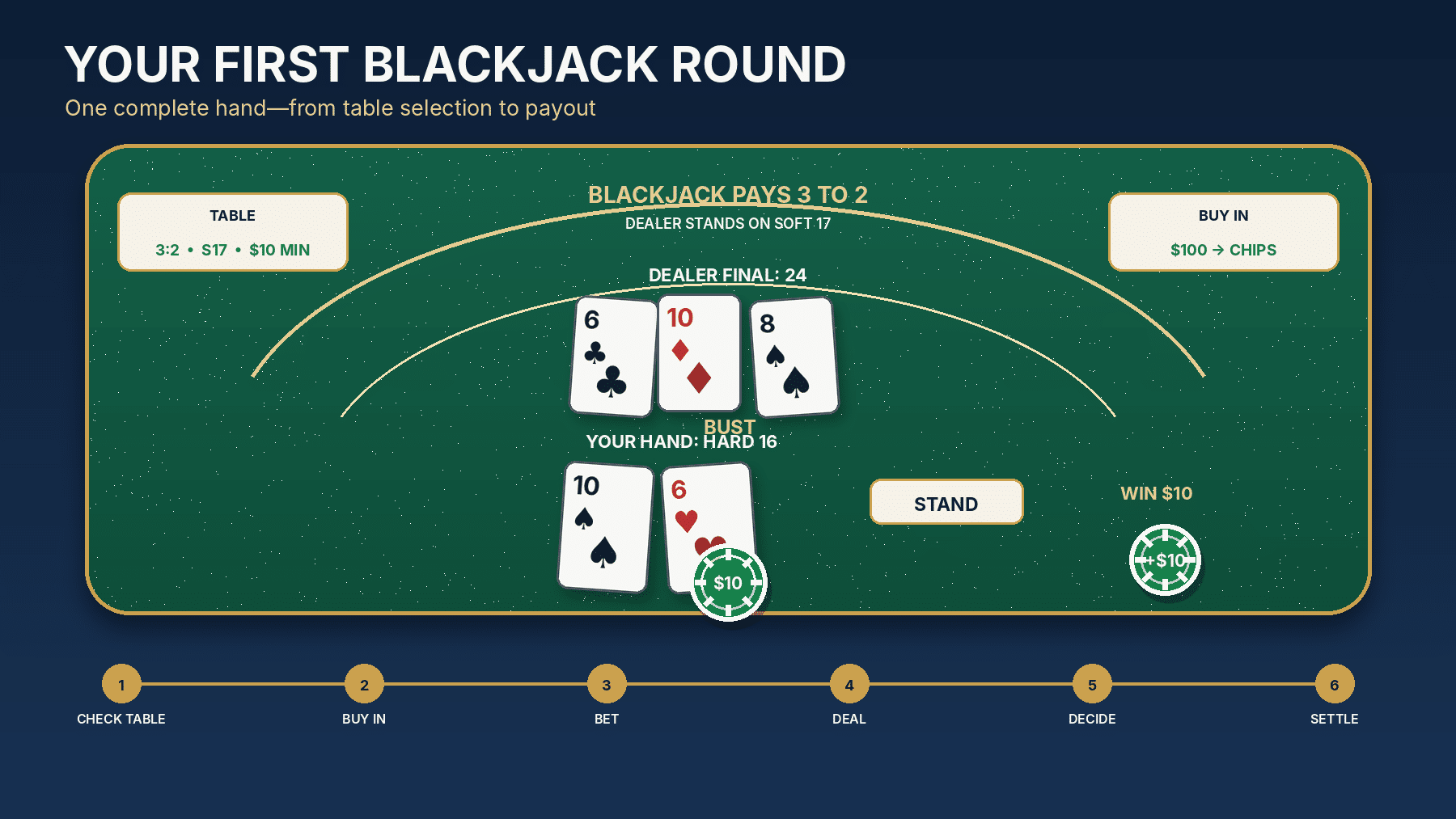
A complete example blackjack round
Assume the following game:
- $10 minimum
- Blackjack pays 3:2
- Dealer stands on soft 17
- Double after split allowed
- American hole card and peek
1. Place the wager
You place one $10 chip inside the betting circle.
2. Receive the cards
You receive:
- 10 of spades
- 6 of hearts
Your total is hard 16.
The dealer shows a 6.
3. Check the strategy chart
Hard 16 against dealer 6 stands under the stated rules.
4. Signal stand
You wave a flat hand over the cards.
5. Dealer completes the hand
The dealer reveals a ten-value hole card for hard 16 and must hit.
The next dealer card is an 8, producing 24.
The dealer busts.
6. Wager is settled
Your surviving $10 wager wins $10 profit.
The dealer returns your original $10 chip and adds $10 in winnings.
Your total stack from that wager is now $20.
Example: a push
You stand on 18 and the dealer also finishes with 18.
The hand pushes.
You receive no profit, but the original wager is returned.
Example: a natural blackjack
You wager $20 and receive ace-king.
The dealer checks and does not have blackjack.
At a 3:2 table:
- Original wager: $20
- Profit: $30
- Total returned: $50
At a 6:5 table, the same hand would produce only $24 profit.
Land-based blackjack versus RNG blackjack
| Feature | Land-based blackjack | RNG blackjack |
|---|---|---|
| Cards | Physical cards | Electronically generated cards |
| Dealer | Physical dealer at the table | Software interface |
| Hand signals | Normally required | Buttons or screen controls |
| Pace | Influenced by table occupancy | Usually controlled by the player |
| Shuffle | Shoe, batch shuffler or continuous shuffler | Every-round reset or programmed virtual shoe |
| Rules | Felt, placard and dealer explanation | Help screen and paytable |
| Other players | Share the table | Often absent |
Live-dealer online blackjack
Live-dealer blackjack combines physical cards and a real streamed dealer with an online betting interface.
You normally:
- Join before the betting timer closes.
- Select a chip denomination.
- Place the main and optional side bets digitally.
- Receive the shared or seated player hand.
- Choose an action using buttons.
- Act before the decision timer expires.
Rules can include:
- One seat per player
- Unlimited-seat shared hands
- Bet behind
- Automatic stand after a timeout
- Restricted split hands
- One card only on split aces
- Provider-specific side bets
Do not assume the procedure matches the last live table you played.
See our live online blackjack guide.
Beginner mistakes to avoid
Choosing the first open table
Check the payout and rules before focusing on seat availability.
Playing a minimum that feels stressful
A table is too expensive when one correct split or double creates financial pressure.
Ignoring the 6:5 inscription
The lower blackjack payout materially worsens the game.
Using the wrong strategy chart
A chart for S17, DAS and American peek is not perfectly correct for H17, no DAS or full ENHC.
Standing because the dealer looks strong
Use the chart rather than intuition.
Refusing to double because the wager is large
If a mathematically correct double feels unaffordable, the original wager was too large.
Taking insurance automatically
Insurance is a separate wager and is normally declined by a non-counter.
Touching chips after betting closes
Wait until the hand has been settled.
Blaming third base
Another player does not know the next card and cannot systematically cause the table to lose.
Using side bets while learning
Side bets add complexity and usually carry a substantially higher house edge.
Chasing losses
Increasing wagers because of previous losses does not improve the probability of the next hand.
Playing too quickly online
RNG blackjack can produce far more rounds per hour than a full physical table.
Beginner session checklist
Before the first real-money wager, confirm:
- The blackjack payout is visible.
- You know whether the dealer stands or hits soft 17.
- The table minimum fits the session budget.
- You have enough room for splits and doubles.
- Your strategy chart matches the rules.
- You know whether surrender is offered.
- You know whether the dealer uses a hole card.
- You will decline optional side bets while learning.
- You have established a maximum session loss.
- You are prepared to leave when the session budget is gone.
How to leave the table
You may normally stop before placing a new wager.
At a physical casino:
- Wait until the current hand is settled.
- Move the chips out of the betting position.
- Tell the dealer you are leaving or ask to color up.
- The dealer may exchange small-denomination chips for larger ones.
- Take the chips to the casino cage for cash redemption.
Do not interrupt an active round to demand a color-up transaction.
Leaving an online table
After the hand is settled:
- Select leave, lobby or close table.
- Confirm that the table balance returns to the casino account.
- Review any pending withdrawal or wagering conditions separately.
Leaving the game table is not necessarily the same as withdrawing funds from the casino account.
Beginner blackjack glossary
- Basic strategy
- The mathematically best action for a hand and dealer upcard under defined rules.
- Blackjack
- An ace plus a ten-value card as the original two-card hand.
- Bust
- A hand total above 21.
- Double down
- Add another wager and receive exactly one final card.
- Even money
- An immediate 1:1 settlement offered when the player has blackjack and the dealer shows an ace; it is equivalent to insurance under a 3:2 blackjack payout.
- First base
- The first player position to act.
- Hard hand
- A hand with no ace currently counted as 11.
- Hit
- Request another card.
- Hole card
- The dealer’s face-down second card in an American-style game.
- Insurance
- A separate wager that the dealer has blackjack when showing an ace.
- Natural
- Another term for a two-card blackjack.
- Push
- A tie in which the original main wager is normally returned.
- S17
- Dealer stands on soft 17.
- H17
- Dealer hits soft 17.
- Shoe
- A device from which cards are dealt in many multi-deck games.
- Soft hand
- A hand containing an ace that can currently count as 11.
- Split
- Separate an eligible pair into two independently played hands.
- Stand
- Keep the current total and take no additional cards.
- Surrender
- End the original two-card hand and normally forfeit half the original wager.
- Third base
- The last player position to act.
- Upcard
- The dealer’s visible card.
Another player’s decision does not change the correct basic-strategy play for your hand. See how to handle difficult or inexperienced blackjack players without blaming them for the card order.
Before your first real-money blackjack hand
Knowing the mechanics does not remove the house edge or guarantee a winning session. Free practice is a valid stopping point; you do not need to wager money to enjoy or understand blackjack.
- Check legality and eligibility. Use the relevant regulator, meet the age requirement, and confirm that the exact venue, domain, or app is authorized.
- Read the rules before buying in. Record the blackjack payout, S17 or H17, decks, DAS, surrender, and hole-card procedure.
- Use the matching strategy chart. Do not assume one chart covers every rule set or proprietary variation.
- Set a total loss limit and time limit. Use money that is not needed for bills, debt, savings, or another person.
- Leave room for correct doubles and splits. If a correct action would exceed the budget, the original wager is too large.
- Decide how the session ends. A win goal and stop-loss can control exposure, but neither changes the probability of the next hand.
- Do not chase. Do not increase stakes, extend time, or obtain more money to recover a loss.
Practice the full sequence without money in the free blackjack practice guide. If play stops feeling controlled, use the responsible-gambling resources.
Frequently asked questions
How do you play blackjack for beginners?
Choose a suitable table, place a wager, receive two cards, compare the hand with the dealer’s upcard and use a rule-matched strategy chart to choose hit, stand, double, split or surrender. The dealer then completes the house hand and settles the wager.
What is the goal of blackjack?
The goal is to beat the dealer without exceeding 21. You can win with a higher valid total, a natural blackjack when the dealer does not have one, or when the dealer busts while your hand remains active.
What is the best blackjack table for a beginner?
A practical beginner table has a comfortable minimum, a 3:2 blackjack payout, clearly posted rules and enough time to make decisions. S17 and double after split are preferable when otherwise comparable games are available.
Do I need to memorize basic strategy before playing?
No. A rule-matched strategy card or trainer can be used while learning. The important point is to avoid substituting intuition, streaks or betting systems for the chart.
How do I buy blackjack chips at a casino?
Wait until the dealer is ready, place cash flat on the felt and allow the dealer to count it before exchanging it for chips. Procedures can vary, so follow the dealer’s instructions.
What are the blackjack hand signals?
At a common face-up table, tap the felt for a hit and wave a flat hand to stand. For a double or split, place the required additional wager beside the original and follow the dealer’s requested signal.
Should a beginner take blackjack insurance?
Normally no. Insurance is a separate wager with negative expectation for a non-counter under ordinary deck composition.
Does sitting at third base improve my odds?
No. Third base acts last but does not receive better cards or gain a mathematical advantage merely from seeing the other players act first.
Can I learn blackjack online before going to a casino?
Yes. Free RNG games and strategy trainers are useful for learning hand totals and decisions, while free live-dealer demonstrations can help with the pace and interface.
What happens if both the player and dealer bust?
The player bust is normally settled immediately and loses. A later dealer bust does not return that wager.
Technical and instructional sources
- Nevada Gaming Control Board: approved table-game rules
- Nevada Gaming Control Board: approved live-blackjack dealing and action procedures
- New Jersey blackjack table inscriptions and payout rules
- GLI-19: interactive gaming disclosure and game-rule standards
- The Venetian: blackjack actions and hand signals
- The Venetian gaming guide: shoe-dealt and hand-dealt procedures
- Wizard of Odds: blackjack basics and rule effects
- Wizard of Odds: mathematical effect of blackjack rule variations
- Wizard of Odds: rule-specific basic strategy calculator
Procedure note: casino, jurisdiction, provider and game-version rules vary. Follow the posted table instructions and dealer directions for the game being offered.