A low minimum bet is useful only when the rest of the game fits a small budget. A fast €1 game with poor rules, compulsory side bets or expensive withdrawals can cost more than its headline minimum suggests. Compare the cost of the whole session before choosing a table.
This guide concerns ordinary recreational play with a house advantage. It does not assume card counting, a profitable promotion or a way to turn a small bankroll into income. The examples use hypothetical games, not advertised offers.
At tiny stakes, also check rounding and permitted bet increments. A €0.10 natural at 3:2 produces €0.15 profit mathematically. If the interface cannot represent that amount, its published settlement rule matters. Do not assume a displayed payout ratio establishes how fractional amounts are credited.
What counts as low-stakes blackjack?
There is no universal threshold. For one reader, €1 per opening hand is low; for another, even that amount is too much. Separate three numbers: the account deposit minimum, the initial bet per hand and the maximum exposure during a round. A small deposit minimum does not establish a small table minimum.
Check the individual game inside the lobby, not merely a category labelled “from €1.” A live table may have different limits from a computer-dealt game. Limits can also differ by currency, seat, time or game mode. Practice play provides a way to learn the rules without putting money at risk.
A small opening bet can become several bets
Suppose you open one hand for €1. A permitted double requires another €1. If you split a pair and double both resulting hands, the round can expose €4. Where four hands are permitted and each may be doubled, the theoretical exposure reaches €8 from that €1 opening bet. Actual permissions depend on the rules; split aces often have restrictions.
That is why “I have fifty bets” is incomplete. A €50 budget contains fifty €1 initial wagers, but not fifty fully funded split-and-double rounds. Multiple seats and optional side bets add further exposure. Do not increase the opening stake simply because the displayed account balance looks large.
Compare rules before comparing minimums
| Check | Why it matters at small stakes |
|---|---|
| Natural blackjack payout | On a €10 wager, 3:2 pays €15 profit; 6:5 pays €12. The stake is returned separately. |
| Dealer soft 17 and doubling permissions | These alter the correct strategy and expected cost. |
| Splitting and surrender | Restrictions change available decisions; a generic strategy chart may be wrong. |
| Optional wagers | A €1 main bet plus a €1 side bet is €2 initially at risk, with separate odds. |
| Speed and number of seats | More initial wagers per hour mean more turnover even at the same minimum. |
The payout example compares two natural-blackjack outcomes; it does not calculate the complete house edge. Use the rule-comparison tool for its stated assumptions and the strategy recommendation tool to match decisions to supported rules.
A worked comparison: the cheapest-looking game can cost more
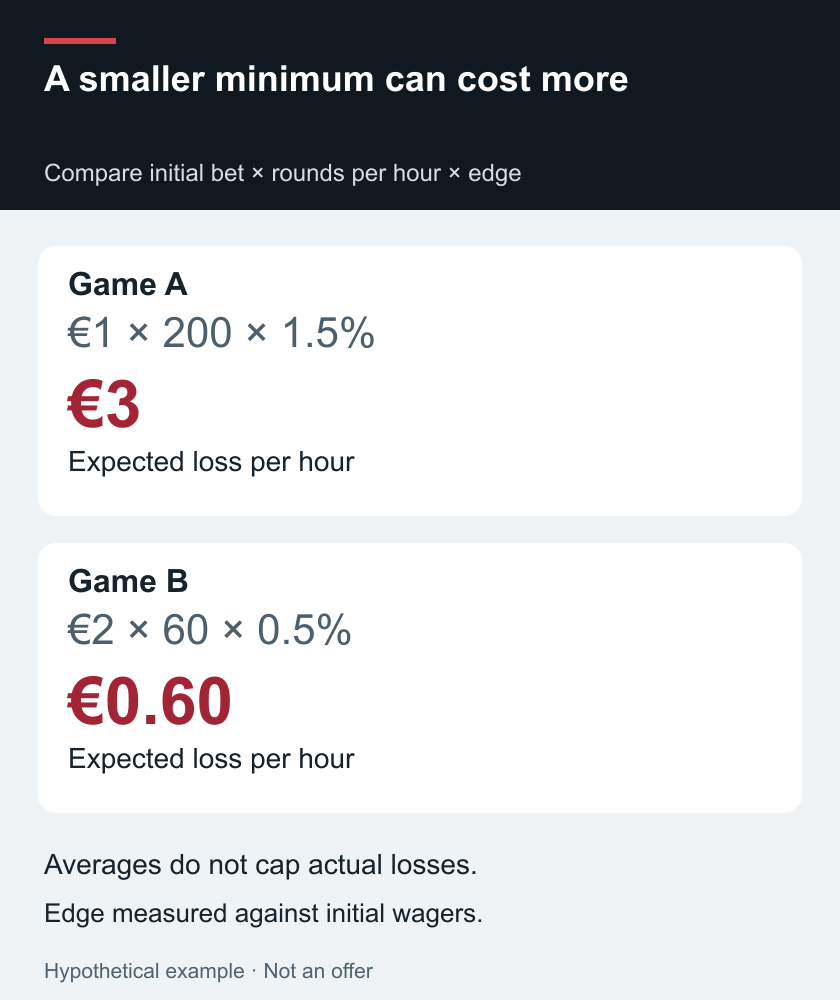
Assume Game A has a €1 initial wager, 200 initial rounds per hour and a 1.5% house edge measured against initial wagers. Expected hourly loss is €1 × 200 × 0.015 = €3. Game B has a €2 initial wager, 60 initial rounds per hour and a 0.5% edge on the same basis: €2 × 60 × 0.005 = €0.60.
These are illustrative assumptions, not measurements of available games. Game B has the higher minimum but the lower modelled hourly cost. Actual losses can greatly exceed either average. The calculation excludes side bets, payment fees and strategy errors; it also does not establish an affordable session budget.
Do not multiply an edge based on initial bets by a turnover figure that already includes every split and double. Matching the denominator matters. The expected-loss calculator explains its input basis.
Payment costs can dominate a small session
A fixed €3 withdrawal fee consumes 6% of a €50 withdrawal and 15% of a €20 withdrawal. That is an account-level expense, not an extra blackjack house edge. Currency conversion can add another cost. Check the minimum withdrawal, fixed fee, exchange rate, verification requirements and whether the original deposit method supports cashouts.
A bonus can create more restrictions than its headline value solves. Do not accept one merely to meet a deposit minimum. Read the bonus and wagering guide separately, including whether blackjack qualifies at all.
Before committing money
- Confirm that the exact game is permitted where you are physically located and that the relevant licence covers it.
- Read the actual game rules and minimums.
- Count all initial wagers, seats and potential extra wagers in a round.
- Set an affordable loss limit and time limit before play.
- Check the net cashout after payment and conversion costs.
- Choose practice instead if the minimum or payment conditions do not fit.
A payment logo, overseas licence or accessible website is not proof of local permission. Do not bypass location restrictions. There is no obligation to find a real-money alternative when no suitable legal game exists.
Common questions
Is a €1 table automatically beginner-friendly?
No. Rule complexity, pace and interface clarity matter alongside the minimum. Practise with the same rules before judging your decision accuracy under time pressure.
Will a smaller bet make me profitable?
It reduces money exposed per decision, not the percentage house advantage. A betting progression cannot repair unfavourable rules.
Should I raise stakes to avoid withdrawal fees?
No. Increasing gambling exposure to dilute a fixed fee creates a different and potentially much larger cost. Compare payment conditions before depositing.
Further reading
Continue with table limits for limit terminology, bankroll management for session planning, and free blackjack practice for decisions without financial exposure. All numerical examples above are worked illustrations with their assumptions stated.
Calculate the cost of your example
Compare a complete session using initial wagers. Enter your own hypothetical assumptions; this is an average cost, not a spending limit.
An average cost is not a loss limit. Fees can exceed the starting amount; a negative balance here means the route is not funded. A negative net rebate means costs exceed the rebate. No result establishes a profitable or lawful game.
Printable rules and session-cost worksheet
Record the complete rules before comparing two games. Leave unknown values blank; do not replace them with favorable assumptions. This worksheet does not supply strategy for variants.
| Check | Game A | Game B |
|---|---|---|
| Date and source | ________________ | ________________ |
| Decks and shuffle method | ________________ | ________________ |
| Blackjack payout | ________________ | ________________ |
| Dealer soft 17 | ________________ | ________________ |
| Doubling permissions | ________________ | ________________ |
| Double after split | ________________ | ________________ |
| Resplit and ace restrictions | ________________ | ________________ |
| Surrender and dealer peek | ________________ | ________________ |
| Initial stake and positions | ________________ | ________________ |
| Initial hands per hour | ________________ | ________________ |
| Duration | ________________ | ________________ |
| Compatible estimated house edge | ________________ | ________________ |
| Payment costs | ________________ | ________________ |
| Personal maximum loss and stop time | ________________ | ________________ |
Expected game loss = initial stake × initial hands per hour × hours × house edge ÷ 100. Add payment costs separately. Keep your personal loss limit separate from this average.
Download worksheet CSV