USDT blackjack combines two different decisions: whether a blackjack game is suitable and whether a particular token transfer is compatible and economical. USDT does not improve the game’s rules, remove identity checks or make an otherwise prohibited service legal.
The useful comparison is not “crypto versus cash” in the abstract. It is the complete route from money you can spend, through the gaming account, and back to money or tokens you can use. A low transfer fee is only one part of that route.
USDT is an asset; a blockchain is its transfer network
Tether’s official protocol list includes USD₮ on Ethereum and Tron. Support for the asset does not mean support for every network.
“ERC20” alone can be insufficient because compatible token standards exist on multiple networks. Read the full network name, exact asset and receiving instructions. A wallet showing “USDT” is not evidence that the destination accepts that version. Similar-looking addresses do not establish compatibility either.
Before any transfer, compare the sending service’s withdrawal network with the receiver’s deposit network and current supported token. Do not copy a contract address from an advertisement or confuse a token contract with your personal deposit address. A supported protocol at the issuer does not imply support at a particular platform.
Follow the money through five stages
| Stage | Question that changes the cost |
|---|---|
| Acquire tokens | What exchange spread, purchase fee or funding charge applies? |
| Send tokens | Does the withdrawal fee include network costs, and what minimum applies? |
| Credit the gaming account | Is the balance USDT, dollars or another currency? At what conversion rate? |
| Request a cashout | What review, minimum, fixed fee and permitted network apply? |
| Use the proceeds | What sale spread, transfer or bank-withdrawal charge remains? |
The account denomination is especially important. Depositing USDT does not necessarily mean that wagers and withdrawals remain in USDT. A platform might convert the deposit into euros, then convert a later withdrawal back. Ask for the rate and rounding method at both stages.
A worked example: the screen balance is not the final result
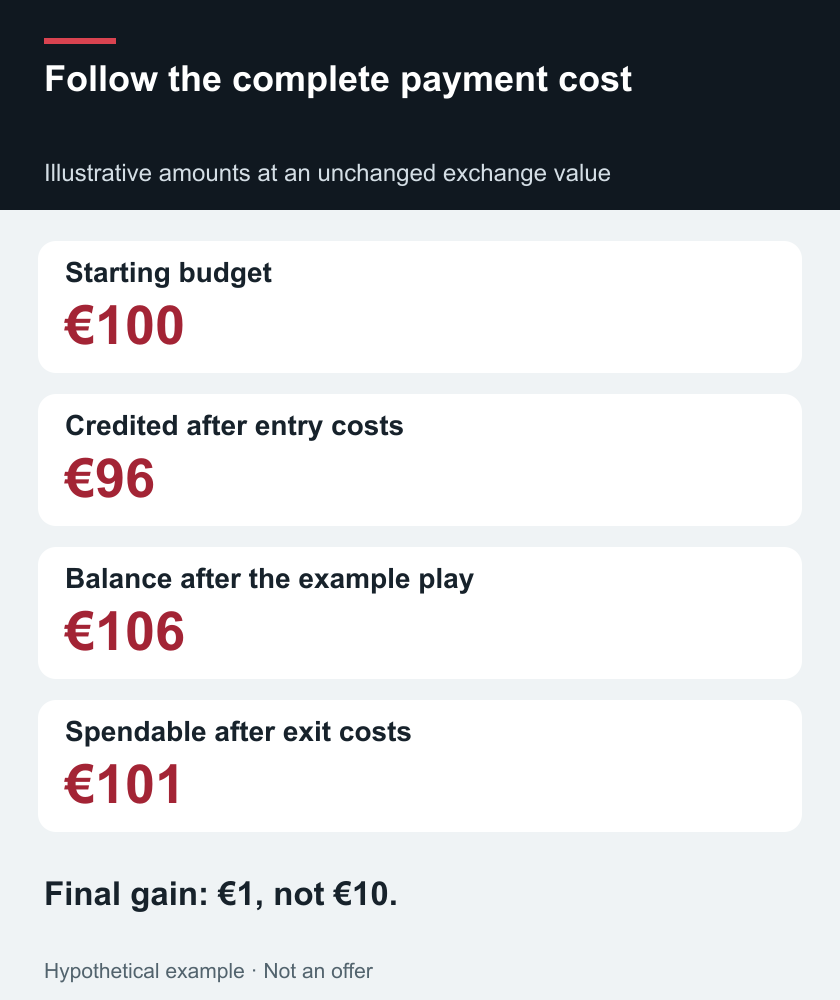
Use a hypothetical €100 starting budget. Acquisition and outward-transfer costs consume €4, leaving €96 credited at an assumed unchanged exchange value. After play the balance is €106. Cashout and conversion costs total €5, leaving €101 spendable. The final gain is €1 against the original €100, even though the gaming balance increased by €10.
This is bookkeeping, not a forecast of winning. If the account finishes at €86 instead, the same assumed €5 exit cost leaves €81: a €19 overall loss. Real exchange rates and fees may change during the process. Record amounts actually received rather than treating the advertised peg as an executed conversion rate.
Stable value is a target, not a guarantee
USDT is designed to track the US dollar. That does not make it a bank deposit or guarantee that every market will exchange it for exactly one dollar. A reader spending euros also has dollar/euro exposure even if the dollar peg holds. Holding a token, holding a platform balance and holding money in a bank are different arrangements with different risks.
A cashout depends on the platform releasing funds, the transfer reaching a compatible destination and that destination crediting them. Verification or account restrictions can occur independently of blockchain speed. Network confirmations prove neither business solvency nor local authorisation.
Issuer redemption is not an ordinary retail cashout
Tether’s published direct-redemption minimum is US$100,000. Selling a small balance through another service is a different transaction.
Consequently, “redeemable” does not mean that a recreational player can always send €50 worth of tokens directly to the issuer and receive bank money. Compare the actual conversion service you would use, its eligibility rules and its total costs. Never assume that the gaming platform’s withdrawal fee covers the later sale.
Self-custody adds a separate responsibility
An ordinary self-custodial Ethereum transfer needs transaction resources; Ethereum identifies ETH as its native fee asset. A hosted service may handle fees differently.
Check the wallet’s current fee instructions rather than assuming a USDT balance alone can fund every transfer. Protect recovery credentials offline and never send them to support. A transaction hash can help locate a transfer without exposing a seed phrase. Sending a small amount first does not prove future withdrawals will be honoured, and should never substitute for checking legality and eligibility.
Questions to settle before choosing a payment route
- Is this exact game lawfully available at my location?
- Do both ends support the same current token-network combination?
- What currency is used for wagers and settlement?
- What identity and source-of-funds checks may apply?
- Can I receive a withdrawal through my own compatible account or wallet?
- What remains after every fee and conversion?
If any essential answer is missing, do not treat a fast deposit screen as enough information. Cryptocurrency is not a workaround for licensing, age, location or verification restrictions.
Common questions
Is TRC20 always the cheapest option?
No. Compare actual service charges and compatibility. A cheaper unsupported network is not a usable option.
Does USDT make blackjack anonymous?
No. Public transaction records and account information can be connected, and financial services can require identification.
Does a fast blockchain mean an instant withdrawal?
No. Account review, approval, broadcasting, confirmation and destination crediting are separate stages.
Continue the comparison
The broader crypto blackjack guide compares asset types. The withdrawal guide covers account processing. Evaluate the game itself with the rule-comparison tool. Payment technology does not change blackjack expected value.
Calculate the whole payment route
Express every amount in the same currency. Include only costs paid on this route; do not count the same network charge twice. This is a fee calculation, not a prediction of token prices.
An average cost is not a loss limit. Fees can exceed the starting amount; a negative balance here means the route is not funded. A negative net rebate means costs exceed the rebate. No result establishes a profitable or lawful game.