what surrender does, the difference between early and late surrender, the exact standard multi-deck surrender hands, and how S17, H17 and no-hole-card rules change the decision.
On this page
- Blackjack surrender at a glance
- Reference rules used on this page
- What surrender means
- Why surrender can be the best decision
- Late surrender
- Early surrender
- Early versus late surrender
- How to surrender at a physical table
- How to surrender online
- Standard S17 late-surrender strategy
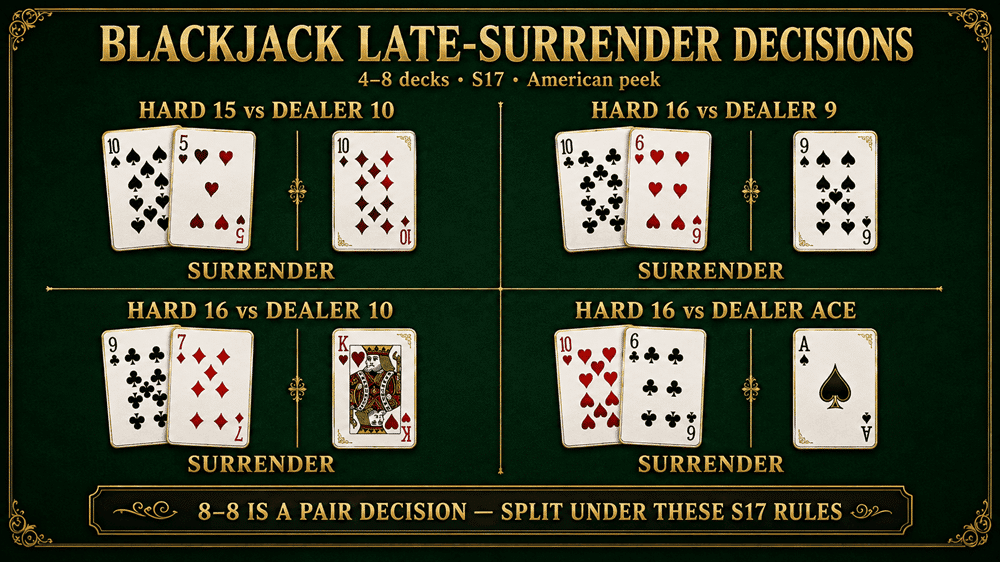
- Hard 15 against dealer 10
- Hard 15 against dealer ace
- Hard 16 against dealer 9, 10 or ace
- Why 8-8 is not ordinary hard 16
- H17 surrender changes
- Can hard 17 really be surrendered?
- Why surrender is normally unavailable after another action
- American peek and late surrender
- European no-hole-card blackjack
- How surrender affects the house edge
- Surrender and bankroll exposure
- Surrender is not a stop-loss system
- Card counting and surrender deviations
- Surrender in blackjack variants
- Worked surrender examples
- Common surrender mistakes
- Never surrendering because it feels weak
- Surrendering hard 15 against ace in every game
- Surrendering every hard 16
- Surrendering 8-8 against dealer 10 under standard S17 rules
- Trying to surrender after taking a card
- Assuming every table offers surrender
- Confusing early and late surrender
- Using the same chart for S17 and H17
- Using vague count intuition
- Five-step surrender decision
- Frequently asked questions
- Technical and regulatory sources
For the complete decision matrix, use our blackjack basic strategy charts. For the fallback decision when surrender is unavailable, see hit or stand in blackjack.
Surrender in blackjack means ending the hand immediately and forfeiting one-half of the original wager. It is used only on selected weak starting hands where losing half a bet has better expected value than continuing to play.
With a $20 original wager, the casino keeps $10, the player receives $10 back, and the hand ends. Surrender is not a side bet or promotional refund. It is a rule-defined player action available only at certain tables and only at the permitted time.
Blackjack surrender at a glance
| Question | Answer |
|---|---|
| What does surrender cost? | Normally one-half of the original wager. |
| When is late surrender used? | After the dealer checks for blackjack and confirms that the dealer does not have it. |
| When is early surrender used? | Before the dealer checks for blackjack. |
| Can you surrender after hitting? | Not in ordinary blackjack. It is normally a first-decision option on the original two-card hand. |
| Can you surrender after splitting or doubling? | Not in standard blackjack, although selected variants use special rescue rules. |
| Does every table offer surrender? | No. It must be stated in the table rules or game information. |
| Is surrender always best on hard 16? | No. It depends on the dealer upcard, pair status and rules. |
| Does surrender apply to side bets? | No. It normally affects only the original main wager. |
Reference rules used on this page
The primary strategy examples use four to eight decks, dealer stands on soft 17, late surrender, double after split, American hole-card and peek procedure, and 3:2 blackjack.
Under this reference game:
- Surrender hard 15 against dealer 10.
- Surrender hard 16 against dealer 9, 10 or ace.
- Do not apply the hard-16 surrender rule to a pair of 8s; split the pair.
H17 adds important surrender decisions against a dealer ace. Early surrender and full no-hole-card games require separate strategy.

What surrender means
Surrender replaces the normal outcome of the hand with a fixed half-wager loss.
Suppose the player has hard 16 against dealer 10 and wagers $20. If the player surrenders, $10 is lost, $10 is returned, and no further action is permitted.
If the player continues instead, the final result can be a win, loss or push. Surrender is correct only when the expected loss from continuing is greater than one-half of the original wager.
Why surrender can be the best decision
A surrender hand is usually weak against a strong dealer upcard. Hard 16 against dealer 10 performs badly whether the player hits or stands. Late surrender locks in a loss of exactly one-half unit, which is better than the average loss from playing the hand out under the qualifying rules.
Surrender does not mean the hand is guaranteed to lose, that surrender wins money, or that every uncomfortable hand should be abandoned. It means the fixed half-wager loss has better expected value than the available alternatives.
Late surrender
Late surrender is the common American-style form.
- The player and dealer receive their initial cards.
- The dealer checks the hole card for blackjack when showing an ace or ten-value card.
- If the dealer has blackjack, the original wager loses before surrender is available.
- If the dealer does not have blackjack, the player may surrender an eligible hand.
Because dealer blackjack has already been ruled out, late surrender is less valuable than early surrender but still favorable when used correctly.
Early surrender
Early surrender allows the player to surrender before the dealer checks for blackjack.
This is especially valuable against dealer ace and ten-value upcards because the player can surrender half the wager instead of losing the full wager when the dealer has a natural blackjack.
Early surrender uses a broader, rules-dependent strategy. Do not apply a late-surrender chart to an early-surrender game.
Early versus late surrender
| Feature | Late surrender | Early surrender |
|---|---|---|
| Timing | After the dealer checks for blackjack | Before the dealer checks for blackjack |
| Dealer blackjack | Player loses the full original wager before surrender becomes available | Player can surrender before dealer blackjack is confirmed |
| Player value | Favorable but limited | Much more favorable |
| Strategy range | Small set of weak hands | Broader and rules-dependent |
| Availability | Offered at selected tables | Rare in ordinary casino blackjack |
How to surrender at a physical table
Surrender procedures are not universal. A common procedure is to say “surrender” clearly, wait for the dealer to acknowledge it, and use the local signal when instructed—often drawing a short horizontal line behind the wager with one finger.
In ordinary late-surrender play, hard 17 is kept; surrender applies only to specific weaker totals under rule-matched strategy. Do not infer a surrender option from the dealer’s upcard alone.
How to surrender online
RNG and live-dealer blackjack normally display a button labeled “Surrender,” “Late surrender” or “Give up.” The button can be unavailable because the game does not offer surrender, the dealer has not completed the check, the hand is no longer eligible, another action was already taken, or the decision timer expired.
Standard S17 late-surrender strategy
| Player hand | Dealer upcard | Action | Fallback |
|---|---|---|---|
| Hard 15 | 10 | Surrender | Hit |
| Hard 16, excluding 8-8 | 9 | Surrender | Hit |
| Hard 16, excluding 8-8 | 10 | Surrender | Hit |
| Hard 16, excluding 8-8 | A | Surrender | Hit |
| 8-8 | 9, 10 or A | Check the pair chart; split under the reference S17 rules | Not an ordinary hard-16 surrender decision |
Hard 15 against dealer 10
Surrender under the reference rules. If surrender is unavailable, hit.
Hard 15 against dealer ace
Under common multi-deck S17 late-surrender strategy, hit rather than surrender. Under H17, late surrender commonly becomes correct.
Hard 16 against dealer 9, 10 or ace
Surrender an ordinary hard 16 against dealer 9, 10 or ace. If surrender is unavailable, hit.
A pair of 8s is different: check the pair chart before the hard-total row.
Why 8-8 is not ordinary hard 16
Two 8s total hard 16, but pair strategy is checked first. Under the reference S17 rules, split 8-8 against dealer 9, 10 or ace.
H17 surrender changes
H17 means the dealer hits soft 17. Common multi-deck H17 late-surrender additions include:
| Player hand | Dealer upcard | S17 | H17 |
|---|---|---|---|
| Hard 15 | A | Hit | Surrender |
| Hard 17 | A | Stand | Surrender |
| 8-8 | A | Split | Surrender in common multi-deck H17 strategy |
Can hard 17 really be surrendered?
Yes, in selected H17 games against dealer ace. This is a rules-dependent exception, not a reason to surrender hard 17 against other upcards.
Why surrender is normally unavailable after another action
Standard surrender is generally limited to the original two-card hand before the player hits, stands, doubles or splits. Some proprietary games allow surrender after those actions, but those are variant rules rather than ordinary blackjack.
American peek and late surrender
When the dealer shows an ace or ten-value card, the dealer checks the hole card first. A dealer blackjack ends the round; otherwise eligible players may surrender. This sequence explains the word late.
European no-hole-card blackjack
No-hole-card games do not always support the same late-surrender sequence because the dealer does not yet have the second card. A game can offer no surrender, early surrender, a game-specific procedure, original-bets-only protection or full exposure to a later dealer blackjack.
Use the strategy for the exact no-hole-card settlement.
How surrender affects the house edge
When used correctly, late surrender modestly improves the player’s expected return because it caps losses on a small group of poor starting situations.
The precise effect depends on S17 or H17, deck count, surrender type, dealer hole-card procedure and the rest of the table rules.
Late surrender is often valued at roughly seven hundredths of a percentage point under common comparison assumptions. Early surrender is much more valuable because it occurs before the dealer blackjack check.
Surrender and bankroll exposure
$10 wager
- Amount forfeited: $5
- Amount returned: $5
$20 wager
- Amount forfeited: $10
- Amount returned: $10
$25 wager
- Amount forfeited: $12.50 when fractional settlement is supported
- Amount returned: $12.50
Physical tables can use chip denominations or procedures that affect how odd wagers are settled. Ask the dealer how half-unit surrender amounts are handled.
Surrender is not a stop-loss system
Do not surrender because the table has lost several hands, you want to protect a recent win, the dealer appears lucky, or you are afraid to hit. The decision depends on the current hand, dealer upcard and rules.
Card counting and surrender deviations
Card counters begin with basic strategy and use exact index numbers to add or remove selected surrender plays.
Possible index families include hard 14 against dealer 10, hard 15 against dealer 9 or ace, hard 16 against dealer 8, and changes to marginal base-strategy surrender hands.
The exact index depends on the counting system, true-count conversion, deck count, S17 or H17, surrender type and chosen index set. A vague “high positive count” is not enough.
Surrender in blackjack variants
Spanish 21
Spanish 21 commonly allows late surrender and can also offer double-down rescue, where the player surrenders after doubling under special variant rules.
Super Fun 21 variants
Selected versions permit surrender after actions that would normally end eligibility, including hits, splits or doubles.
Free Bet Blackjack
Many versions do not offer surrender and compensate with free splits or doubles while using a dealer-22 push rule.
Always use the rules and strategy for the named variant.
Worked surrender examples
| Player hand | Dealer upcard | Rules | Action |
|---|---|---|---|
| 10-5 | 10 | S17 late surrender | Surrender; otherwise hit |
| 10-5 | A | S17 | Hit |
| 10-5 | A | H17 late surrender | Surrender |
| 10-6 | 9 | Reference rules | Surrender; otherwise hit |
| 10-6 | 10 | Reference rules | Surrender; otherwise hit |
| 10-6 | A | Reference rules | Surrender; otherwise hit |
| 8-8 | 10 | S17 | Split |
| 8-8 | A | S17 | Split |
| 8-8 | A | H17 late surrender | Surrender |
| 10-7 | A | S17 | Stand |
| 10-7 | A | H17 late surrender | Surrender |
Common surrender mistakes
Never surrendering because it feels weak
Correct surrender preserves half a wager where continuing loses more on average.
Surrendering hard 15 against ace in every game
That is not correct under the reference S17 late-surrender rules.
Surrendering every hard 16
Hard 16 surrenders only against selected strong upcards, and 8-8 must be checked as a pair.
Surrendering 8-8 against dealer 10 under standard S17 rules
Split the pair.
Trying to surrender after taking a card
Standard late surrender is normally available only before another player action.
Assuming every table offers surrender
Check the table placard, felt, rules screen or dealer instructions.
Confusing early and late surrender
The timing changes both the value of the rule and the correct strategy.
Using the same chart for S17 and H17
H17 adds important surrender decisions against dealer ace.
Using vague count intuition
Count-based surrender deviations require exact indices.
Five-step surrender decision
- Confirm that surrender is offered.
- Identify whether it is early or late surrender.
- Confirm that the hand is still the original two-card hand and remains eligible.
- Check pair status before treating the cards as an ordinary hard total.
- Use a strategy chart matched to S17 or H17 and the dealer hole-card procedure.
Frequently asked questions
What does surrender mean in blackjack?
Surrender ends the hand immediately. The player normally forfeits one-half of the original wager and receives the other half back.
What is the difference between early and late surrender?
Early surrender occurs before the dealer checks for blackjack. Late surrender occurs after the dealer checks and confirms that the dealer does not have blackjack.
When should you surrender hard 15?
Under common four- to eight-deck S17 late-surrender rules, surrender hard 15 against dealer 10. H17 commonly adds surrender against dealer ace.
When should you surrender hard 16?
Under the reference S17 rules, surrender hard 16 against dealer 9, 10 or ace, except when the hand is a pair of 8s.
Should you surrender a pair of 8s?
Under common S17 rules, split 8-8 rather than surrendering it. In common multi-deck H17 late-surrender strategy, 8-8 against dealer ace can be surrendered.
Can you surrender after hitting?
Not in ordinary blackjack. Surrender is normally available only on the original two-card hand before another player action.
Can you surrender online?
Yes, when the game offers it. The interface normally displays a surrender button during the eligible decision window.
Does every blackjack table allow surrender?
No. Surrender is optional and must be disclosed in the table rules or game information.
Does surrender reduce the house edge?
Yes, when used correctly. Late surrender modestly improves expected return, while early surrender is substantially more valuable because it occurs before the dealer blackjack check.
Does card counting change surrender decisions?
Yes. Count-based indices can add or remove selected surrender plays, but the player needs an exact counting system and rule-matched thresholds.
Technical and regulatory sources
- Wizard of Odds: early and late blackjack surrender
- Wizard of Odds: four- to eight-deck S17 and H17 strategy
- Wizard of Odds: rule-specific basic-strategy calculator
- Wizard of Odds: mathematical effect of surrender rules
- Nevada Gaming Control Board: approved live-blackjack late-surrender option
- Nevada Gaming Control Board: variant surrender after other player actions
- GLI-19: interactive game-rule and player-option disclosure standards
Strategy note: the main examples use four- to eight-deck S17, late-surrender and American-peek rules. Exact surrender decisions can change with H17, deck count, early surrender, pair status, composition, card-count indices and dealer hole-card procedure.