Key idea: How doubling down works, when basic strategy calls for it, how the rules change the decision, and why the wager should be sized so that correct doubles remain affordable.
On this page
- Doubling down at a glance
- Reference rules used on this page
- What doubling down means
- Doubling down does not mean the profit is automatically doubled
- How to double down at a physical table
- How to double down online
- When is doubling allowed?
- Core hard-hand doubles
- Hard 9
- Hard 10
- Hard 11
- Hard 11 against dealer ace
- Soft-hand doubles
- Doubling soft 13 and soft 14
- Doubling soft 15 and soft 16
- Doubling soft 17
- Doubling soft 18
- How H17 changes doubling strategy
- Double after split
- Doubling after splitting aces
- American peek and dealer blackjack
- European no-hole-card exposure
- What is double for less?
- Is double for less mathematically optimal?
- Bankroll and session exposure
- When not to double down
- Why availability and strategy are different
- Card counting and double-down deviations
- Doubling in single-deck and double-deck blackjack
- Doubling in blackjack variants
- Worked double-down examples
- Common double-down mistakes
- Always doubling 11 without checking the rules
- Doubling hard 10 against dealer 10
- Ignoring soft doubles
- Doubling a pair before checking the split chart
- Refusing a correct double because the wager feels too large
- Doubling for less as a default
- Assuming DAS is always available
- Ignoring the dealer hole-card procedure
- Doubling because of a streak
- Using a variant’s doubling rule in standard blackjack
- Five-step double-down decision
- Frequently asked questions
- Technical and regulatory sources
- Worked expected-value comparison: hit or double
- A partial double is not automatically better than hitting
For the complete decision chart, use our blackjack basic strategy guide. For the practical difference between taking a card and ending the hand, see hit or stand in blackjack.
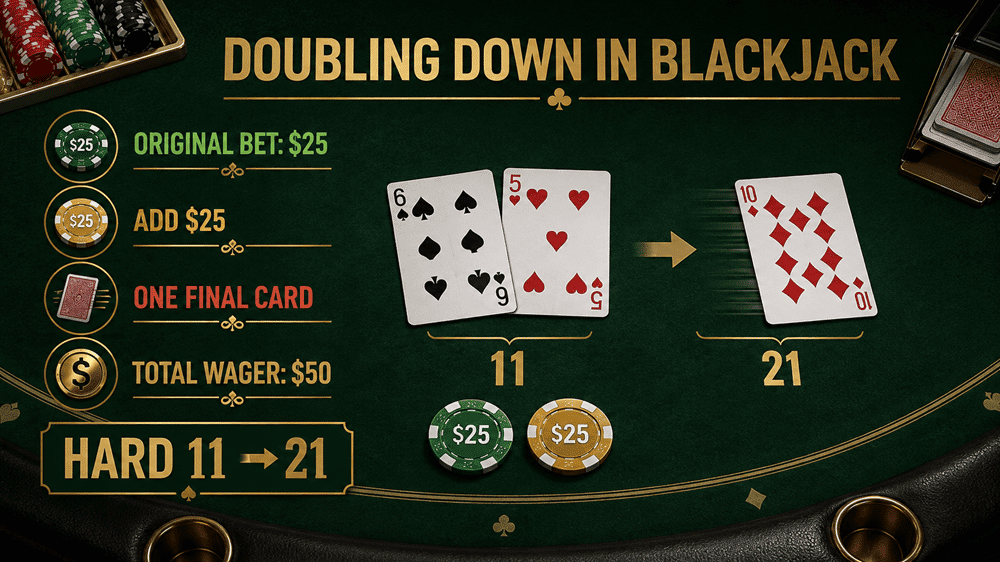
Doubling down means adding a second wager after the initial two cards and receiving exactly one final card. A full double normally matches the original wager, so a $25 starting bet becomes $50 of total exposure.
Doubling is valuable because it lets the player place more money on the table when the player hand is relatively strong, the dealer upcard is relatively weak, or both conditions apply.
It does not guarantee a win. A mathematically correct double can still lose, push or receive a poor final card.
Doubling down at a glance
| Question | Direct answer |
|---|---|
| What does double down mean? | Add another wager after the first two cards and receive exactly one final card. |
| How large is a full double? | Normally equal to the original wager. |
| Can the player hit again afterward? | No. The hand normally stands automatically after the one double-down card. |
| Can every hand be doubled? | Not always. Some games allow any first two cards; others restrict doubling to selected totals. |
| Can a split hand be doubled? | Only when double after split, or DAS, is allowed. |
| Can a player double for less? | Some tables allow an added wager smaller than the original wager. |
| Does basic strategy normally favor a full double? | Yes. When doubling is the highest-value action, adding the full permitted amount normally maximizes expected value. |
| Does card counting change doubles? | Yes. Count-based indices can add or remove selected doubles after basic strategy is mastered. |
Reference rules used on this page
The strategy examples below use one declared game:
- Four to eight decks
- Dealer stands on soft 17, abbreviated S17
- Double on any first two cards
- Double after split allowed, abbreviated DAS
- Late surrender available
- American hole-card and peek procedure
- Blackjack pays 3:2
Specific doubles can change in single deck, double deck, H17, no-DAS, restricted-double and no-hole-card games.
What doubling down means
Suppose the original wager is $25 and the player receives 6-5 for hard 11.
A full double normally works as follows:
- The player places another $25 beside the original wager.
- The total amount at risk becomes $50.
- The dealer gives the hand exactly one additional card.
- The hand then stands automatically.
- The complete $50 wager wins, loses or pushes according to the final result.
If the player receives a 10-value card, the hand finishes at 21. If the player receives a 2, it finishes at 13. The right to double does not guarantee a favorable card.
Doubling down does not mean the profit is automatically doubled
Doubling increases the amount wagered. It does not create a special payout.
On an ordinary winning double:
- Original wager: $25
- Added double wager: $25
- Total wager: $50
- Profit at 1:1: $50
- Total returned including both stakes: $100
If the hand loses, the full $50 is collected. If it pushes, the $50 is normally returned.
A natural blackjack is usually settled before a doubling decision and is not normally doubled. Proprietary variants can use different procedures.
How to double down at a physical table
At a common face-up blackjack table:
- Place the added chips beside the original wager, not on top of it.
- Use the table’s required hand signal or point to the wager.
- Say “double” clearly when the action could be confused with a split.
- Do not touch the cards or chips after the dealer accepts the action.
The dealer normally turns the final card sideways to show that no further action is allowed.
Procedures vary, especially in hand-dealt pitch games. Follow the dealer’s instructions rather than assuming one signal is universal.
How to double down online
RNG and live-dealer blackjack normally display a button labeled:
- Double
- Double down
- 2x
The interface should automatically add the allowed wager and deal one final card.
The button can be unavailable because:
- The hand contains more than two cards
- The total is outside the permitted range
- The table prohibits doubling after a split
- The account balance is too low
- The maximum wager would be exceeded
- The decision timer has expired
When is doubling allowed?
Common rule structures include:
| Rule | Meaning |
|---|---|
| Double on any two cards | Any original two-card total can legally be doubled, even when strategy would not recommend it. |
| Double on 9, 10 or 11 only | Hard and sometimes qualifying soft totals outside that range cannot be doubled. |
| Double on 10 or 11 only | The player loses several profitable hard-9 and soft-hand doubles. |
| DAS | Double after split is allowed. |
| No DAS | Hands created by splitting cannot be doubled. |
| Double for less | The added wager may be smaller than the original wager. |
| Double on more than two cards | An unusual favorable rule found in selected variants, not ordinary blackjack. |
Online-game standards call for double-down limitations and double-after-split rules to be disclosed clearly in the game information.
Core hard-hand doubles
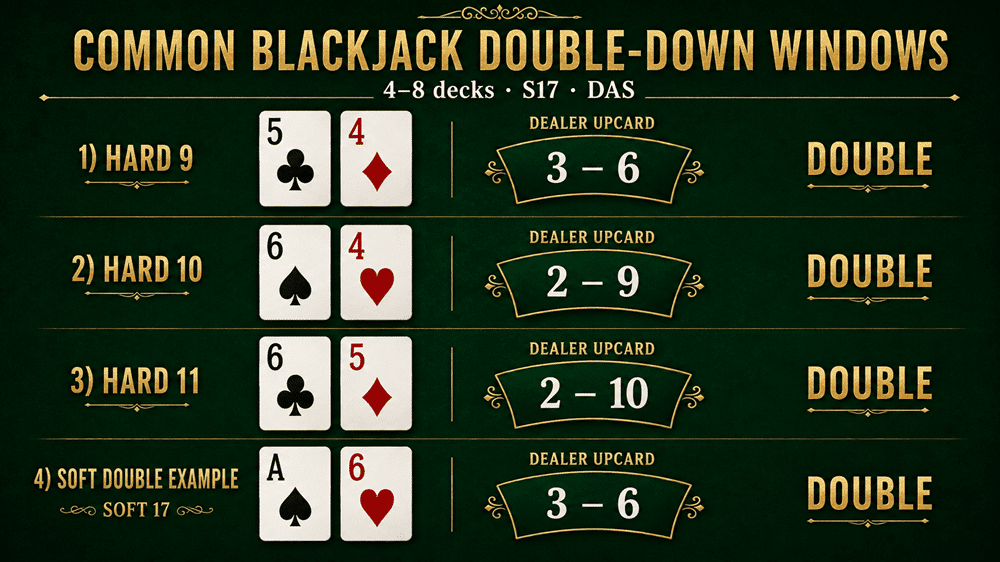
Under the reference S17 rules, the main hard-total doubles are:
| Player total | Dealer upcard | Action | Fallback if doubling is unavailable |
|---|---|---|---|
| Hard 9 | 3–6 | Double | Hit |
| Hard 10 | 2–9 | Double | Hit |
| Hard 11 | 2–10 | Double | Hit |
| Hard 11 | A | Hit under S17 | Not applicable |
Hard 9
Double hard 9 against dealer 3 through 6.
Hit against:
- Dealer 2
- Dealer 7
- Dealer 8
- Dealer 9
- Dealer 10
- Dealer ace
The double is strongest when the dealer has a vulnerable upcard and the player can improve with many ranks.
Hard 10
Double hard 10 against dealer 2 through 9.
Hit against dealer 10 or ace.
A 10-value card would create 20, but the decision is not based only on hoping for a ten. Strategy compares the expected value of doubling with hitting across every possible next card and dealer outcome.
Hard 11
Under the reference S17 rules:
- Double against dealer 2 through 10.
- Hit against dealer ace.
Hard 11 is one of the strongest doubling totals because any 10-value card creates 21 and no one-card draw can bust the hand.
It is still not a universal “always double” rule. H17, deck count, no-hole-card exposure and count-based indices can change selected decisions.
Hard 11 against dealer ace
This decision depends heavily on the rules.
| Rules | Typical basic-strategy action |
|---|---|
| Four to eight decks, S17, American peek | Hit |
| Four to eight decks, H17, American peek | Double if allowed; otherwise hit |
| European no-hole-card with full wager exposure | Can differ; use a dedicated ENHC chart |
| Single deck or double deck | Can differ with S17, H17 and other rules |
Do not memorize “always double 11” without attaching it to a ruleset.
Soft-hand doubles
A soft hand contains an ace counted as 11.
Soft doubles are valuable because the hand cannot bust on the one double-down card. A large card simply forces the ace from 11 to 1.
Under the reference S17 rules:
| Soft hand | Dealer upcard | Action | Fallback |
|---|---|---|---|
| A-2 or A-3 | 5–6 | Double | Hit |
| A-4 or A-5 | 4–6 | Double | Hit |
| A-6 | 3–6 | Double | Hit |
| A-7 | 3–6 | Double | Stand |
| A-8 | Any | Stand under S17 | Not applicable |
Doubling soft 13 and soft 14
A-2 and A-3 double against dealer 5 or 6.
Against other upcards, hit.
These hands are weak, but the dealer’s vulnerable upcard creates enough value to justify placing the additional wager.
Doubling soft 15 and soft 16
A-4 and A-5 double against dealer 4 through 6.
Hit against other upcards.
Doubling soft 17
A-6 doubles against dealer 3 through 6.
Hit against dealer 2 and 7 through ace.
Soft 17 is not a standing hand for the player under ordinary strategy.
Doubling soft 18
A-7 doubles against dealer 3 through 6.
If doubling is unavailable, stand against those upcards.
Under the reference rules:
- Stand against dealer 2, 7 or 8.
- Hit against dealer 9, 10 or ace.
How H17 changes doubling strategy
H17 means the dealer hits soft 17. Starting from the reference S17 chart, important multi-deck changes include:
| Player hand | Dealer upcard | S17 action | H17 action |
|---|---|---|---|
| Hard 11 | A | Hit | Double if allowed; otherwise hit |
| A-7, soft 18 | 2 | Stand | Double if allowed; otherwise stand |
| A-8, soft 19 | 6 | Stand | Double if allowed; otherwise stand |
This is one reason a strategy card must match the dealer soft-17 rule.
Double after split
DAS means the player can double a hand created by splitting.
Example: split 8s receive a 3
Suppose the player splits 8-8 and one resulting hand receives a 3, creating hard 11.
- With DAS: the player may double when strategy calls for it.
- Without DAS: the player must use the fallback action, normally hit.
DAS improves the value of splitting because it preserves profitable doubles that arise on the new hands.
Prohibiting DAS costs the player approximately 0.14 percentage points under standard comparison assumptions. Restricting doubles to 10 and 11 costs approximately 0.18 percentage points compared with allowing doubles on any first two cards. Exact effects depend on the full ruleset.
Doubling after splitting aces
Most ordinary blackjack games restrict split aces.
Common rules include:
- One card only to each split ace
- No hitting split aces
- No doubling split aces
- No resplitting aces
Some variants allow drawing, resplitting or doubling after split aces. Those are favorable special rules and require a matching strategy.
American peek and dealer blackjack
In an American hole-card game, the dealer normally checks for blackjack before player actions when showing an ace or ten-value card.
After a no-blackjack check, a player can double without the added wager later losing to an already completed dealer natural.
European no-hole-card exposure
In a full European no-hole-card game, players can double before the dealer receives the second card.
If the dealer later completes a natural blackjack, the player may lose:
- The original wager
- The added double wager
This additional exposure changes selected doubles against dealer 10 or ace.
Some no-hole-card games use original-bets-only protection and return qualifying added wagers. Confirm whether the game uses full ENHC, OBO, OBBO or another settlement rule.
What is double for less?
Double for less allows the player to add less than the original wager while still receiving only one final card.
$25 example
- Original wager: $25
- Full double: add $25
- Double for less: add an amount below $25, subject to chip and table rules
Double for less means adding any permitted amount below the full matching wager; it does not have to be less than half the original wager.
Is double for less mathematically optimal?
When doubling is the highest-value action, a full double normally maximizes expected value because every extra permitted dollar is being placed in a favorable relative situation.
Doubling for less can reduce short-term exposure, but it also gives up part of the value that justified doubling.
A better long-term solution is usually to choose a smaller original wager so that full doubles and splits remain affordable.
Double for less can still be preferable to refusing a correct double entirely when the current wager has already been placed and the player cannot comfortably add the full amount. It should be treated as a compromise, not the normal strategy.
Bankroll and session exposure
A table minimum understates the amount that can be at risk after correct decisions.
One double
- Starting wager: $25
- Full double: add $25
- Total exposure: $50
Split followed by two doubles
- Starting wager: $25
- Split: add $25
- Double first hand: add $25
- Double second hand: add $25
- Total exposure: $100
Select a table where correct doubles do not feel financially or emotionally impossible.
See our guide to blackjack table limits and round exposure.
When not to double down
Do not double merely because:
- The previous hands lost
- You feel “due” for a ten
- The dealer has won several rounds
- The original wager is small
- You want to recover losses quickly
- The option button is available
- A side bet won
- Another player recommends it
A legally available double is not necessarily a strategically correct double.
Why availability and strategy are different
A game may allow doubling on any first two cards, including:
- Hard 5
- Hard 12
- Hard 20
- Soft 20
That does not make those doubles correct under ordinary basic strategy.
The rule defines what the player may do. Strategy identifies what the player should do.
Card counting and double-down deviations
Card counters begin with basic strategy and use count-based indices to change selected doubles.
A positive count can add doubles because the remaining shoe is richer in ten-value cards. A negative count can remove selected doubles.
Examples vary by system and rules, but can include:
- Doubling hard 9 against dealer 2 at a specified positive count
- Declining a marginal hard-10 or hard-11 double at a sufficiently negative count
- Adding selected soft doubles
A general instruction to let “the count dictate” every double does not identify an actionable play. A counter needs a defined counting system, true-count conversion where applicable, and exact indices for the rules being played.
Do not improvise count deviations from the general idea that “more tens are good.”
Doubling in single-deck and double-deck blackjack
Smaller deck counts can change close doubling decisions because removing one card has a larger effect on the remaining composition.
Possible differences include:
- Hard 8 doubles against selected dealer upcards
- Hard 9 doubles against dealer 2
- Hard 11 against dealer ace
- Additional soft-hand doubles
The exact action still depends on S17 or H17, DAS, surrender and hole-card procedure.
Use a dedicated single-deck or double-deck chart rather than applying a partial list from memory.
Doubling in blackjack variants
Proprietary variants can change both the right to double and what happens afterward.
Spanish 21
Spanish 21 often allows doubling on more than two cards and can offer double-down rescue. It uses a separate strategy because numeral 10s are removed and other player-favorable rules apply.
Double Down Madness
This variant can allow doubling after more than two cards and hitting after a double. Dealer 22 push rules compensate for the added player flexibility.
Free Bet Blackjack
Selected doubles can be funded by the house, while dealer 22 usually pushes non-blackjack player hands.
Double Exposure
Both dealer cards are visible, but tie, payout and doubling rules can differ from standard blackjack.
Never carry a standard doubling chart into a variant without verifying the full rules.
Worked double-down examples
5-4 against dealer 6
- Player total: hard 9
- Dealer upcard: 6
- Double
6-4 against dealer 9
- Player total: hard 10
- Dealer upcard: 9
- Double
6-4 against dealer 10
- Player total: hard 10
- Dealer upcard: 10
- Hit
6-5 against dealer 10
- Player total: hard 11
- Dealer upcard: 10
- Double
6-5 against dealer ace in S17
- Player total: hard 11
- Dealer upcard: ace
- Hit
6-5 against dealer ace in H17
- Player total: hard 11
- Dealer upcard: ace
- Double if allowed
A-6 against dealer 5
- Player total: soft 17
- Dealer upcard: 5
- Double
- If doubling is unavailable: hit
A-7 against dealer 4
- Player total: soft 18
- Dealer upcard: 4
- Double
- If doubling is unavailable: stand
Common double-down mistakes
Always doubling 11 without checking the rules
Hard 11 against an ace changes with S17, H17, deck count and no-hole-card exposure.
Doubling hard 10 against dealer 10
Hit under the reference rules.
Ignoring soft doubles
A-2 through A-7 create important doubles against selected weak dealer upcards.
Doubling a pair before checking the split chart
Two 5s are played as hard 10, but pairs such as 8-8 and A-A must be evaluated as pair decisions first.
Refusing a correct double because the wager feels too large
The original wager was too large for the available session budget.
Doubling for less as a default
A partial double gives up some of the expected value of the correct full double.
Assuming DAS is always available
No-DAS tables remove doubles from hands created by splitting.
Ignoring the dealer hole-card procedure
Full ENHC exposure can place both the original and added wager at risk against a later dealer blackjack.
Doubling because of a streak
Previous wins and losses do not change the correct action on the current hand.
Using a variant’s doubling rule in standard blackjack
Multiple-card doubles, hitting after doubling and double-down rescue are not standard rules.
Five-step double-down decision
- Confirm that the hand still contains exactly two cards unless a special variant allows otherwise.
- Check whether the cards form a pair that should be split first.
- Identify the hard or soft total and dealer upcard.
- Confirm S17 or H17, DAS, doubling restrictions and hole-card procedure.
- Use the matching strategy chart and add the full permitted wager when doubling is correct.
Frequently asked questions
What does doubling down mean in blackjack?
Doubling down means adding another wager after the initial two cards and receiving exactly one final card. The hand then stands automatically.
How much does a full double down cost?
A full double normally adds an amount equal to the original wager. A $25 starting wager therefore becomes $50 of total exposure.
When should you double hard 9?
Under common four- to eight-deck S17 rules, double hard 9 against dealer 3 through 6 and hit against other upcards.
When should you double hard 10?
Double hard 10 against dealer 2 through 9. Hit against dealer 10 or ace under the reference rules.
Should you always double hard 11?
No. Under common multi-deck S17 rules, double against dealer 2 through 10 and hit against an ace. Under H17, doubling against the ace becomes correct.
Can you double a soft hand?
Yes. Soft 13 through soft 18 have profitable doubles against selected weak dealer upcards because the ace prevents an immediate one-card bust.
Can you double after splitting?
Only when the table permits double after split, abbreviated DAS. No-DAS games require the player to use the fallback hit or stand action.
What does double for less mean?
It means adding an amount smaller than the original wager while still receiving only one final card. A full double normally has the higher expected value when doubling is correct.
Can you hit after doubling down?
Not in ordinary blackjack. The player receives exactly one card and the hand then stands. Selected proprietary variants can use different rules.
Does card counting change doubling decisions?
Yes. A trained counter can add or remove selected doubles at defined count indices, but those deviations require an exact counting system and rule-matched index set.
Technical and regulatory sources
- Wizard of Odds: four- to eight-deck basic strategy
- Wizard of Odds: rule-specific strategy calculator
- Wizard of Odds: mathematical effects of doubling rules
- Wizard of Odds: European no-hole-card strategy
- Nevada Gaming Control Board: approved live-blackjack doubling rules example
- GLI-19: interactive blackjack rule-disclosure standards
Strategy note: examples use four- to eight-deck S17, DAS, late-surrender and American-peek rules. Exact doubles can change with deck count, H17, no DAS, doubling restrictions, count information and dealer hole-card procedure.
Worked expected-value comparison: hit or double
Suppose a rule-matched analysis says hitting a particular hand returns an average of +0.12 unit per original unit, while doubling returns +0.28 unit after the extra stake is included. On a $10 opening bet, the modeled values are +$1.20 for hitting and +$2.80 for doubling. Doubling is preferred because its expected gain is higher, even though it can lose $20 on this one hand.
The comparison must use the same player cards, dealer upcard and rules. If doubling is prohibited, “hit” becomes the available choice; if European no-hole-card rules expose extra wagers to a later dealer blackjack, the value can change. Expected value is an average over all possible draws, not a promise about the next card. Set the session budget before play so that a correct double is affordable without chasing or changing the plan.
A partial double is not automatically better than hitting
Doubling for less still limits you to one final card. Reducing the additional stake does not restore the option to hit again when that card is small. Compare the actual amount added, the player cards and the table rules before assuming a partial double is the better alternative.
Use the hypothetical values above as an illustration, not as advice for a real hand. If hitting returns +0.12 unit per original wager and a full double returns +0.28, taking one card and standing has an expected return of +0.14 per unit of total stake. Adding half the original wager gives 1.5 × 0.14 = +0.21; adding one quarter gives 1.25 × 0.14 = +0.175. Both exceed hitting in that example. On a different hand, the advantage of a full double can be much smaller, so a partial double can fall below the value of hitting.
If completing a double would exceed the remaining session budget, do not add funds to chase losses. Use the available chart fallback or end the session, and choose a smaller opening wager for a future session. Permission to double for less does not mean every permitted amount is mathematically superior.